
Maritime ·
How Sharks Detect Electricity
Sharks have ruled the oceans for more than 400 million years. Long before dinosaurs walked the Earth, sharks were already evolving into highly efficient predators capable of surviving dramatic planetary changes, mass ext...
By Rebecca "Madam Chronicler" Ryan
Sharks have ruled the oceans for more than 400 million years. Long before dinosaurs walked the Earth, sharks were already evolving into highly efficient predators capable of surviving dramatic planetary changes, mass extinctions, and shifting marine ecosystems.
Part of that success comes from their incredible senses.
Most people know sharks possess an excellent sense of smell. Others have heard that sharks can detect vibrations in the water or see surprisingly well in low-light conditions. But one of the most fascinating shark abilities is also the least understood:
Sharks can detect electricity.
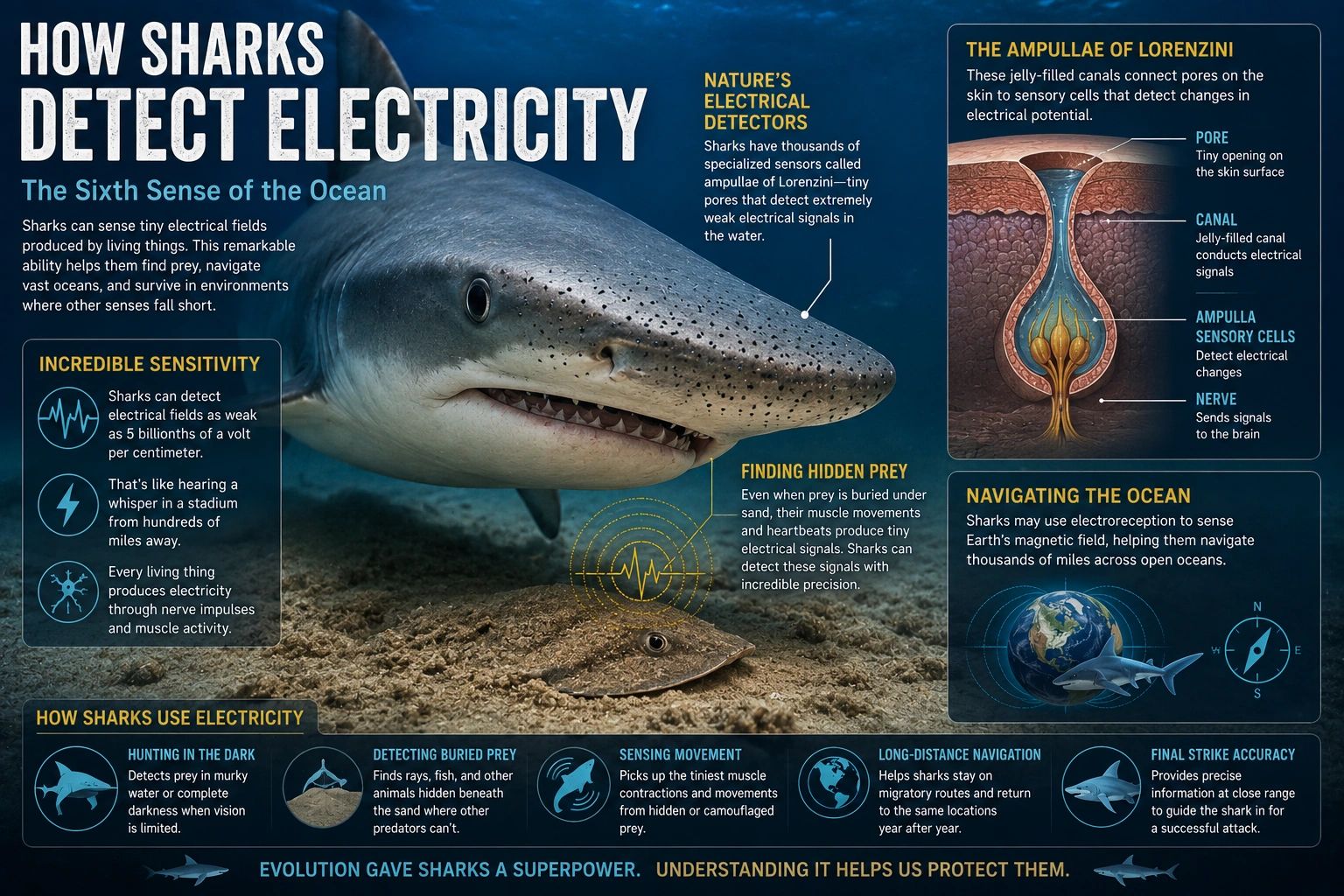
Hidden across the heads of sharks are thousands of tiny sensory organs that allow them to sense weak electrical fields generated by living organisms. This extraordinary adaptation gives sharks a kind of biological “sixth sense” unlike almost anything humans experience.
With this ability, sharks can locate prey buried beneath sand, navigate across entire oceans, detect muscle movements from hidden animals, and even sense Earth’s magnetic field.
Scientists consider shark electroreception one of the most advanced sensory systems in the animal kingdom.
And the more researchers study it, the more incredible it becomes.
The Discovery of Shark Electroreception
For centuries, scientists struggled to understand the tiny pores scattered across a shark’s snout and head.
These small openings were visible on many shark species, but their purpose remained a mystery. Early researchers believed they might help with mucus production or pressure sensing. Others assumed they had little biological importance.
That changed in the 20th century.
Scientists eventually discovered that these pores connected to a network of jelly-filled canals linked to specialized sensory cells. The organs became known as the ampullae of Lorenzini, named after Italian physician Stefano Lorenzini, who first described them in 1678.
It would take centuries before researchers fully understood what they actually did.
In the 1960s and 1970s, experiments revealed that sharks and rays could detect incredibly weak electrical fields in the water. This discovery transformed scientific understanding of shark behavior and sensory biology.
Researchers realized sharks possessed a sensory ability almost alien in its sophistication.
What Are the Ampullae of Lorenzini?
The ampullae of Lorenzini are specialized electroreceptors found in sharks, rays, skates, and some other cartilaginous fish.
These sensory organs appear externally as tiny dark pores concentrated around the shark’s snout, head, and jaws.
Beneath the skin, each pore connects to a canal filled with conductive jelly. At the base of the canal sits a cluster of sensory cells capable of detecting minute electrical changes in the surrounding water.
The system is astonishingly sensitive.
Some sharks can detect electrical fields as weak as five billionths of a volt per centimeter.
To put that into perspective, sharks can sense electrical activity far weaker than the output of a standard household battery.
Every living organism produces electricity.
Muscle contractions, heartbeat activity, nerve impulses, and cellular functions all generate tiny electrical signals. Sharks can detect these signals even when prey is hidden from sight.
This means a shark can locate a fish buried beneath the sand purely by sensing the faint bioelectric field produced by its body.
It is one of the most powerful hunting adaptations in the ocean.
How Sharks Use Electricity to Hunt
Electroreception plays a critical role in shark hunting behavior.
Many prey animals attempt to hide from predators by burying themselves in sediment, camouflaging against reefs, or remaining motionless in dark water. For most predators, these tactics work effectively.
But not against sharks.
Detecting Hidden Prey
Bottom-dwelling animals such as stingrays, flounders, and crustaceans often hide beneath the sand where they are invisible to predators.
Sharks can still find them.
As the hidden animal breathes or moves its muscles, tiny electrical signals radiate outward through the water and sediment. The shark’s ampullae of Lorenzini detect those signals with remarkable precision.
Hammerhead sharks are especially famous for this ability.
Their wide hammer-shaped heads spread electroreceptors across a broader area, effectively turning the cephalofoil into a giant biological metal detector. Hammerheads sweep their heads back and forth over the seafloor while searching for buried stingrays.
Once detected, the shark can strike with surprising accuracy.
Hunting in Darkness
Many sharks hunt at night or in deep water where visibility is poor. Electroreception gives them an advantage when vision becomes unreliable.
Even in complete darkness, electrical fields reveal the presence of living prey.
This allows sharks to continue hunting efficiently in environments where other predators struggle.
Final Attack Guidance
Scientists believe sharks use multiple senses while hunting.
Smell may help them locate prey from long distances. Hearing and vibration detection assist with tracking movement. Vision becomes important during pursuit.
But electroreception often guides the final strike.
When prey gets extremely close, electrical signals become the shark’s most precise targeting system.
Sharks Can Sense the Earth’s Magnetic Field
Electroreception does more than help sharks hunt.
Researchers now believe sharks also use their sensory system for navigation.
Ocean migrations can span thousands of miles across seemingly featureless water. Some shark species repeatedly travel between feeding grounds, breeding areas, and nursery habitats with astonishing accuracy.
How do they navigate such vast distances?
Scientists suspect sharks may use Earth’s magnetic field as a kind of biological GPS.
Magnetic Navigation
Earth produces natural electromagnetic fields that vary across geographic regions.
Studies suggest sharks may detect these fields indirectly through their ampullae of Lorenzini. As sharks swim through seawater and magnetic fields interact with conductive tissues, weak electrical signals may form that help the animals orient themselves.
Experiments involving captive sharks have shown behavioral responses to artificial magnetic field manipulation.
This ability could explain how sharks:
- Return to the same migration routes annually
- Locate breeding grounds
- Navigate across open oceans
- Maintain orientation during long-distance travel
Some researchers compare shark navigation to migratory birds or sea turtles, both of which also appear capable of sensing magnetic fields.
Electroreception Is Older Than Dinosaurs
One of the most remarkable aspects of shark electroreception is its age.
Sharks evolved more than 400 million years ago, making them older than dinosaurs, trees, and even many modern ecosystems.
The ampullae of Lorenzini represent an ancient sensory adaptation that survived multiple mass extinctions.
This suggests electroreception provided enormous evolutionary advantages.
Over millions of years, sharks refined this sensory system into one of nature’s most sophisticated biological tools.
Few sensory systems have remained so successful for so long.
Why Humans Cannot Sense Electricity Like Sharks
Humans generate electricity too.
Every heartbeat, muscle contraction, and nerve impulse in the human body produces electrical activity. Medical technologies like electrocardiograms (ECGs) and electroencephalograms (EEGs) measure these signals routinely.
But humans cannot naturally detect external electrical fields the way sharks can.
Why?
The answer lies in evolution.
Humans evolved primarily as land-based animals relying heavily on vision, hearing, and touch. Air does not conduct electricity nearly as effectively as seawater, so electroreception never became a useful survival adaptation for humans or most terrestrial animals.
Water, especially saltwater, is an excellent electrical conductor.
For marine predators, electroreception became an incredibly valuable tool.
Sharks evolved in environments where detecting hidden prey and navigating murky waters provided major survival advantages.
Humans evolved in entirely different ecological conditions.
Different Sharks Have Different Electroreception Abilities
Not all sharks possess identical electroreception capabilities.
Species hunting styles influence how their ampullae of Lorenzini develop and function.
Hammerhead Sharks
Hammerheads possess some of the most advanced electroreception systems among sharks.
Their wide cephalofoils spread electroreceptors over a larger surface area, increasing directional sensitivity and prey detection precision.
This makes hammerheads exceptionally effective at finding buried stingrays.
Great White Sharks
Great whites rely heavily on electroreception during close-range hunting.
Researchers believe electroreceptors help great whites target seals accurately during high-speed ambush attacks.
Nurse Sharks
Nurse sharks often hunt along the seafloor in low-visibility environments. Electroreception helps them locate hidden prey among rocks and sediment.
Whale Sharks
Even filter-feeding whale sharks possess ampullae of Lorenzini, although their use differs from active predatory species.
Scientists continue studying how electroreception functions across various shark species.
Scientists Are Studying Shark Senses to Improve Technology
Shark electroreception fascinates not only marine biologists but also engineers and technology researchers.
Scientists are studying shark sensory systems for potential applications in:
- Underwater robotics
- Navigation systems
- Medical sensors
- Bio-inspired engineering
- Submarine detection technology
Nature often solves problems more efficiently than human engineering.
Sharks evolved highly sensitive electrical detection systems long before humans invented electronic instruments.
Researchers hope understanding these biological systems may inspire new technological breakthroughs.
Can Sharks Detect Human Heartbeats?
One of the most common shark myths claims sharks can detect human heartbeats from miles away.
The truth is more complicated.
Sharks can detect the electrical activity produced by living organisms, including humans. However, the range is far shorter than popular myths suggest.
Electroreception functions best at close distances.
A shark is unlikely to detect a human heartbeat from hundreds of feet away. But at close range, especially in murky water, the shark may sense electrical signals generated by muscles and nerves.
This ability likely helps sharks investigate unfamiliar objects in their environment.
Importantly, detecting electrical signals does not automatically mean a shark will attack.
Sharks use electroreception as one sensory input among many.
Shark Repellents and Electroreception
Understanding shark electroreception has also influenced the development of shark deterrent technologies.
Some shark repellents attempt to overload or disrupt the ampullae of Lorenzini using electric or magnetic fields.
These devices aim to create uncomfortable sensory stimulation that encourages sharks to avoid the area.
Results vary depending on species and environmental conditions, but research into shark deterrent technology continues expanding.
Scientists emphasize that no deterrent system is completely foolproof.
Still, studying shark sensory biology provides valuable insights into how sharks perceive their environment.
Electroreception and Shark Conservation
The study of shark senses also contributes to conservation efforts.
Understanding shark behavior helps researchers design safer fishing gear, reduce accidental bycatch, and create more effective marine protected areas.
Many shark species face severe threats from:
- Overfishing
- Shark finning
- Habitat destruction
- Climate change
- Bycatch mortality
Because sharks reproduce slowly, populations recover gradually after decline.
Protecting sharks requires understanding how they interact with their environment.
Electroreception research is helping scientists answer important questions about shark migration, hunting behavior, habitat use, and ecological roles.
Sharks Experience the Ocean Differently Than Humans
Perhaps the most fascinating aspect of shark electroreception is what it reveals about perception itself.
Humans experience the world primarily through sight and sound. Sharks experience the ocean through an entirely different sensory framework.
To a shark, the ocean is not just water filled with visible objects.
It is alive with electrical signals.
Every heartbeat, muscle twitch, and movement creates invisible patterns flowing through the sea. Sharks detect a hidden layer of information that humans cannot naturally perceive.
This sensory world likely shapes how sharks hunt, navigate, and interact with their environment in ways scientists are still trying to understand.
The more researchers study shark senses, the more extraordinary these animals become.
Nature’s Living Electrical Detectors
Sharks have survived for hundreds of millions of years because evolution equipped them with remarkable adaptations.
Electroreception is one of the greatest examples.
The ampullae of Lorenzini allow sharks to sense weak electrical fields with incredible sensitivity, giving them advantages in hunting, navigation, and survival that few animals can match.
This “sixth sense” transforms sharks into living electrical detectors capable of perceiving hidden dimensions of the ocean environment.
Far from being simple predators driven only by instinct, sharks are highly specialized animals with sensory systems more advanced than many people realize.
Their ability to detect electricity is not science fiction.
It is real biology—honed through millions of years of evolution beneath the waves.
And it remains one of the most fascinating superpowers in the natural world.
Bibliography and Primary Sources
Primary Sources
- Kalmijn, Adriaan J. “The Detection of Electric Fields from Inanimate and Animate Sources Other Than Electric Organs.” Sharks, Skates, and Rays, Johns Hopkins University Press.
- University of Hawaii Institute of Marine Biology. Electroreception in Sharks and Rays. https://manoa.hawaii.edu/exploringourfluidearth/
- Florida Museum of Natural History. Shark Biology and Senses. https://www.floridamuseum.ufl.edu/shark-attacks/
- NOAA Fisheries. Shark Research and Conservation. https://www.fisheries.noaa.gov/
- National Geographic. How Sharks Detect Electricity. https://www.nationalgeographic.com/
- Smithsonian Ocean Portal. Shark Senses and Electroreception. https://ocean.si.edu/
- Compagno, Leonard J.V. Sharks of the World. Food and Agriculture Organization of the United Nations (FAO).
- Save Our Seas Foundation. Shark Sensory Biology Research. https://saveourseas.com/
- Journal of Experimental Biology. Electroreception and Shark Hunting Behavior. https://journals.biologists.com/jeb/
- University of Miami Shark Research & Conservation Program. https://sharkresearch.earth.miami.edu/
Originally published at the live site .