
Maritime ·
How Today’s Technology Helps Lower Shark Attacks and Save Sharks
Sharks are some of the most powerful and mysterious animals in the ocean. But for many years, they’ve also been misunderstood. People feared them, thanks in part to scary movies and news headlines. That fear led to peopl...
By Rebecca "Madam Chronicler" Ryan
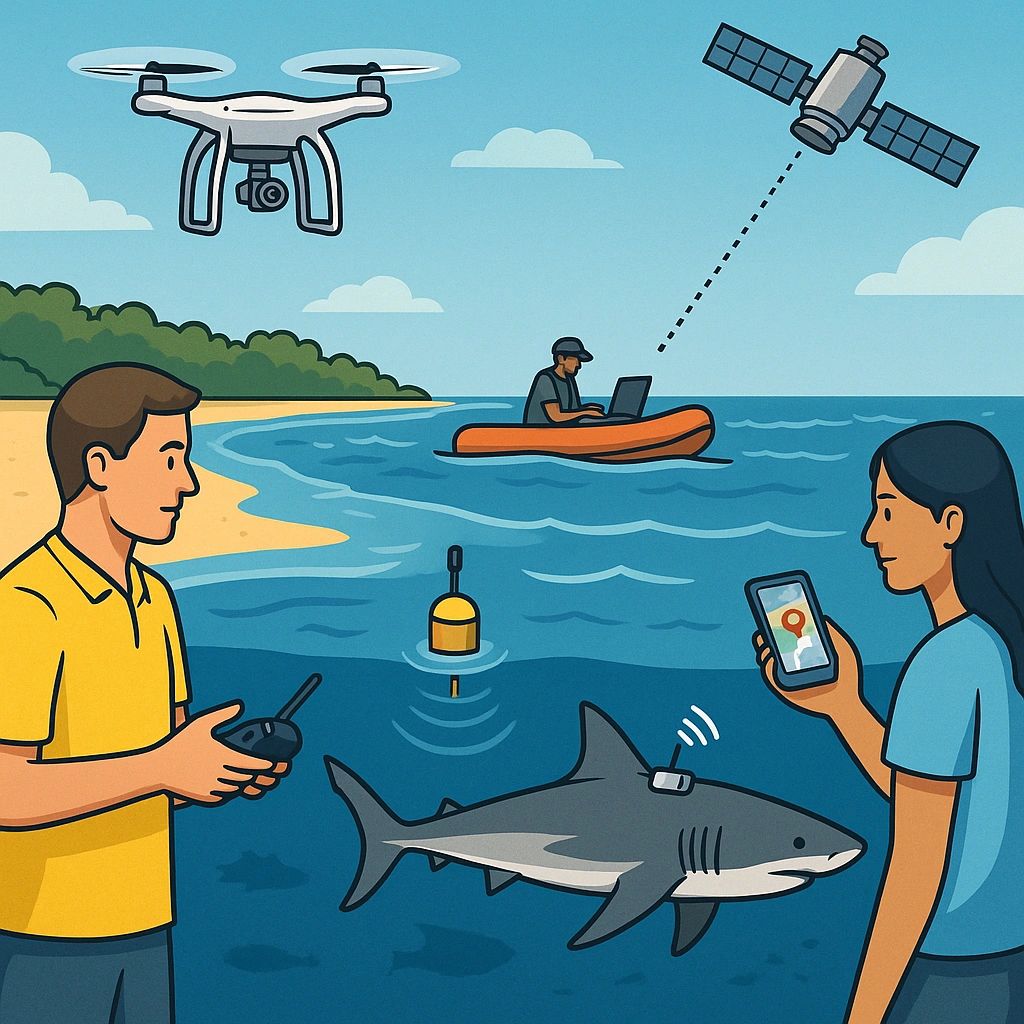
Sharks are some of the most powerful and mysterious animals in the ocean. But for many years, they’ve also been misunderstood. People feared them, thanks in part to scary movies and news headlines. That fear led to people hurting sharks and even killing them—often just to feel safe. But here’s the twist: shark attacks are extremely rare, and today, new technology is helping make the oceans safer for people—and better for sharks too.
From drones and satellite tags to apps and smart buoys, technology is changing how we share the ocean with these amazing animals. It’s helping reduce the risk of shark attacks and protecting sharks from threats like overfishing and habitat loss. So, let’s dive into the cool world of tech and explore how it’s helping both humans and sharks.
Drones: Eyes in the Sky
One of the biggest ways we’ve reduced shark attacks is by using drones. Drones are small flying machines that can take photos and video from the sky. Lifeguards and researchers now use drones to watch over beaches and spot sharks swimming near the shore.
In places like Australia, South Africa, and California, drones patrol popular beaches during busy times. If a drone spots a shark, it alerts lifeguards right away. That gives people enough time to get out of the water calmly and safely.
A 2020 study in New South Wales, Australia found that drones were better than humans at spotting sharks in the water. With better shark detection, fewer surprises happen in the ocean, and everyone is safer—even the sharks, who don’t end up getting hunted just because they were seen close to shore (Butcher et al., 2021).
Shark-Detecting Buoys
Another high-tech tool helping us is the smart buoy. These floating devices sit in the ocean and can listen for sharks that are wearing special tags. These tags are small electronic devices placed on sharks by scientists. When a tagged shark swims close to a buoy, it sends a signal that’s instantly shared with lifeguards, scientists, and even apps on your phone.
These “real-time acoustic receivers” are being used in places like Hawaii and Reunion Island, where shark attacks were once more common. The data helps officials know when and where sharks are moving so they can close beaches or send out warnings when needed (Papastamatiou et al., 2018).
The bonus? No harm comes to the sharks. Instead of hunting them or using dangerous nets, this tech lets us live alongside them peacefully.
Shark-Tracking Apps
Yes, there’s an app for that! In fact, there are several. One of the most popular is called “Shark Smart.” Others include “Sharktivity,” “Global Shark Tracker,” and “Shark Spotters.”
These apps use data from drones, buoys, and shark tags to show users where sharks have been seen recently. Some even let you follow specific sharks that scientists have named and tagged. You can watch them travel across the ocean!
These apps are fun to use but also super helpful. If you’re planning a day at the beach, you can check the app first to see if any sharks have been spotted nearby. It’s another smart way to stay safe without hurting the sharks.
Satellite Tracking: Following Sharks Around the World
Satellite tagging is like giving a shark a GPS tracker. Scientists place a tag on a shark’s fin. This tag sends data to satellites whenever the shark comes near the surface. It can tell us the shark’s location, depth, speed, and even water temperature.
This technology has helped scientists discover the secret lives of sharks. They’ve learned where sharks breed, migrate, and feed. That kind of info is super important. If we know where sharks like to hang out, we can avoid those areas during certain times of year. We can also protect those places from fishing and pollution.
For example, satellite tagging showed that some great white sharks migrate thousands of miles between California and Hawaii, stopping in a spot called the “White Shark Café.” Before tagging, scientists didn’t even know that place existed! (Jorgensen et al., 2010)
Artificial Intelligence and Shark Recognition
Artificial Intelligence (AI) is also diving into the action. AI is like a smart computer that can learn from patterns and make predictions. It’s being used in many ways to help detect sharks and reduce attacks.
Some systems use AI with drone cameras. The AI can instantly recognize if the object in the water is a shark, a dolphin, a swimmer, or even a floating log. That means lifeguards get quicker and more accurate info.
Other AI programs study years of data—like shark sightings, weather, and ocean temperatures—to predict where sharks might show up next. This is called “predictive modeling,” and it helps plan beach safety in a smarter way (Smart et al., 2021).
Virtual Fences
In the past, people used nets and drumlines to keep sharks away from swimmers. Sadly, those old methods often killed sharks, turtles, and dolphins. But now, we have something better: virtual fences.
These high-tech systems use sonar, sound waves, and cameras to create invisible “walls” in the water. When a shark gets close, the system sends an alert. Sometimes it even plays sounds that gently scare the shark away.
Places like Western Australia have started using these eco-friendly fences instead of traditional nets. It’s a win for both human safety and marine life protection (Meyer et al., 2022).
Ocean Robots and Smart Tags
Scientists also use underwater robots to study sharks in ways that were once impossible. These robots can follow sharks and record video or measure water quality. Some robots even work in teams to track entire groups of sharks at once.
Sharks are also getting smarter tags. These tags don’t just tell us where the shark is—they can measure heart rate, stomach movement (to know when a shark eats), and even if a shark is pregnant.
This tech gives scientists a deeper look into shark behavior. The more we understand sharks, the better we can protect both them and us.
3D Mapping and Shark Hotspots
Some researchers are using 3D maps to study where shark attacks happen. They look at how the beach is shaped, where people like to swim, and how currents move. These maps show “hotspots” where shark encounters are more likely.
For example, researchers in South Africa used mapping to find out that great white sharks often come close to shore during certain moon phases and tide patterns. With that knowledge, beach safety teams can be on extra alert when it matters most (Engelbrecht et al., 2021).
Shark Conservation and Citizen Science
Thanks to technology, regular people can now help save sharks too! Citizen science programs let beachgoers report shark sightings or tag data using their phones. Some apps even let you upload drone footage to help scientists track sharks.
This kind of community involvement is huge. It spreads awareness and makes people feel like part of the solution instead of afraid of the problem.
Also, tech has helped conservation groups use social media, websites, and even livestreams to educate the public. When people understand sharks better, they’re more likely to support laws and programs that protect them.
How Technology Is Helping Sharks Bounce Back
Let’s not forget: sharks are in trouble. Around one-third of all shark species are at risk of extinction, mostly due to overfishing, pollution, and climate change. But technology is helping here too.
Fishers now use “smart hooks” that reduce shark bycatch. These hooks have magnets or metals that discourage sharks from biting. Other fisheries use cameras and sensors to monitor what they catch, making sure they follow the rules.
Marine protected areas (MPAs) are also growing, and they’re often watched by satellite. Illegal fishing can now be spotted from space!
Even DNA testing helps conservation. Scientists can test shark fins at markets to see which species they came from. If the fins came from an endangered shark, they can take action (Fields et al., 2020).
What’s Next?
The future is looking bright—if we keep using technology the right way. New ideas are already in the works:
- Smart surfboards that detect sharks and alert surfers.
- Underwater drones that follow sharks without disturbing them.
- Virtual reality experiences that teach people about sharks without needing to see one in real life.
By mixing safety, science, and technology, we’re building a better relationship with sharks. Instead of fearing them, we’re learning to understand and respect them.
Final Thoughts
Sharks aren’t the monsters movies make them out to be. They’re important predators that keep our oceans healthy. And thanks to modern technology, we’re finding new ways to protect both people and sharks at the same time.
Drones, apps, satellites, AI, and even underwater robots are helping us share the ocean more safely and wisely. Shark attacks are becoming rarer, and more sharks are being saved every year.
It’s proof that when we use our brains and hearts together, we can solve big problems—and protect the wild wonders of our world.
Bibliography
Butcher, P. A., Colefax, A. P., Bathgate, R., & Kelaher, B. P. (2021). Drones for shark surveillance and beach safety: Effectiveness and factors influencing detection in surf zones. Journal of Unmanned Vehicle Systems, 9(3), 182–192. https://doi.org/10.1139/juvs-2020-0019
Engelbrecht, T. M., Kock, A. A., & O’Riain, M. J. (2021). The effect of environmental variables on white shark (Carcharodon carcharias) sightings in False Bay, South Africa. Marine Ecology Progress Series, 663, 147–157. https://doi.org/10.3354/meps13642
Fields, A. T., Abercrombie, D. L., Eng, R., Feldheim, K., & Chapman, D. D. (2020). A novel mini-DNA barcoding assay to identify processed shark fins from market samples. Scientific Reports, 10(1), 1–9. https://doi.org/10.1038/s41598-020-63106-7
Jorgensen, S. J., Reeb, C. A., Chapple, T. K., Anderson, S., Perle, C., Sommeran, S. R., … & Block, B. A. (2010). Philopatry and migration of Pacific white sharks. Proceedings of the Royal Society B: Biological Sciences, 277(1682), 679–688. https://doi.org/10.1098/rspb.2009.1155
Meyer, L., Meekan, M. G., & Perry, C. (2022). Using non-lethal shark deterrents to replace nets and drumlines: Review of field testing and real-world application. Marine Policy, 139, 105021. https://doi.org/10.1016/j.marpol.2022.105021
Papastamatiou, Y. P., Bodey, T. W., Friedlander, A. M., Lowe, C. G., & Bradley, D. (2018). Combining telemetry and machine learning to identify behavior-specific habitat preferences in large marine predators. Journal of Animal Ecology, 87(4), 1021–1032. https://doi.org/10.1111/1365-2656.12846
Smart, J. J., Chin, A., Tobin, A. J., White, W. T., & Simpfendorfer, C. A. (2021). Predictive modelling of shark-human interactions. Marine Ecology Progress Series, 666, 159–173. https://doi.org/10.3354/meps13719
Originally published at the live site .