
Maritime ·
Oceanic Whitetip Shark: The Bold Drifter of the Open Sea
When you think of sharks, the great white or hammerhead might come to mind first. But one shark that deserves just as much attention—if not more—is the oceanic whitetip shark. With its long, paddle-shaped fins and bold p...
By Rebecca "Madam Chronicler" Ryan
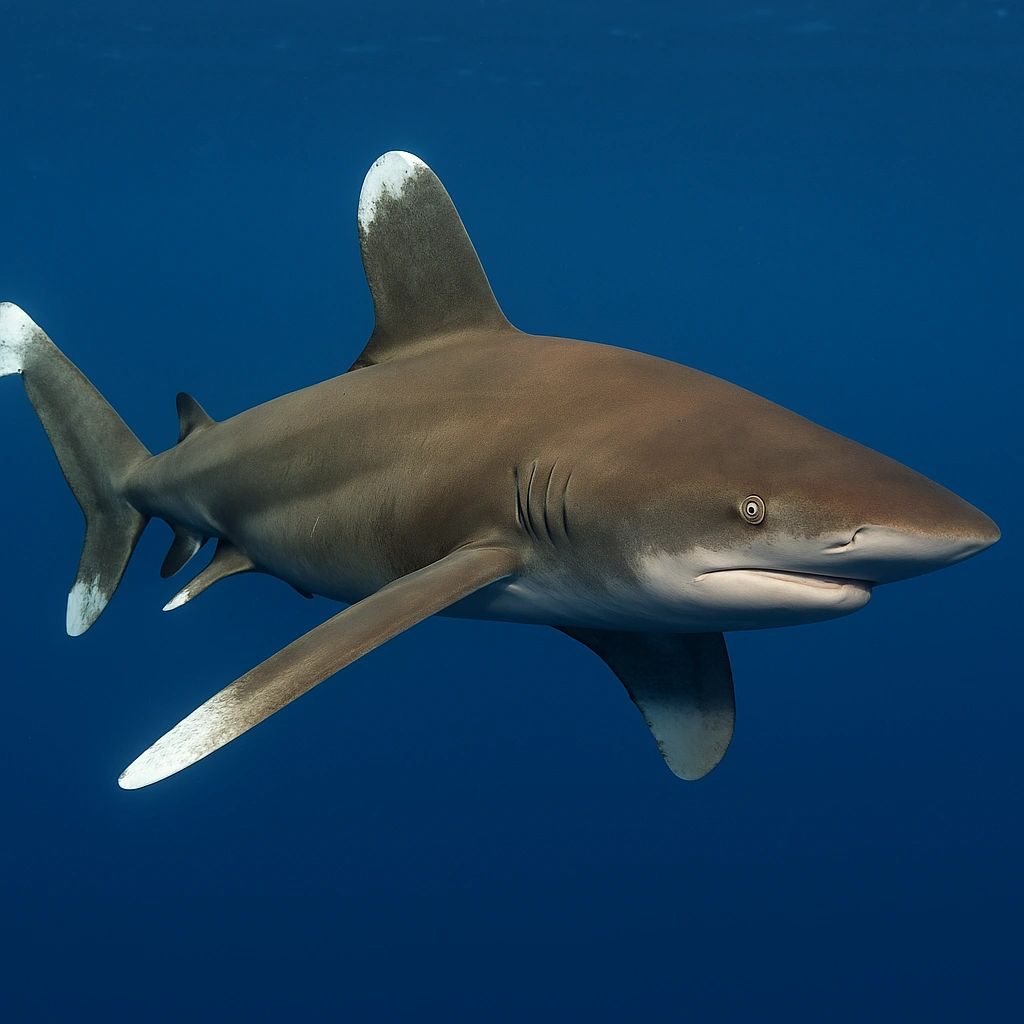
When you think of sharks, the great white or hammerhead might come to mind first. But one shark that deserves just as much attention—if not more—is the oceanic whitetip shark. With its long, paddle-shaped fins and bold personality, this open-ocean predator is a true wanderer of the world’s tropical and subtropical seas. Once abundant, the oceanic whitetip shark (scientific name: Carcharhinus longimanus) is now facing serious threats that could push it closer to extinction.
In this blog, we’ll explore what makes the oceanic whitetip unique, how it lives and hunts, where it’s found, why it’s in trouble, and how people are working to protect it.
What Does the Oceanic Whitetip Shark Look Like?
The oceanic whitetip shark is easy to spot if you’re lucky enough to see one in the wild. Its rounded fins, especially the large pectoral fins, are tipped with bright white. These white marks are what give the shark its name. Its body is usually gray or bronze on top and white underneath, which helps it blend in when viewed from above or below.
Adults are big. Most grow to be about 10 feet long and can weigh up to 370 pounds (Baum et al., 2003). They’re not the fastest swimmers, but they’re built to cruise long distances through open water. These sharks are rarely seen near shore and instead roam the deep blue parts of the ocean, far from land.
Where Do Oceanic Whitetips Live?
Oceanic whitetips are found in tropical and warm temperate seas around the world. This includes parts of the Atlantic, Pacific, and Indian Oceans. They like deep, open ocean areas with water temperatures between 64°F and 82°F (Seki et al., 1998). Because they prefer the open ocean, scientists call them “pelagic” sharks.
Some of their favorite areas include:
- The Gulf of Mexico
- The Caribbean Sea
- The central Pacific near Hawaii
- Waters around Madagascar and the Maldives
But these sharks are not picky travelers. They can swim thousands of miles in search of food, mates, or better conditions.
What Do Oceanic Whitetips Eat?
Oceanic whitetips are opportunistic feeders, which means they’ll eat whatever they can find. Their diet includes:
- Bony fish like tuna and mahi-mahi
- Squid
- Rays
- Sea birds
- Even dead animals floating in the water, like whale carcasses
They’re known for being bold and curious, especially around boats and shipwrecks. In the past, this behavior made them dangerous to shipwreck survivors, as they would often circle and investigate people in the water.
In feeding frenzies, these sharks can become very aggressive, and they’re not afraid to fight other predators for a meal. This behavior has made them feared—but also respected—by sailors and divers.
Are Oceanic Whitetips Dangerous to Humans?
While oceanic whitetip sharks are not the most common shark to attack humans, they do have a notorious reputation in some circles. According to the International Shark Attack File (ISAF), they have been involved in several unprovoked attacks, particularly on shipwreck victims (ISAF, 2023).
One of the most tragic examples was during World War II, when the USS Indianapolis sank in 1945. Hundreds of sailors ended up in the ocean, and many were believed to have fallen victim to oceanic whitetip sharks (Rosenberg, 2002). However, such events are extremely rare and mostly happened during times of war.
Today, very few people even see an oceanic whitetip, let alone have a negative encounter with one. Most shark experts agree that these animals are not out to get humans—they’re just curious and sometimes mistake floating objects for food.
How Do Oceanic Whitetip Sharks Reproduce?
Oceanic whitetip sharks are viviparous, which means they give birth to live young, not eggs. Females are pregnant for about 9 to 12 months and give birth to 1 to 15 pups at a time (Backus et al., 1956).
The pups are born fully developed and are about 2 feet long at birth. Like most sharks, they receive no care from their parents after birth and must survive on their own.
Because these sharks grow slowly and have relatively few babies, their populations can’t bounce back quickly if they’re overfished or killed off. That’s one reason why oceanic whitetips are now endangered.
Why Are Oceanic Whitetip Sharks in Trouble?
Once one of the most common sharks in the open ocean, the oceanic whitetip is now critically endangered according to the International Union for Conservation of Nature (IUCN, 2019). Here are the main reasons why:
1. Overfishing
Oceanic whitetips are often caught by accident in longline fishing gear meant for tuna or swordfish. But they’re also targeted for their fins, which are highly prized in shark fin soup, especially in parts of Asia (Clarke et al., 2006).
Once caught, their fins are often cut off and the rest of the shark is thrown back into the sea to die—a practice called finning. This wasteful and cruel act has wiped out huge numbers of oceanic whitetips over the past 50 years.
2. Slow Reproduction
As mentioned earlier, these sharks don’t have many babies and take a long time to mature. This means they can’t replace their numbers quickly, making it easy for populations to crash.
3. Lack of Data
Because oceanic whitetips live far from shore, scientists don’t have as much information about them compared to coastal sharks. This makes it hard to track how their numbers are doing or how well protection laws are working.
How Are We Protecting Oceanic Whitetip Sharks?
The good news is that many people around the world are now working hard to protect the oceanic whitetip shark.
1. Fishing Bans and Limits
In 2013, oceanic whitetips were added to Appendix II of CITES (the Convention on International Trade in Endangered Species). This means international trade in their fins and other parts is now strictly regulated (CITES, 2013).
The United States also listed the oceanic whitetip as threatened under the Endangered Species Act in 2018, giving it special protection in U.S. waters (NOAA, 2018).
2. Shark Sanctuaries
Several countries have created shark sanctuaries, where no shark fishing is allowed. These include the Bahamas, Palau, and the Marshall Islands. Such areas offer safe spaces where oceanic whitetips can roam and reproduce.
3. Tagging and Tracking
Scientists are now using satellite tags to track oceanic whitetips as they move across the oceans. These tags help researchers learn about their migration patterns, which areas they use most, and how to protect them better (Howey-Jordan et al., 2013).
Fun Facts About the Oceanic Whitetip Shark
Let’s lighten the mood with some cool facts about this amazing animal!
🦈 They’re sometimes called the “sea dog.” Old-time sailors gave them this name because of their boldness and tendency to follow ships.
🦈 They have great senses. Like most sharks, they can smell blood from miles away and detect tiny electric signals from other animals.
🦈 They swim with pilot fish. These little fish often swim right next to the shark’s head and help clean parasites off its skin.
🦈 They may fight each other. In feeding frenzies, oceanic whitetips sometimes bite each other by accident—or on purpose—while going after food.
🦈 They were once the most common shark in the ocean. Back in the 1950s, researchers considered them one of the most numerous large animals in the open sea. That’s sadly no longer the case today.
Why Oceanic Whitetips Matter
Sharks like the oceanic whitetip play a huge role in keeping the ocean healthy. They are top predators, which means they help control populations of fish and squid. Without sharks, the balance of life in the sea would be thrown off.
Also, healthy shark populations are a sign of a healthy ocean. If oceanic whitetips are disappearing, it’s a warning sign that something is wrong with the entire ecosystem.
What Can You Do to Help?
You don’t have to be a scientist to help save the oceanic whitetip shark. Here are a few things you can do right now:
✅ Say no to shark fin soup – This dish is one of the main reasons oceanic whitetips are killed.
✅ Support shark conservation groups – Organizations like Shark Trust, WildAid, and Project AWARE work hard to protect ocean sharks.
✅ Buy sustainable seafood – Look for seafood that’s been caught in a way that doesn’t hurt sharks or the ocean.
✅ Spread the word – Share what you’ve learned with friends and family. The more people who care, the better chance these sharks have of survival.
Final Thoughts: Respect for a Fearless Traveler
The oceanic whitetip shark is a bold, curious, and important part of our planet’s marine world. While it may not be as famous as the great white or tiger shark, it has a unique role in the ocean—and a fascinating story to tell.
This shark once ruled the open ocean. Now, it needs our help to survive. If we protect the waters it calls home, respect the balance of nature, and fight against wasteful fishing practices, we can give the oceanic whitetip shark a fighting chance.
And who knows? Maybe one day, future generations will be able to see this legendary “sea dog” cruising the deep blue again.
Bibliography
Backus, R. H., Springer, S., & Arnold, E. L. (1956). A contribution to the natural history of the white-tip shark, Pterolamiops longimanus (Poey). Deep Sea Research (1953), 3(3), 178–188. https://doi.org/10.1016/0146-6313(56)90002-4
Baum, J. K., Myers, R. A., Kehler, D. G., Worm, B., Harley, S. J., & Doherty, P. A. (2003). Collapse and conservation of shark populations in the Northwest Atlantic. Science, 299(5605), 389–392. https://doi.org/10.1126/science.1079777
Clarke, S. C., McAllister, M. K., Milner-Gulland, E. J., Kirkwood, G. P., Michielsens, C. G. J., Agnew, D. J., Pikitch, E. K., Nakano, H., & Shivji, M. S. (2006). Global estimates of shark catches using trade records from commercial markets. Ecology Letters, 9(10), 1115–1126. https://doi.org/10.1111/j.1461-0248.2006.00968.x
Convention on International Trade in Endangered Species of Wild Fauna and Flora (CITES). (2013). Appendices I, II and III. https://cites.org/eng/app/appendices.php
Howey-Jordan, L. A., Brooks, E. J., Abercrombie, D. L., Jordan, L. K. B., Brooks, A., Williams, S., Gospodarczyk, E., & Chapman, D. D. (2013). Complex movements, philopatry and expanded depth range of a severely threatened pelagic shark, the oceanic whitetip (Carcharhinus longimanus) in the western North Atlantic. PLOS ONE, 8(2), e56588. https://doi.org/10.1371/journal.pone.0056588
International Shark Attack File (ISAF). (2023). Shark attack statistics. Florida Museum of Natural History. https://www.floridamuseum.ufl.edu/shark-attacks/
International Union for Conservation of Nature (IUCN). (2019). The IUCN Red List of Threatened Species: Carcharhinus longimanus. https://www.iucnredlist.org/species/39374/2911619
National Oceanic and Atmospheric Administration (NOAA). (2018). Oceanic whitetip shark listed as threatened under Endangered Species Act. https://www.fisheries.noaa.gov
Rosenberg, M. (2002). Shark attacks: The USS Indianapolis disaster. Military History Quarterly. https://www.historynet.com/uss-indianapolis-shark-attacks/
Seki, M. P., Taira, H. P., & Bigelow, K. A. (1998). Migrations and habitat preferences of oceanic whitetip sharks (Carcharhinus longimanus) in the central Pacific. Fisheries Bulletin, 96(4), 826–839.
Originally published at the live site .