
Maritime ·
Shark Migration: Where Do They Go When Summer Ends?
When summer comes to an end and the days grow shorter, we start thinking about pumpkins, sweaters, and cooler weather. But for sharks, the changing seasons mean something very different. It’s the time when many species b...
By Rebecca "Madam Chronicler" Ryan
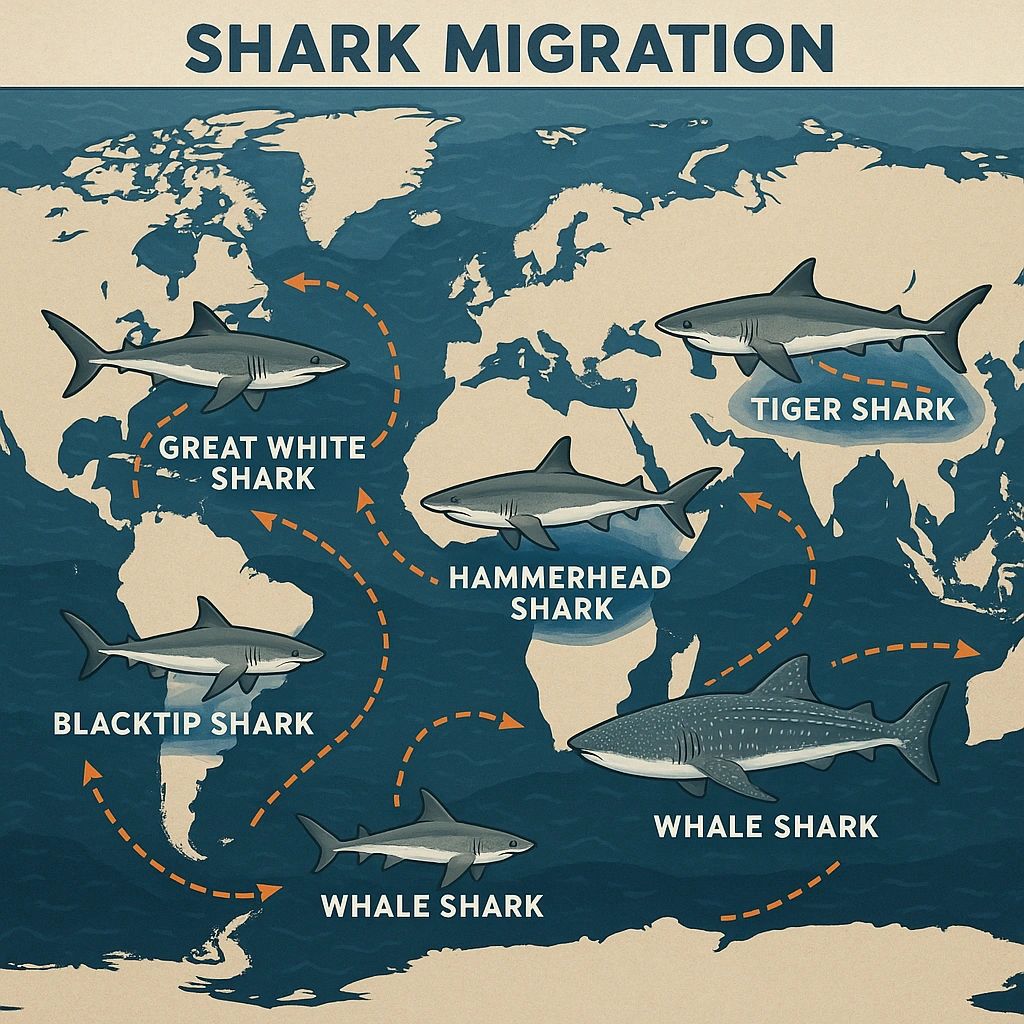
When summer comes to an end and the days grow shorter, we start thinking about pumpkins, sweaters, and cooler weather. But for sharks, the changing seasons mean something very different. It’s the time when many species begin one of the ocean’s most fascinating journeys—migration.
Shark migration is like nature’s underwater road trip. These powerful swimmers travel hundreds, sometimes thousands, of miles to find warmer waters, food, and places to give birth. But where exactly do they go when summer ends? And why do they migrate at all?
Let’s dive deep into this sharky subject and explore the mystery of shark migration!
Why Do Sharks Migrate?
Just like birds fly south for the winter, many sharks migrate for similar reasons. The ocean’s temperature plays a huge role in their lives. Sharks are cold-blooded animals, which means they depend on their environment to keep their body temperature steady. When the water cools down in the fall and winter, some sharks move to warmer places to stay comfortable.
But warmth isn’t the only reason sharks migrate. Other big reasons include:
- Finding food: Some prey fish also migrate, so sharks follow them.
- Breeding: Certain sharks travel to special places to mate or give birth.
- Avoiding danger: Young sharks may migrate to shallow, safe nursery areas.
Migration is all about survival. It helps sharks stay healthy, well-fed, and ready to raise the next generation.
How Do Sharks Know Where to Go?
One of the coolest mysteries of shark migration is how they know where to go—and how to get back. Scientists believe sharks have amazing built-in navigation tools. Here are a few things that help guide them:
- Earth’s magnetic field: Some sharks can sense the Earth’s magnetic field like a natural GPS system.
- Water temperature: Sharks can detect tiny changes in temperature and follow warm or cool water currents.
- Smell: Sharks have an excellent sense of smell, and some may recognize scents in the water that help guide them.
- Memory: Just like salmon returning to the same river, sharks might remember routes from past migrations.
Thanks to new technology like satellite tags and tracking systems, scientists can now follow individual sharks as they migrate across oceans. And what they’ve learned is jaw-dropping!
Famous Shark Migrations
Let’s look at some of the most famous shark migrations around the world—and where these sea travelers go when the summer ends.
1. Great White Sharks (Carcharodon carcharias)
Great white sharks are among the most well-known migrators. In the warmer months, they gather in coastal areas like California, South Africa, and Australia. But when summer ends?
In the Pacific Ocean, many great whites leave the California coast and head out to a mysterious area halfway to Hawaii known as the “White Shark Café.” Scientists still aren’t sure why they go there—it might be for mating, feeding, or both.
In South Africa, great whites migrate along the coastline, moving between feeding grounds. In Australia, they swim from cool southern waters to warmer northern areas.
These trips can be over 1,000 miles long!
2. Tiger Sharks (Galeocerdo cuvier)
Tiger sharks prefer warm, tropical waters, but they still migrate seasonally. In the western Atlantic, many tiger sharks move from places like the Carolinas and Florida to the Caribbean or the Gulf of Mexico during the fall and winter months.
Females are especially known for migrating to warm, shallow areas to give birth to their pups. These nursery zones help protect the babies from predators.
Researchers using satellite tags found that tiger sharks can travel over 7,500 miles in a year!
3. Hammerhead Sharks (Sphyrna lewini)
Scalloped hammerheads are known for gathering in large schools—sometimes in the hundreds! In summer, they often patrol coastal areas and offshore reefs.
When fall rolls around, hammerheads in the eastern Pacific head to seamounts—underwater mountains—like Cocos Island (Costa Rica), Malpelo Island (Colombia), and the Galápagos. These areas offer safety and food.
Juvenile hammerheads may head to protected bays or estuaries where the water is warmer and there are fewer predators.
4. Blacktip Sharks (Carcharhinus limbatus)
Blacktip sharks are small but fast and love warm, shallow water. In the U.S., they’re famous for their annual migration along the Atlantic coast.
During spring and summer, blacktips are often seen as far north as North Carolina. But as water temperatures drop in fall, they head south to Florida and the Gulf of Mexico.
In fact, every winter, thousands of blacktip sharks gather off the beaches of South Florida—so many that you can sometimes see them from the air!
5. Whale Sharks (Rhincodon typus)
Whale sharks—the largest fish in the sea—also migrate. They’re filter feeders that follow the blooms of plankton and tiny fish.
In the summer, whale sharks gather in hotspots like Mexico’s Yucatán Peninsula, the Philippines, and Western Australia.
But when the seasons shift, they swim thousands of miles to new feeding grounds. Some whale sharks have been tracked migrating across entire ocean basins.
These gentle giants use migration to stay near the best buffet tables in the sea!
What Happens If Sharks Can’t Migrate?
Migration isn’t just a nice trip for sharks—it’s a matter of life or death. And unfortunately, human activities are getting in the way.
Here are some dangers that can disrupt shark migration:
- Climate change: Warmer oceans can shift prey patterns, confuse migration timing, or make old routes too hot or too cold.
- Fishing: Longlines and nets can accidentally catch migrating sharks.
- Pollution: Dirty water or noisy areas may force sharks to avoid important habitats.
- Coastal development: Construction near coasts can destroy nursery areas.
If sharks can’t migrate safely, it could hurt entire populations. And since sharks are top predators, that would throw the ocean food chain out of balance.
How Scientists Track Migrating Sharks
To better understand shark migration, researchers use special tags that attach to a shark’s dorsal fin or back. These tags can record data like:
- Location
- Depth
- Water temperature
- Time of day
Some tags send the data to satellites. Others pop off after a while and float to the surface, where scientists can collect them.
This technology has revealed amazing migration journeys. For example:
- One tiger shark traveled over 2,000 miles from Bermuda to the Caribbean.
- A great white named Nicole swam from South Africa to Australia and back—a round trip of over 12,000 miles!
- Hammerheads tagged off Malpelo Island traveled over 600 miles to coastal nursery zones.
Thanks to shark tracking, we now have maps of their migration superhighways!
How You Can Help Protect Migrating Sharks
Even if you’re far from the ocean, you can still help sharks stay safe on their journeys. Here’s how:
- Support shark conservation groups: Groups like OCEARCH, Shark Trust, and Marine Megafauna Foundation work to protect migrating sharks.
- Reduce plastic waste: Plastic can end up in the ocean and hurt sharks and their prey.
- Eat sustainable seafood: Look for seafood with eco-labels so sharks aren’t caught by accident.
- Spread the word: The more people know about shark migration, the more support there will be to protect it!
Fun Shark Migration Facts
- The longest known migration by a shark was over 12,000 miles!
- Some sharks return to the same exact beach or reef every year.
- Florida’s coast becomes a shark highway every winter, especially for blacktips.
- Some pregnant female sharks travel hundreds of miles just to find a safe nursery.
- Great whites can dive over 3,000 feet during migrations.
Final Thoughts: Sharks on the Move
Shark migration is one of nature’s greatest adventures. It’s a journey of survival, instinct, and discovery. From the open Pacific to the warm waters of the Caribbean, sharks are constantly on the move, guided by invisible forces we’re only beginning to understand.
As summer fades and the seasons change, these amazing animals swim silently through the oceans, chasing warmth, food, and safety. Their travels connect distant parts of the world and remind us how closely everything in nature is tied together.
By learning about shark migration, we’re not just following their path—we’re also helping to protect it. And that’s something to celebrate, season after season.
Bibliography
- Bonfil, R., Meyer, M., Scholl, M. C., Johnson, R., O’Brien, S., Oosthuizen, H., … & Paterson, M. (2005). Transoceanic migration, spatial dynamics, and population linkages of white sharks. Science, 310(5745), 100-103. https://doi.org/10.1126/science.1114898
- Hammerschlag, N., Gallagher, A. J., Wester, J., Luo, J., & Ault, J. S. (2012). Don’t bite the hand that feeds: assessing ecological impacts of provisioning ecotourism on an apex marine predator. Functional Ecology, 26(3), 567–576. https://doi.org/10.1111/j.1365-2435.2012.01973.x
- Lea, J. S. E., Humphries, N. E., von Brandis, R. G., Clarke, C. R., & Sims, D. W. (2016). Acoustic telemetry and network analysis reveal the space use of a coastal apex predator. Scientific Reports, 6, 23170. https://doi.org/10.1038/srep23170
- Hueter, R. E., Heupel, M. R., Heist, E. J., & Keeney, D. B. (2004). Evidence of philopatry in sharks and implications for the management of shark fisheries. Journal of Northwest Atlantic Fishery Science, 35, 239–247. https://doi.org/10.2960/J.v35.m493
- Chapman, D. D., Feldheim, K. A., Papastamatiou, Y. P., & Hueter, R. E. (2015). There and back again: a review of residency and return migrations in sharks, with implications for population structure and management. Annual Review of Marine Science, 7, 547–570. https://doi.org/10.1146/annurev-marine-010814-015730
- OCEARCH Shark Tracker. (n.d.). Retrieved from https://www.ocearch.org/tracker/
Originally published at the live site .