
Places ·
Steamboats and Space Dreams: The History of Florida’s Space Coast
Florida’s Space Coast is famous for rockets, astronauts, and the roar of launches that shake the sand along Cocoa Beach. But before NASA and SpaceX turned this part of Florida into the heart of space exploration, the Ind...
By Rebecca "Madam Chronicler" Ryan
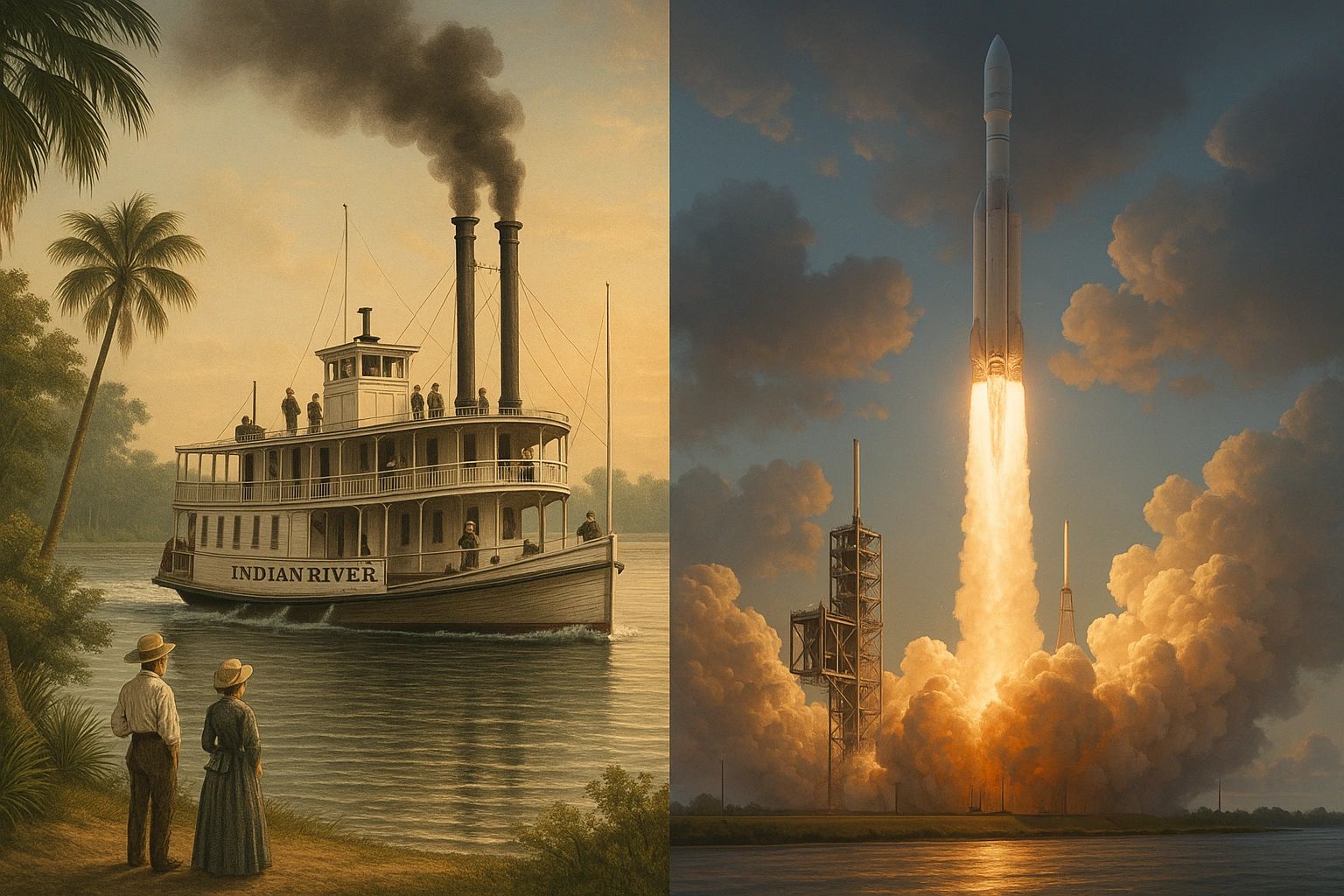
Florida’s Space Coast is famous for rockets, astronauts, and the roar of launches that shake the sand along Cocoa Beach. But before NASA and SpaceX turned this part of Florida into the heart of space exploration, the Indian River Lagoon and nearby waterways were alive with a very different kind of engine—the paddle-wheeling, steam-powered boats that once connected river towns and carried people, goods, and dreams up and down the coast.
This blog will take you on a journey through time, from the steamboat era of the 1800s to the rocket age of the 20th and 21st centuries. Along the way, you’ll see how transportation and technology transformed Florida’s east coast into a place where past and future meet in a stunning way.
Life on the River Before Rockets
Long before rockets flew into the sky, the rivers and lagoons of Florida were the highways of the region. The Indian River Lagoon, the Banana River, and the St. Johns River were the lifeblood of communities like Cocoa, Titusville, and Melbourne. Dense forests, swamps, and sandy scrublands made overland travel slow and dangerous, so water routes were the fastest way to move people and goods.
Native peoples, including the Ais and Timucua, used dugout canoes to navigate these waters for thousands of years. When European settlers and later American pioneers arrived, they too relied on the rivers. By the mid-1800s, a new technology was making travel and trade faster: the steamboat.
The Rise of Steamboats on the Space Coast
Steamboats first appeared in Florida in the early 1800s, carrying passengers, cotton, lumber, and supplies. By the 1850s, they became common on the St. Johns River, connecting Jacksonville to interior towns. The Indian River Lagoon and its sister waterways soon followed.
These paddle-wheelers were more than just boats—they were floating communities. Some offered luxury cabins for wealthy visitors from the North who came to Florida for winter vacations. Others were working vessels that carried oranges, fish, and cattle to market. Steamboats were vital in making Brevard County and other Space Coast communities accessible to the outside world.
In fact, the town of Titusville grew rapidly thanks to the steamboat trade. It became the hub for shipments of citrus and produce heading north. Cocoa, another important stop, relied on these vessels to bring goods and tourists to its riverfront docks.
One traveler in the 1870s described the journey along the Indian River by steamboat as both beautiful and strange, with miles of shimmering water, palm trees, and the occasional alligator sliding into the shallows. For many visitors, it was their first glimpse of “wild Florida.”
Steamboats Fuel Tourism and Growth
The late 19th century was a golden age for Florida steamboats. Wealthy northerners, including industrialists and politicians, came south for fishing, hunting, and relaxation. Steamboats gave them a comfortable way to travel while also fueling the tourism economy that Florida still thrives on today.
Hotels sprang up along the rivers, and small communities developed around steamboat landings. Citrus groves expanded because farmers now had reliable transport for their fruit. Fish markets grew as mullet, shad, and other catches could be shipped quickly.
But steamboats were not just about work—they carried culture, too. Mail, newspapers, and books arrived by steamer. Traveling shows and performers sometimes made their way to Florida towns by boat. The river, once quiet and isolated, buzzed with the sounds of steam whistles and paddle wheels.
The Decline of the Steamboat Era
As important as steamboats were, their reign didn’t last forever. By the early 20th century, railroads and later automobiles took over as the main way to travel and move goods. Roads and train lines offered faster, more direct routes than winding rivers.
By the 1920s and 1930s, most steamboats had vanished from the Indian River Lagoon and nearby waterways. A few still ran tours or ferried supplies, but their golden days were over. The rivers grew quieter again, though their role in shaping the Space Coast would not be forgotten.
Entering the Space Age
Fast forward to the mid-20th century. The United States was in the middle of the Cold War, and space exploration became a national priority. In 1950, the government chose Cape Canaveral as a launch site because of its open skies, flat land, and access to the Atlantic Ocean.
The Space Coast’s transformation was stunning. Where once paddle-wheelers had carried oranges and tourists, massive rockets now stood on launchpads. The roar of steam engines on the rivers was replaced by the thunder of Saturn V rockets heading to the Moon.
Towns like Cocoa and Titusville experienced a second boom, this time fueled not by citrus and steamboats but by engineers, scientists, and astronauts. Families moved to the area for jobs with NASA and its contractors. Schools, neighborhoods, and businesses sprang up almost overnight.
The Apollo Era: Dreams Lift Off
The 1960s were the defining decade for the Space Coast. The Apollo program made history when Neil Armstrong and Buzz Aldrin set foot on the Moon in 1969. The Kennedy Space Center became a symbol of American achievement, and millions around the world tuned in to watch launches from Florida’s shores.
For locals, spaceflight became part of daily life. Children growing up in Cocoa Beach or Titusville could see rockets launch from their backyards. Workers who once might have picked oranges or loaded steamboats now assembled spacecraft or tracked satellites.
The economy boomed, and the Space Coast’s identity was forever linked to exploration and technology.
The Shuttle Era: A New Kind of Steamboat?
From 1981 to 2011, the Space Shuttle program defined the region. The shuttles, with their reusable design, carried astronauts into orbit dozens of times. Towns filled with tourists eager to watch launches, much like the steamboat passengers of the 19th century who came for Florida’s river journeys.
In a way, the shuttles were the “new steamboats”—complex machines that carried people across a vast frontier. Just as paddle wheelers had opened up Florida’s rivers, the shuttles opened the gateway to low Earth orbit.
The Modern Era: SpaceX and Beyond
Today, the Space Coast is busier than ever. Companies like SpaceX, Blue Origin, and United Launch Alliance have joined NASA in launching rockets from Cape Canaveral and Kennedy Space Center. Reusable rockets land themselves on floating platforms, bringing the space industry into a new age of efficiency.
The area has also embraced its history. Museums like the American Space Museum in Titusville preserve the stories of the space race, while riverfront towns celebrate their steamboat past. Cocoa Village, with its historic district, reminds visitors of the days when steamships lined the docks.
How Steamboats and Space Connect
At first glance, steamboats and rockets might seem worlds apart. But both industries share something important: they opened new frontiers. Steamboats connected isolated communities, brought goods to market, and made Florida accessible. Rockets connected Earth to space, brought satellites into orbit, and made the universe more accessible.
Both eras also shaped the Space Coast’s culture and economy. Steamboats built the first foundation for towns along the rivers. Rockets transformed them into global centers of science and exploration.
And just as steamboats once drew tourists to Florida’s waters, rocket launches today draw crowds to the beaches. Families gather with lawn chairs and cameras, waiting for the bright flare of liftoff—a tradition that links the past and present in a uniquely Space Coast way.
Preserving the Past, Embracing the Future
Communities along the Space Coast are proud of both their riverboat and spacefaring histories. Festivals, museums, and historic markers keep the memory of steamboats alive. At the same time, every new rocket launch points toward a future where Florida continues to play a key role in exploration.
For visitors, it’s an incredible place to experience both history and cutting-edge technology. You can stroll through Cocoa Village’s historic streets, ride a boat on the Indian River Lagoon, and then head to Kennedy Space Center to stand beneath a Saturn V rocket or watch a launch.
Conclusion: A Coast of Innovation
From the steady churn of paddle wheels to the fiery thrust of rockets, Florida’s Space Coast has always been about movement, exploration, and innovation. The waterways once carried steamboats filled with citrus, fish, and tourists. Today, the skies carry rockets filled with satellites, astronauts, and dreams of Mars.
The connection between these eras reminds us that progress is never built from scratch—it grows from the foundations of the past. Without the river towns shaped by steamboats, the Space Coast might never have been ready for rockets. Without rockets, the world might never have seen the Space Coast as a place where the future begins.
So next time you watch a launch from Cocoa Beach or Titusville, think about the steam whistles that once echoed across the Indian River. Both sounds—the whistle and the rocket’s roar—belong to the story of a coast that has always been reaching for something more.
References
Colburn, D. R., & Landers, J. J. (Eds.). (1991). The African American heritage of Florida. University Press of Florida.
Crooks, J. B. (1970). Politics and progress: The rise of urban progressivism in Florida, 1900–1920. The Florida Historical Quarterly, 49(2), 95–116.
Hollister, C. D. (1972). Steamboating on Florida rivers. The Florida Historical Quarterly, 51(1), 15–34.
Launius, R. D. (2019). NASA: A history of the U.S. civil space program. Krieger Publishing.
McCarthy, K. M. (2004). The history of Florida. Pineapple Press.
Neal, A. (2012). Steamboats in Florida. Arcadia Publishing.
Orloff, R. W. (2001). Apollo by the numbers: A statistical reference. NASA History Division.
Siddiqi, A. A. (2010). Challenge to Apollo: The Soviet Union and the space race, 1945–1974. NASA History Series.
Weaver, J. C. (2019). The transformation of Florida’s Space Coast. Florida Historical Quarterly, 97(3), 257–285.
Originally published at the live site .