
Boats ·
The Boat-Tailed Grackle: Florida’s Loud Coastal Survivor
As the cardinal’s clear whistle faded into the background that morning, another sound quickly took its place.
By Rebecca "Madam Chronicler" Ryan
As the cardinal’s clear whistle faded into the background that morning, another sound quickly took its place.
It wasn’t musical.
It wasn’t soft.
It was sharp, metallic, and almost jarring—like the creak of a rusty hinge echoing across the yard.
At first, it didn’t even sound like a bird.
It sounded mechanical.
When I looked down at the Merlin Bird ID app, the answer appeared.
Boat-Tailed Grackle.
A Voice That Stands Out
Of all the birds Merlin identified that morning, the Boat-Tailed Grackle was perhaps the easiest to recognize by sound alone.
Its call doesn’t blend into the background. It cuts through it.
Where other birds create melodies, the grackle produces something harsher. Its voice is a mix of squeaks, clicks, and metallic tones that can feel almost out of place in a natural setting.
And yet, once you recognize it, you begin to hear it everywhere.
It becomes one of the defining sounds of Florida’s coastal environment.
Seeing the Grackle
Not long after hearing its call, I spotted it.
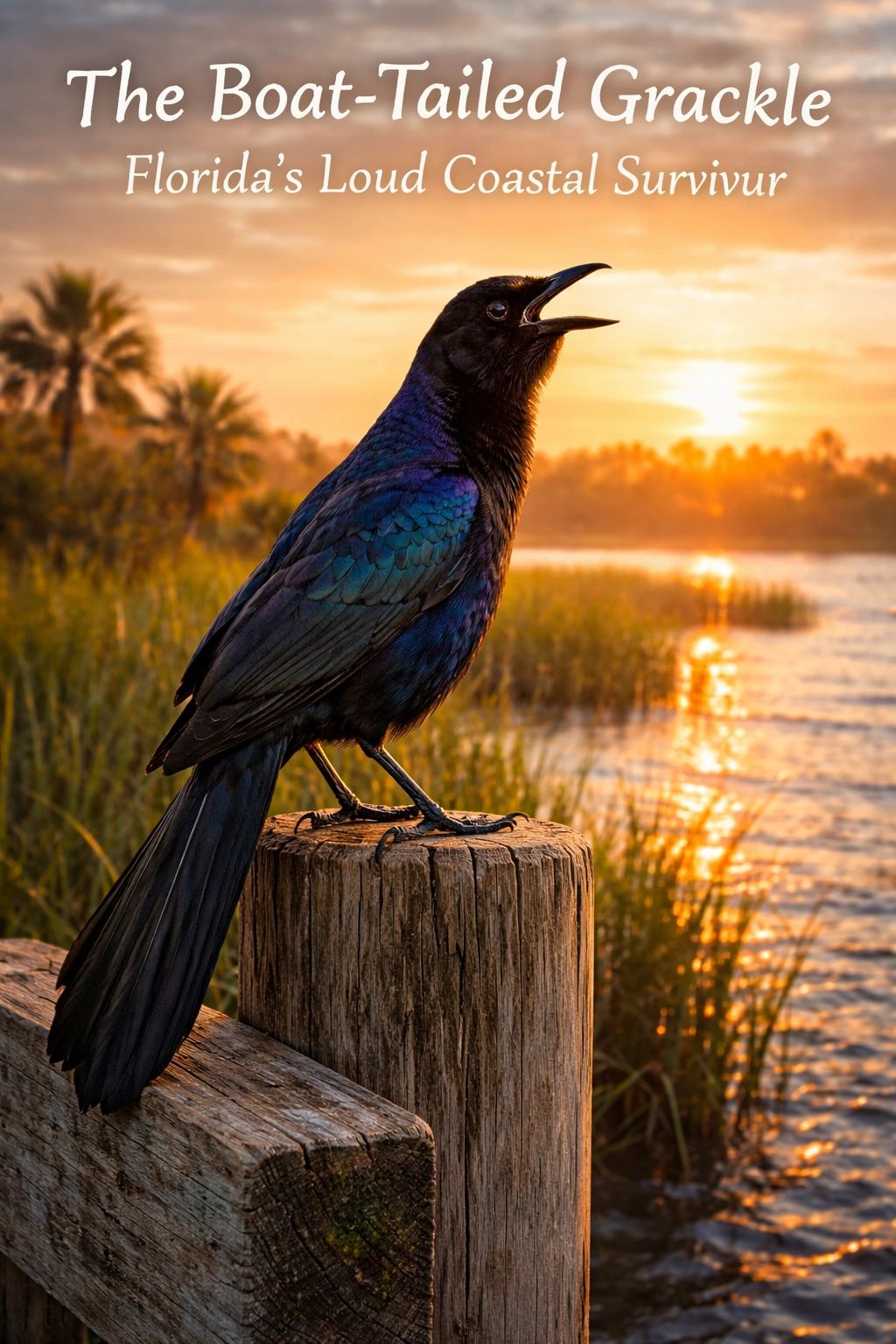
Perched confidently on a nearby branch, the bird’s dark form stood out against the morning light. At first glance, it appeared almost completely black. But as the sunlight shifted, its feathers revealed subtle hints of iridescent blue and purple.
The male Boat-Tailed Grackle is a striking bird when viewed up close.
Its long, keel-shaped tail gives it a distinctive silhouette, especially in flight. The tail fans out behind it, adding to its presence and making it easy to distinguish from other blackbirds.
The female, on the other hand, looks entirely different. She is smaller and brown, blending more easily into the environment. This contrast between male and female is one of the most noticeable differences among Florida’s common birds.
A Bird Built for the Coast
The Boat-Tailed Grackle is closely tied to water.
Unlike some of the other birds identified that morning, this species thrives in coastal environments. It is commonly found near marshes, estuaries, lagoons, and shorelines.
Living near the Indian River Lagoon, it’s no surprise that Merlin picked it up.
These birds are not just occasional visitors to these areas. They are part of the ecosystem. Their presence is as much a feature of the coastline as the water itself.
They move easily between natural habitats and human-developed spaces, often appearing in parking lots, docks, and outdoor dining areas near the water.
Adapting to Human Environments
One of the most interesting things about Boat-Tailed Grackles is how well they adapt to human activity.
They are opportunistic feeders, willing to take advantage of whatever food sources are available. This includes natural prey like insects and small animals, as well as scraps left behind by people.
Watching a grackle in a public space, there is a sense of confidence in its behavior. It does not hesitate to approach areas where food might be found. It learns quickly and adjusts its actions based on experience.
This adaptability has allowed the species to thrive in places where other birds might struggle.
Feeding and Behavior
Grackles are active and alert, constantly scanning their surroundings.
They walk with purpose, often pausing to inspect the ground before moving again. Their diet is varied, including insects, small fish, crustaceans, seeds, and even discarded food.
Near water, they may be seen foraging along the edges, taking advantage of whatever the tide brings in. In urban areas, they shift their focus, searching for opportunities created by human presence.
This flexibility is one of their greatest strengths.
A Social Bird
Boat-Tailed Grackles are rarely alone.
They often gather in groups, especially in areas where food is plentiful. These groups can create a constant level of activity, with birds moving, calling, and interacting with one another.
Their calls, combined with their numbers, make them hard to ignore.
In some cases, their presence can feel overwhelming, especially in areas where they congregate in large numbers. But this social behavior plays an important role in their survival.
By staying together, they increase their awareness of potential threats and improve their chances of finding food.
The Role They Play in the Ecosystem
Despite their sometimes noisy and bold behavior, Boat-Tailed Grackles serve an important role in their environment.
They help control insect populations, feed on small aquatic animals, and contribute to the balance of coastal ecosystems.
Their presence is a sign of a functioning environment, even if their behavior occasionally brings them into conflict with human expectations.
Returning to That Morning
As the Merlin app continued to identify birds, the grackle’s call remained one of the most distinctive sounds in the background.
It didn’t have the melodic quality of the cardinal or the complexity of the mockingbird. It wasn’t subtle or refined.
But it was unmistakable.
It added a different kind of energy to the morning, one that felt raw and unfiltered.
It reminded me that not all parts of nature are designed to be beautiful in the traditional sense. Some are simply functional, direct, and unapologetically present.
A Different Kind of Beauty
The Boat-Tailed Grackle may not be the bird people think of when they imagine peaceful backyard scenes.
Its call can be harsh. Its behavior can be bold. Its presence can be overwhelming.
But there is a different kind of beauty in that.
It is a bird that survives and thrives in changing environments. It adapts, learns, and persists. It takes what is available and makes use of it.
In many ways, it reflects the environment it lives in—dynamic, unpredictable, and constantly shifting.
More Than Just Noise
At first, the grackle’s call might seem like noise.
But once you recognize it, once you understand where it fits into the environment, it becomes something more.
It becomes a signal.
A reminder that the natural world is not always quiet or gentle. It is active, sometimes chaotic, and full of competing voices.
The grackle is one of those voices.
And like the others identified that morning, it plays a role in shaping the soundscape of the place.
Conclusion: A Voice You Can’t Ignore
That morning in the backyard, the Boat-Tailed Grackle stood out in a way that none of the other birds did.
Not because it was the most beautiful or the most complex, but because it was the most impossible to ignore.
Its call cut through everything else, demanding attention.
And in doing so, it revealed something important.
Nature is not just made up of soft songs and quiet moments. It is also made up of sharp sounds, bold behavior, and species that thrive by being exactly what they are.
The Boat-Tailed Grackle is one of those species.
And once you hear it, you won’t mistake it for anything else.
Bibliography
Cornell Lab of Ornithology. All About Birds: Boat-Tailed Grackle.
Cornell Lab of Ornithology. Merlin Bird ID App. Cornell University.
National Audubon Society. Boat-Tailed Grackle.
Sibley, David Allen. The Sibley Guide to Birds. Alfred A. Knopf.
Florida Fish and Wildlife Conservation Commission. Florida Bird Species Information.
Originally published at the live site .