
Maritime ·
The Carolina Chickadee: The Familiar Call
Some birds feel distant.
By Rebecca "Madam Chronicler" Ryan
Some birds feel distant.
Some feel wild in a way that keeps them just out of reach.
And then there are birds that feel familiar the moment you notice them.
The Carolina chickadee is one of those birds.
A Sound That Feels Like a Greeting
The first time I really noticed it, it didn’t feel like a discovery.
It felt like recognition.
A quick series of notes—light, clear, and almost conversational—cut through the background noise of the yard. It wasn’t loud, but it carried just enough to stand out.
“Chick-a-dee-dee-dee…”
The sound didn’t feel random.
It felt intentional.
Almost like a greeting.
I paused, listening, trying to place it, but unlike some of the other birds I had been learning, this one felt oddly familiar even before I knew what it was.
Still, I opened the Merlin Bird ID app and let it listen.
Within seconds, it gave me the answer.
Carolina Chickadee.
And somehow, that name fit immediately.
Looking for Something Small—and Fast
Once I had a name, I started looking.
Not high in the sky.
Not far out in the open.
But somewhere close.
The movement was quick—faster than most of the birds I had been watching. A small shape darting between branches, stopping for just a moment, then moving again before your eyes could fully settle on it.
It didn’t stay still long.
But it didn’t disappear either.
It stayed close enough to follow—if you paid attention.
A Bird That Feels Familiar
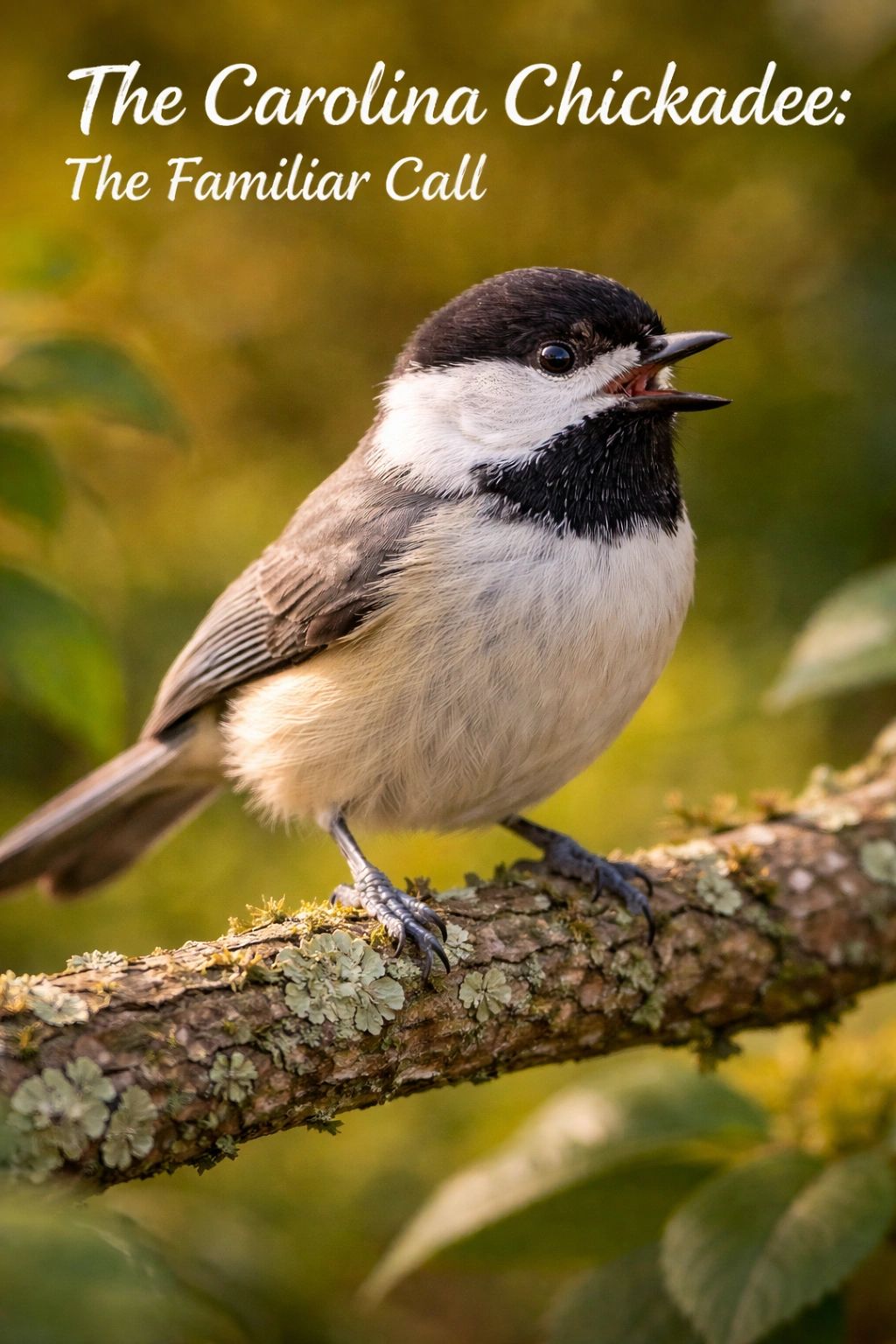
When I finally got a clear look, the details matched the feeling I had from the sound.
Small.
Compact.
A soft gray body with a lighter underside.
A black cap and throat that stood out clearly against its face.
Its eyes were dark and bright, giving it an alert expression that felt almost expressive.
It didn’t look dramatic.
It didn’t need to.
It felt recognizable.
Movement That Feels Like Curiosity
The Carolina chickadee doesn’t move with urgency.
It moves with curiosity.
It hops along branches, pauses, tilts its head slightly, then moves again. It seems to inspect everything—bark, leaves, small spaces where something might be hidden.
And unlike birds that keep their distance, the chickadee doesn’t seem overly concerned with yours.
It doesn’t rush away immediately.
It lingers.
A Voice That Means More Than It Seems
What makes the chickadee especially interesting is how much it communicates through sound.
Its most recognizable call—“chick-a-dee-dee-dee”—isn’t just a simple song. According to the Smithsonian Handbooks: Birds of North America (Eastern Region), the number of “dee” notes can actually change depending on the situation.
More “dee” notes can signal greater alertness or potential danger.
Fewer notes feel calmer.
It’s not just a sound.
It’s information.
And once you know that, the call feels different.
A Bird That Stays Close
The Carolina chickadee is a year-round resident, especially in places like Florida.
It doesn’t migrate long distances.
It stays.
It builds nests in tree cavities, often using natural holes or abandoned woodpecker sites, lining them with soft materials to create a sheltered space.
Because it stays in one place, it becomes part of the environment in a consistent way.
Not temporary.
Not passing through.
Always there.
Feeding With Quiet Intention
Watching the chickadee feed adds another layer to its personality.
It moves quickly, grabbing small seeds or insects, then often flying off to eat them elsewhere. Sometimes it wedges food into bark, holding it in place while it pecks it apart.
Other times, it stores food for later.
This behavior reflects a kind of quiet preparation.
It isn’t just reacting to the moment.
It’s thinking ahead.
Rarely Alone for Long
One of the things that stood out most was how often the chickadee wasn’t alone.
It moved alongside other birds—sometimes with tufted titmice, sometimes with other small species—forming loose, shifting groups that moved through the trees together.
Each bird had its own rhythm.
Its own sound.
But they shared the same space.
And that made the yard feel more connected.
The Moment Merlin Made It Clear
Like the other birds in this series, everything started with that first moment of recognition.
Before Merlin, the sound felt familiar but undefined.
After Merlin, it had a name.
And once it had a name, it became easier to notice again.
And again.
And again.
A Bird That Changes the Feeling of the Yard
The Carolina chickadee doesn’t dominate the space.
It doesn’t demand attention.
But it adds something subtle.
A sense of movement.
A sense of awareness.
A kind of quiet energy that fills in the space between louder, more obvious moments.
It makes the yard feel more alive.
A Presence That Feels Personal
There is something about the chickadee that feels different from many other birds.
It doesn’t just exist in the space.
It interacts with it.
And in a small way, it feels like it interacts with you too.
Not in a dramatic way.
Not in a way that changes everything.
But just enough to feel noticed.
Conclusion: The Familiar Call
The Carolina chickadee is not the loudest bird.
It is not the most colorful.
It is not the most dramatic.
But it is one of the most familiar.
Its call feels like something you’ve heard before—even if you haven’t.
Its presence feels close, even when it’s moving quickly through the trees.
And once you recognize it—once you connect that small, energetic movement with that simple, repeating call—you realize something simple.
Some birds don’t just pass through your yard.
They become part of it.
Bibliography
Cornell Lab of Ornithology. All About Birds: Carolina Chickadee.
Smithsonian Institution. Smithsonian Handbooks: Birds of North America (Eastern Region).
National Audubon Society. Carolina Chickadee.
Sibley, David Allen. The Sibley Guide to Birds.
Florida Fish and Wildlife Conservation Commission. Florida Bird Species Information.
Originally published at the live site .