
Stories ·
The Carolina Wren: The Loudest Voice in the Backyard
Some birds fill the sky.
By Rebecca "Madam Chronicler" Ryan
Some birds fill the sky.
Others fill the trees.
The Carolina Wren fills the air.
A Sound That Changes the Moment
A few days ago, I stepped outside expecting the usual rhythm of the yard. The kind of quiet that isn’t really silent—just a blend of wind, distant movement, and the familiar background sounds that fade together when you’re not paying attention.
But that day, something cut through it.
It was sharp. Clear. Loud enough that it didn’t feel like it belonged to something small. The sound carried across the yard with a kind of confidence that made everything else seem quieter by comparison.
At first, I couldn’t place it.
It didn’t sound like the birds I had already started to recognize. It wasn’t the steady whistle of a cardinal or the layered mimicry of a mockingbird. It was shorter, more direct—repeated in bursts that felt intentional.
So I opened the Merlin Bird ID app and let it listen.
Within seconds, it confirmed it.
Carolina wren.
And just like that, the moment shifted.
Following a Voice Instead of a Bird
Once I had a name for the sound, I started looking for it.
That’s when I realized how different this bird was from the others I had been observing.
It wasn’t out in the open.
It didn’t perch where it could easily be seen.
Instead, it moved through the edges of the yard—the spaces between things. Low shrubs, the underside of branches, along fences and tucked-away corners where shadows collect.
It didn’t stay still.
It appeared briefly, then disappeared just as quickly.
It felt less like spotting a bird and more like following a voice.
And that voice never seemed to stop.
Small Bird, Unexpected Presence
When I finally caught a clear glimpse of it, the contrast between sound and size was immediate.
The Carolina Wren is small—much smaller than its voice suggests.
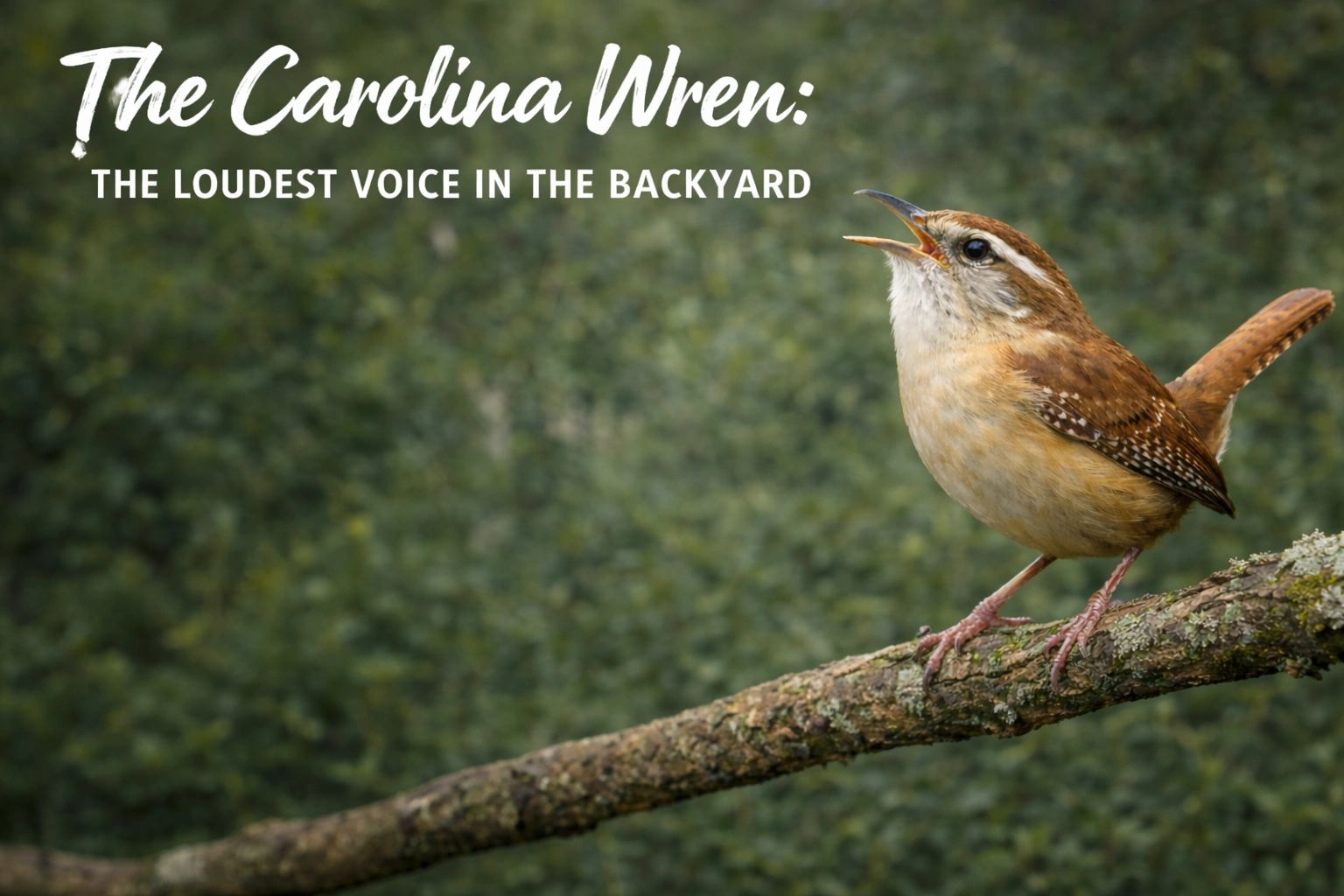
Its body is compact, covered in warm reddish-brown tones that blend almost perfectly with bark and leaves. Subtle barring lines its wings and tail, and a bold white stripe above its eye gives it a sharp, expressive look.
Its tail is often raised, angled upward as if the bird is always alert.
There is nothing about it that visually prepares you for the sound it produces.
And yet, once you hear it, you understand why it stands out.
A Song That Carries Farther Than Expected
The Carolina Wren’s song is one of the most recognizable sounds in the southeastern United States.
Clear phrases, repeated with precision, carry across space in a way that feels almost deliberate. Many people describe it as “tea-kettle, tea-kettle, tea-kettle,” but hearing it in your own yard gives it a different kind of meaning.
According to the Smithsonian Handbooks: Birds of North America (Eastern Region), the Carolina Wren produces one of the loudest songs relative to its body size of any North American bird.
And that becomes obvious almost immediately.
Its voice doesn’t stay close.
It fills the space.
A Bird That Refuses to Be Seasonal
What makes the Carolina Wren even more noticeable is that it doesn’t limit itself to a season.
Many birds grow quieter outside of breeding periods, their songs fading into occasional calls or disappearing altogether. The Carolina wren doesn’t follow that pattern.
It sings year-round.
Even when other birds quiet down, its voice remains. It continues to mark its presence, reinforcing its territory through sound.
In Florida, where conditions allow it to stay active all year, that consistency becomes part of the environment.
The sound doesn’t come and go.
It stays.
Living Closer Than You Think
Unlike many birds that keep their distance, the Carolina Wren lives close.
Very close.
It doesn’t just pass through your yard—it becomes part of it. It builds nests in places that bring it into everyday life: flowerpots, mailboxes, garage shelves, porch corners, and tucked-away spaces that feel protected.
Field guides, including Smithsonian references, often describe its nesting behavior as highly adaptable and opportunistic.
It uses what’s available.
And what’s available is often right next to you.
Movement That Never Really Stops
Watching a Carolina Wren is like watching energy in motion.
It hops quickly between surfaces, darts through low branches, and climbs through spaces that larger birds ignore. It moves with speed, but not without direction.
There is purpose behind everything it does.
It isn’t wandering.
It’s searching.
Feeding With Precision
That movement is tied to how it feeds.
The Carolina Wren spends much of its time foraging for insects and spiders, probing into small spaces with its slightly curved bill. It looks under leaves, along bark, and into crevices where other birds might not bother to search.
Smithsonian descriptions often note its thorough and methodical foraging behavior, and seeing it firsthand makes that easy to understand.
It doesn’t rush.
It investigates.
And it finds what others miss.
A Curious and Aware Bird
There is also something noticeably curious about the Carolina wren.
It doesn’t simply move through its environment—it engages with it.
It will approach, pause, observe, then shift again. There is a sense that it is constantly aware of what is happening around it.
It doesn’t feel reactive.
It feels intentional.
The Moment Merlin Changed Everything
What stayed with me most wasn’t just seeing the bird.
It was that first moment of recognition.
Before Merlin identified the call, the sound was just part of the background—noticeable, but undefined. After that moment, it became something specific.
Something I could follow.
Something I could recognize again and again.
And that changed everything.
Learning to Listen Differently
The Carolina Wren teaches you something simple but important.
To listen first.
Not everything reveals itself visually.
Some things exist just beneath awareness, waiting to be recognized through sound.
Once you start listening differently, the environment changes.
What once felt quiet becomes layered.
What once felt still becomes active.
A Constant Presence in the Yard
Over time, the Carolina Wren becomes familiar.
Its call repeats throughout the day.
Its movement becomes recognizable.
Its presence becomes expected.
But that familiarity doesn’t make it less interesting.
If anything, it makes it more meaningful.
Because it’s not a one-time moment.
It’s ongoing.
The Energy Behind the Silence
The Carolina Wren adds something unique to the yard.
Energy.
Movement.
Sound.
It fills the spaces between stillness, creating a sense of constant activity even when everything else seems quiet.
It doesn’t dominate visually.
But it defines the atmosphere.
Conclusion: The Voice That Was Always There
The Carolina Wren is not the biggest bird in the yard.
It is not the most colorful.
It is not the easiest to see.
But it is one of the most present.
Its voice carries across space.
Its movement fills the gaps between stillness.
Its presence remains, day after day, season after season.
And once you recognize it—once you connect that powerful sound to the small bird moving through the shadows—you realize something simple.
The yard was never quiet.
It was just waiting for you to listen.
Bibliography
Cornell Lab of Ornithology. All About Birds: Carolina Wren.
Smithsonian Institution. Smithsonian Handbooks: Birds of North America (Eastern Region).
National Audubon Society. Carolina Wren.
Sibley, David Allen. The Sibley Guide to Birds.
Florida Fish and Wildlife Conservation Commission. Florida Bird Species Information.
Originally published at the live site .