
Boats ·
The Catfish That Almost Sank the Boat
Introduction: When a Fish Becomes a Legend
By Rebecca "Madam Chronicler" Ryan
Introduction: When a Fish Becomes a Legend
Some fishing stories sound too wild to be true. You’ve heard them before—the one that got away, the monster beneath the surface, or the fish so big it pulled the fisherman right out of the boat. But every now and then, a story comes along that makes you pause and wonder if nature still has surprises we don’t fully understand. This is the story of a catfish so massive, so powerful, that it nearly sank a boat and etched itself into local legend.
Catfish are known to grow large, but what happens when one grows beyond all expectations? This blog takes you deep into the mysterious world of giant catfish, explores the science behind their unbelievable size and strength, and retells the legendary moment when one fish nearly capsized a boat. Buckle up, because this tale is equal parts biology, folklore, and human adventure.
Chapter One: Meeting the Giants of Freshwater
To understand the catfish that almost sank the boat, we first need to get to know its kind. Catfish are not just one species—they make up one of the largest families of freshwater fish on Earth, with more than 3,000 recognized species. They are found on nearly every continent, swimming in rivers, lakes, swamps, and even some coastal areas.
What makes catfish stand out is not just their size, but their adaptability. Some species are small enough to fit in the palm of your hand, while others can grow longer than a grown man and weigh several hundred pounds. They get their name from the long “whiskers,” or barbels, around their mouths, which help them sense food in murky waters. Unlike humans, they don’t rely heavily on eyesight; instead, they use touch, taste, and smell to navigate the dark underwater world.
The largest freshwater catfish in the world is the Mekong giant catfish (Pangasianodon gigas), which can grow up to 10 feet long and weigh more than 600 pounds. Then there’s the Wels catfish (Silurus glanis), common in Europe, known for reaching lengths of over 9 feet. In the United States, blue catfish (Ictalurus furcatus) and flathead catfish (Pylodictis olivaris) are the true river monsters, capable of tipping the scales at over 100 pounds. These aren’t the fish you fry up for dinner—they’re powerful animals that can wrestle with a fisherman and win.
Chapter Two: The Setting—A River That Hides Monsters
The story of the catfish that nearly sank the boat begins on a wide, winding river. Locals knew it well—muddy waters that carried both beauty and danger. Rivers like this are perfect for catfish: deep holes, fallen trees, slow-moving currents, and a buffet of smaller fish. Over decades, maybe even centuries, these waters nurtured catfish into giants.
Fishermen had long whispered about “river monsters.” Some told stories of fish so big they could swallow a dog. Others claimed old divers saw catfish lurking near dam walls, bigger than a man, their mouths wide enough to engulf a basketball. While some tales were dismissed as fisherman’s exaggerations, science backs up the possibility. Catfish truly can reach sizes that boggle the imagination.
Chapter Three: The Day It Happened
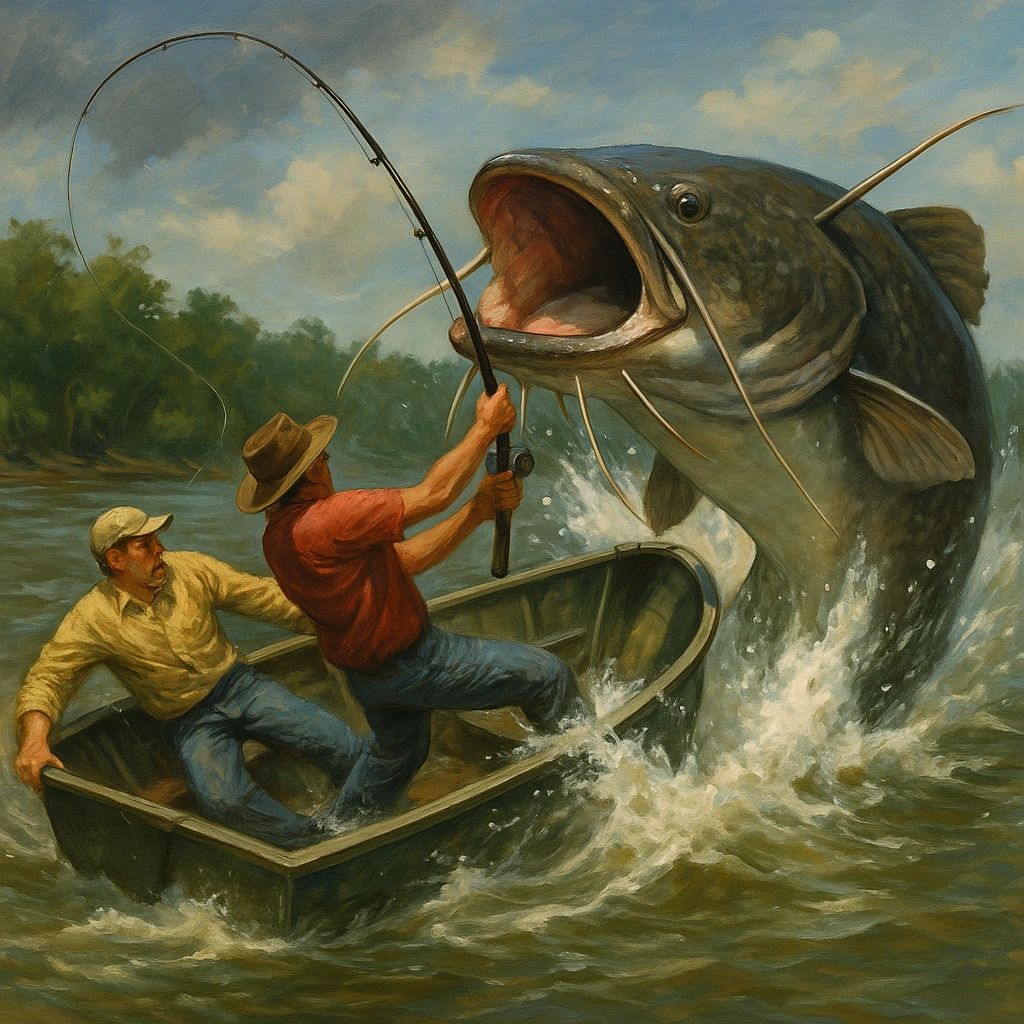
It was a hot summer afternoon, the kind where the air itself seemed heavy. A small aluminum boat floated in the middle of the river. Two men sat inside—seasoned fishermen, not easily startled. They had caught catfish before, even some weighing over 50 pounds. But that day, they were after something bigger.
Their bait was set: a slab of cut fish on a thick, heavy-duty line. Catfish are bottom-feeders, so the bait sank deep into the shadows. For an hour, the boat drifted slowly, the men waiting in silence. Then it happened—the line went tight with a suddenness that jolted the rod like it had been hooked to a truck.
One man grabbed the pole, bracing himself. The rod bent in a perfect arch, the reel screaming as line ripped off at lightning speed. The boat shook. “That’s no ordinary fish,” he muttered. Whatever was down there was strong enough to drag the entire boat against the current.
For nearly twenty minutes, they fought. The fisherman pulled back with all his strength, only for the fish to surge forward again, tugging the boat dangerously close to the riverbank. At one point, the boat tilted as if about to capsize. Water splashed over the side. The men yelled, trying to balance, their hearts pounding as if they were in a battle for survival.
Finally, the fish surfaced. What they saw was unbelievable—a catfish so huge it looked like a shadow with fins. Its head alone was the size of a truck tire, its whiskers thrashing in the air. It rolled once, creating a wave that rocked the boat violently. Then, with a final surge of strength, it snapped the line and disappeared into the depths.
Silence. Only the sound of the river remained. The boat rocked gently, as if mocking them. They hadn’t landed the fish, but they had seen it—and it had almost sunk them.
Chapter Four: Why Catfish Grow So Big
So how can catfish reach such monstrous sizes? The answer lies in biology and environment.
- Longevity Many catfish species live a long time. Blue catfish, for example, can live over 25 years. The longer they live, the more they grow. Unlike humans, many fish never stop growing; they just slow down with age. That means the oldest catfish are often the biggest.
- Abundant Food Catfish aren’t picky eaters. They feed on insects, crustaceans, fish, and sometimes even small mammals or birds. In rivers rich with food, a catfish has everything it needs to bulk up.
- Low Predation Once catfish reach a certain size, few predators can challenge them. That gives them the freedom to grow without much threat—except from humans.
- Adaptability Catfish thrive in murky, low-oxygen environments where many fish would struggle. Their ability to breathe through specialized structures helps them survive in waters that might suffocate others.
Chapter Five: Science Meets Myth
When stories like “the catfish that almost sank the boat” spread, skeptics often roll their eyes. But science has shown that giant catfish really do exist. In 2005, researchers confirmed a record-breaking Mekong giant catfish in Thailand that weighed 646 pounds. In 2011, a fisherman in Italy landed a Wels catfish over 8 feet long. In the U.S., the record for the largest blue catfish caught stands at 143 pounds, hauled in from Kerr Lake, Virginia.
Folklore and science often overlap. Divers near European dams have told tales of Wels catfish so large they swallowed ducks and pigeons whole. In the American South, old stories claim divers working on bridges encountered catfish “the size of Volkswagens.” While some exaggeration is likely, the biology of catfish makes it possible for them to reach sizes that fuel these legends.
Chapter Six: Human Encounters with River Monsters
The fishermen who almost lost their boat are not alone. Across the world, others have had similar encounters.
- The Italian River Beast: In 2015, anglers in the Po River hooked a Wels catfish weighing 280 pounds. It was so strong it dragged the fishermen downstream for over an hour before they finally landed it.
- American Giants: In states like Alabama and Missouri, flathead and blue catfish regularly grow over 100 pounds. Catching one often requires teamwork, patience, and gear strong enough to handle a creature that fights like a bear underwater.
- Asia’s Ancient Giants: In the Mekong River, local communities revere the giant catfish as sacred. For centuries, fishermen told stories of fish as long as canoes. Today, science has confirmed that these legends are rooted in truth.
These encounters remind us that humans don’t fully control nature. Sometimes, it’s the fish that’s in charge.
Chapter Seven: When the Boat Almost Sank—Retelling the Legend
Let’s revisit that fateful day. The fishermen, still shaken, told their story at the dock. Soon, word spread. Some laughed, others nodded knowingly. The river had always held secrets, and now it had a new one: the catfish that almost sank the boat.
For weeks afterward, other fishermen went out, hoping to meet the monster themselves. Some claimed they hooked something big, only to lose it. Others said they saw shadows moving under the water, larger than any fish should be. Whether it was the same catfish or a family of giants, no one could be sure.
What made the story stick wasn’t just the size of the fish, but the way it turned the tables. The hunters became the hunted. The boat—the very symbol of safety—was nearly overturned by a creature most people think of as harmless bottom-feeders.
Chapter Eight: Lessons from the Deep
So what does this story teach us?
- Respect for Nature The river is not a playground; it’s a wild ecosystem where humans are just visitors. The catfish reminds us that even in familiar waters, mysteries remain.
- Conservation Matters Many giant catfish species are endangered. The Mekong giant catfish, for example, is critically endangered due to overfishing and habitat loss. If we want future generations to have their own “monster fish” stories, protecting rivers is essential.
- The Value of Storytelling Legends like the catfish that almost sank the boat connect people to nature in a personal way. They inspire awe, curiosity, and sometimes fear—all emotions that keep us engaged with the natural world.
Conclusion: The One That Got Away
Every fisherman has a story about “the one that got away.” But few can say their fish nearly sank the boat. Whether you believe every detail or not, the story serves a bigger purpose. It reminds us that rivers still hide giants, that nature still holds surprises, and that sometimes, the line between myth and reality is as thin as a fishing line stretched to its breaking point.
So, next time you’re out on the water, think about what lurks beneath. Maybe you’ll catch a catfish big enough to brag about—or maybe, just maybe, you’ll meet the river monster yourself.
Bibliography
- Carlander, K. D. (1969). Handbook of freshwater fishery biology: Volume one. Iowa State University Press.
- Hogan, Z. S. (2011). Review of the status of the Mekong giant catfish (Pangasianodon gigas). Environmental Biology of Fishes, 91(4), 479–483. https://doi.org/10.1007/s10641-011-9803-5
- Graham, K., & DeiSanti, C. (1999). The population and fishery of blue catfish in the lower Missouri River. North American Journal of Fisheries Management, 19(2), 451–462.
- Hensel, K., & Holčík, J. (1997). Past and current status of the Wels catfish (Silurus glanis) in the Danube River. Environmental Biology of Fishes, 48(2), 143–148.
- Jackson, D. C. (1999). Flathead catfish: Biology, fisheries, and management. American Fisheries Society Symposium, 24, 23–35.
Hogan, Z. S., Moyle, P. B., May, B., Vander Zanden, M. J., & Baird, I. G. (2004). The imperiled giants of the Mekong. American Scientist, 92(3), 228–237.
Originally published at the live site .