
Stories ·
The Common Grackle: The Iridescent Shadow in Plain Sight
After the short, nasal calls of the Fish Crow faded into the background, another sound began to emerge—one that felt sharper, stranger, and harder to define.
By Rebecca "Madam Chronicler" Ryan
After the short, nasal calls of the Fish Crow faded into the background, another sound began to emerge—one that felt sharper, stranger, and harder to define.
It wasn’t a song.
It wasn’t even a single sound.
It was a mix of clicks, whistles, and metallic notes that seemed to shift from one moment to the next, like something being tuned or tested rather than performed.
At first, it felt out of place.
Then Merlin identified it.
Common Grackle.
A Sound That Feels Mechanical
Of all the birds that morning, the Common Grackle had one of the most unusual voices.
Its call doesn’t follow the familiar patterns of melody or repetition. Instead, it feels almost experimental, as though the bird is trying out different sounds rather than committing to a single one.
Some calls resemble sharp clicks. Others stretch into longer, creaking notes. Occasionally, there are whistles that rise and fall unexpectedly.
Listening to it, there is a sense that the sound doesn’t belong to nature in the traditional way people expect. It feels closer to something mechanical, something artificial.
And yet, once you recognize it, you begin to hear it everywhere.
A Bird That Changes in the Light
Not long after hearing its call, I spotted it.
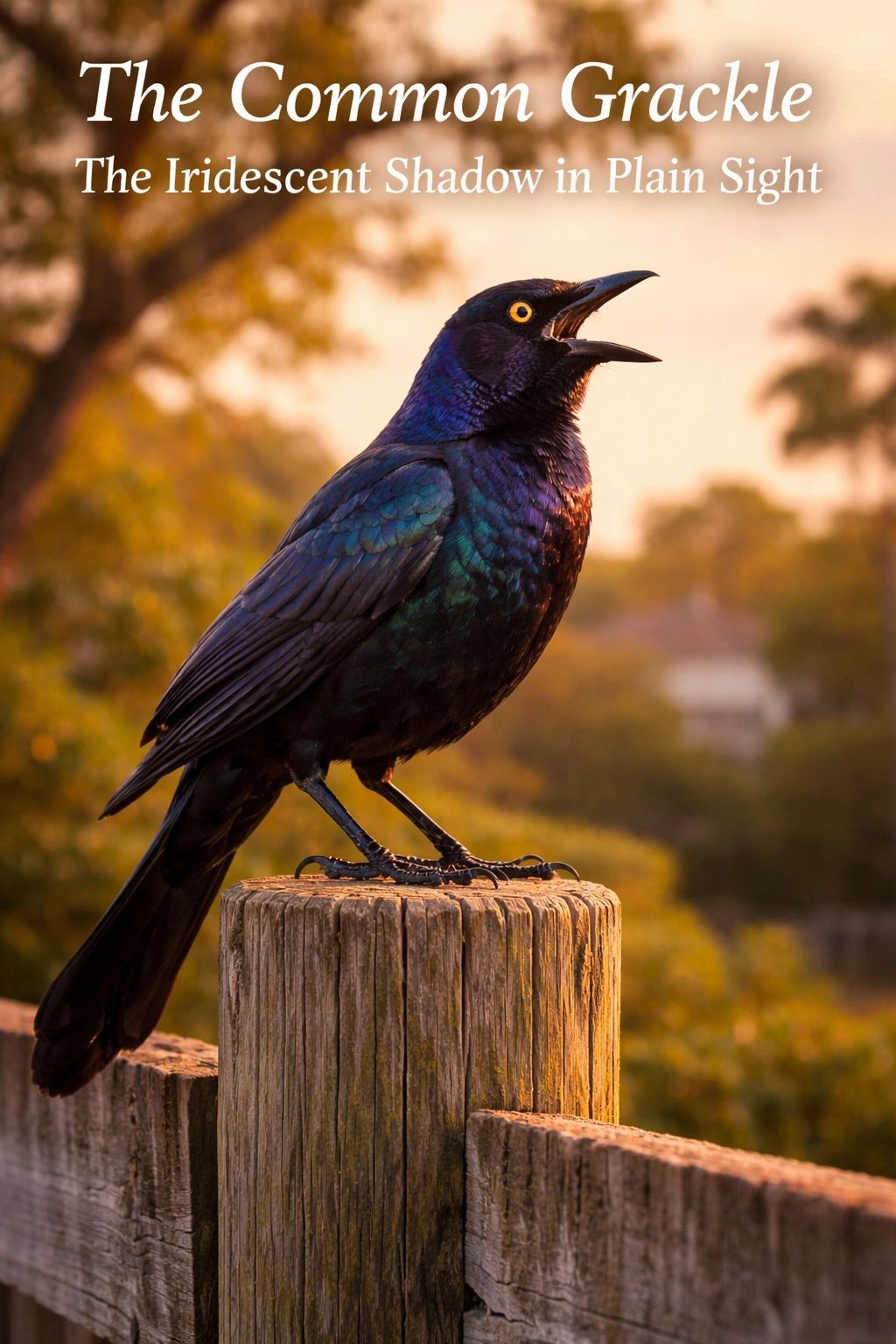
At first, it looked like just another dark bird perched among the branches. But as the light shifted, its feathers revealed something more.
Hints of blue.
Flashes of purple.
A subtle green sheen that appeared and disappeared depending on the angle.
The Common Grackle is not truly black. Its feathers are iridescent, reflecting light in ways that transform its appearance moment by moment.
In direct sunlight, it can seem almost luminous. In shadow, it fades back into a dark silhouette, easy to overlook.
This shifting appearance gives the bird a kind of dual identity—visible and hidden at the same time.
The Eyes That Stand Out
One of the most striking features of the Common Grackle is its eyes.
Bright, pale yellow, they contrast sharply with the dark feathers surrounding them. The effect is almost intense, giving the bird a focused, watchful expression.
When a grackle looks in your direction, it feels as though it is studying you as much as you are studying it.
There is an awareness there, a sense of calculation that adds to the bird’s presence.
A Life Between Worlds
Unlike the Boat-Tailed Grackle, which is closely tied to coastal environments, the Common Grackle moves more freely between different habitats.
It can be found in open fields, suburban neighborhoods, parks, and even parking lots.
It is as comfortable in a grassy lawn as it is perched on a power line.
This adaptability allows it to exist in spaces where natural and human environments overlap. It thrives in the in-between areas, where change is constant and opportunities are everywhere.
Feeding and Movement
Watching a Common Grackle on the ground, there is a sense of intention in its movements.
It walks rather than hops, its steps measured and steady. It pauses often, scanning the ground before making quick, decisive movements to pick up food.
Its diet is varied, including insects, seeds, grains, small animals, and even scraps left behind by people.
This flexibility makes it a successful species, capable of surviving in a wide range of conditions.
The Power of Numbers
Common Grackles are rarely alone.
They often gather in large groups, especially outside of breeding season. These flocks can grow to impressive sizes, filling trees and open spaces with movement and sound.
When they move together, the effect is striking.
The sky fills with shifting shapes, the birds turning in unison as they change direction. Their calls overlap, creating a constant, layered noise that feels almost overwhelming.
These gatherings are not random.
They provide safety, increasing awareness of predators and improving access to food. They also reflect the social nature of the species, a reminder that even birds that seem solitary are often part of larger networks.
A Bird Often Misunderstood
Despite their adaptability and presence, Common Grackles are not always appreciated.
Their large flocks, loud calls, and bold behavior can make them seem intrusive. They are sometimes seen as pests, especially in areas where they gather in large numbers.
But this perspective overlooks the role they play in the ecosystem.
Grackles help control insect populations. They contribute to seed dispersal. They are part of the balance that keeps environments functioning.
Like many adaptable species, they succeed because they take advantage of opportunities. In doing so, they reflect the changes happening in the environments they inhabit.
Returning to That Morning
Standing in the backyard, listening as Merlin identified bird after bird, the Common Grackle felt like a presence that was both familiar and unexpected.
It wasn’t as visually striking as the cardinal, nor as vocally complex as the mockingbird.
But it had its own kind of impact.
Its call added a different texture to the morning, something sharper and less predictable. Its appearance shifted with the light, revealing details that were easy to miss at first glance.
It was a reminder that even birds we think we understand can still surprise us.
The Beauty in Subtlety
The Common Grackle does not rely on obvious beauty.
It does not have bright colors that stand out immediately. It does not sing in a way that feels traditionally pleasing.
Instead, its appeal lies in the details.
The way its feathers catch the light.
The intensity of its gaze.
The complexity of its behavior.
These are the kinds of qualities that only become visible when you take the time to look closely.
More Than Just Background Noise
Like the Fish Crow, the Common Grackle is easy to overlook.
Its presence becomes part of the background, something that blends into the daily rhythm of the environment.
But when you focus on it—when you isolate its call, watch its movements, and notice its details—it becomes something else entirely.
It becomes a subject.
A story.
A piece of the larger system that connects everything in the environment.
Conclusion: A Bird That Reveals Itself Slowly
That morning, the Common Grackle did not demand attention in the same way as some of the other birds.
It did not stand out immediately.
But over time, as I listened and watched more closely, it revealed itself in layers.
Its voice, strange and mechanical at first, became recognizable.
Its appearance, dark and simple at a glance, became complex and reflective.
Its behavior, subtle and steady, became intentional and purposeful.
The Common Grackle is not a bird that reveals everything at once.
It is a bird that rewards attention.
And once you begin to notice it, you realize it has been there all along, waiting to be seen.
Bibliography
Cornell Lab of Ornithology. All About Birds: Common Grackle.
Cornell Lab of Ornithology. Merlin Bird ID App. Cornell University.
National Audubon Society. Common Grackle.
Sibley, David Allen. The Sibley Guide to Birds. Alfred A. Knopf.
Florida Fish and Wildlife Conservation Commission. Florida Bird Species Information.
Originally published at the live site .