
Maritime ·
The Fish Crow: The Overlooked Voice Along Florida’s Waterways
After the distant, sharp whistle of the Greater Yellowlegs faded into the background, another sound emerged—closer this time, but somehow harder to place.
By Rebecca "Madam Chronicler" Ryan
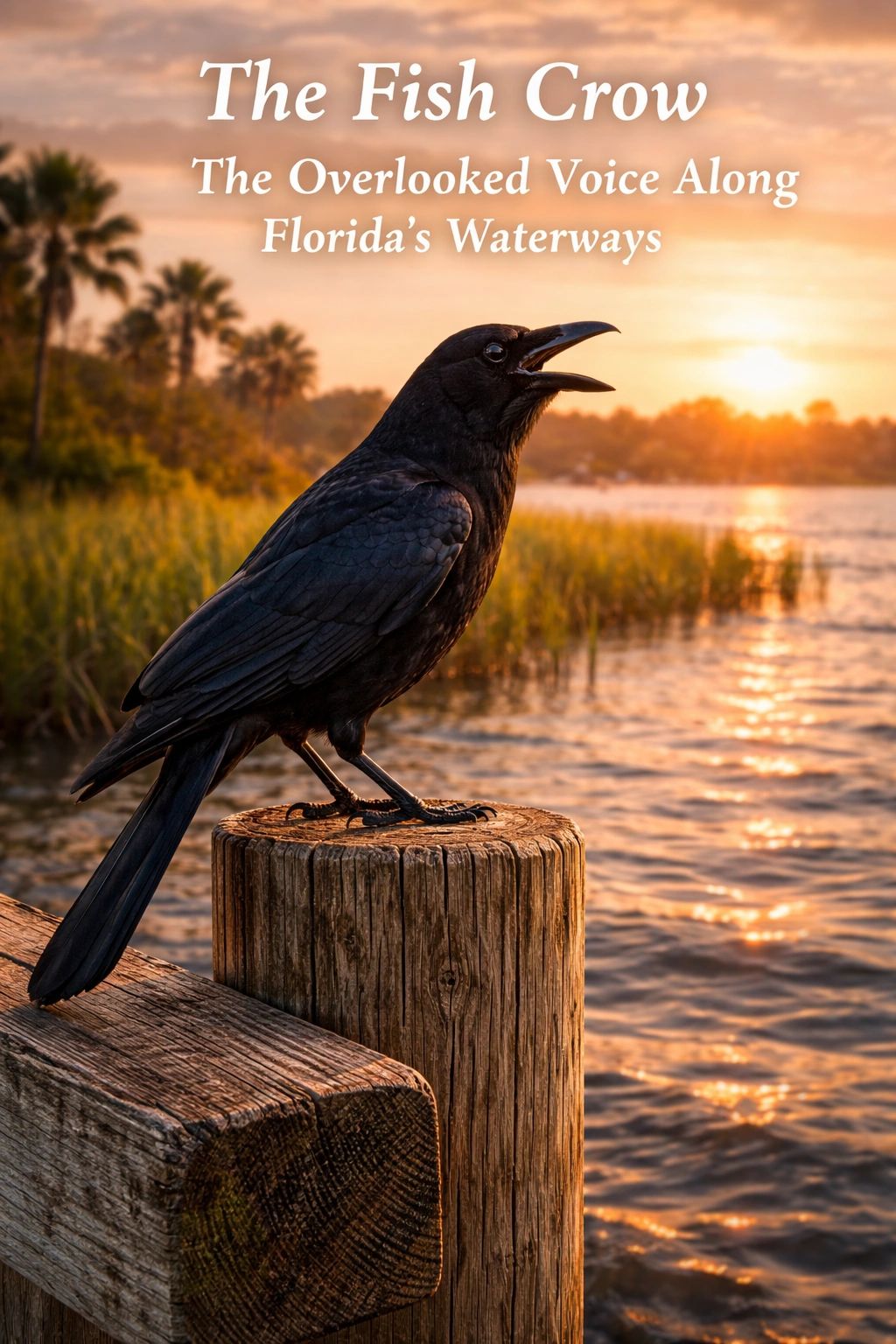
After the distant, sharp whistle of the Greater Yellowlegs faded into the background, another sound emerged—closer this time, but somehow harder to place.
It was brief.
Almost abrupt.
A short, nasal call that didn’t quite match the familiar “caw” most people associate with crows.
At first, it was easy to dismiss. It sounded like it could belong to any number of birds moving through the trees. But when it repeated, there was something distinct about it. Something slightly off from what I expected.
I glanced down at the Merlin Bird ID app.
Fish Crow.
A Familiar Bird That Sounds Different
At a glance, the Fish Crow looks almost identical to the American Crow.
It has the same dark plumage, the same shape, the same steady presence. If you saw one perched in a tree or flying overhead, there’s a good chance you wouldn’t think twice about it.
But the difference becomes obvious the moment it calls.
Instead of the classic “caw,” the Fish Crow produces a shorter, more nasal sound. Many people describe it as an “uh-uh” or a clipped, almost questioning note.
It’s subtle, but once you hear it, you realize you’ve probably been hearing it all along without recognizing it.
A Bird of the Water’s Edge
The name “Fish Crow” is not accidental.
Unlike its more widespread relative, this species is closely tied to water. It thrives near rivers, estuaries, marshes, and coastal areas, making it a common presence along Florida’s waterways.
Living near the Indian River Lagoon, it makes perfect sense that Merlin picked it up.
These birds move easily between natural habitats and developed areas, often appearing near docks, shorelines, and neighborhoods close to water.
Their presence feels connected to the movement of the environment itself, as if they follow the flow of tides and activity along the coast.
Intelligence in Motion
Like other members of the crow family, Fish Crows are highly intelligent.
Watching one move through its environment, there is a sense of awareness in everything it does. It doesn’t wander aimlessly. It observes, evaluates, and acts with purpose.
Crows are known for their problem-solving abilities, and Fish Crows are no exception. They learn quickly, adapting their behavior based on experience.
They remember where food can be found. They recognize patterns. They respond to changes in their environment in ways that suggest a level of understanding beyond simple instinct.
This intelligence is part of what allows them to thrive in both natural and human-influenced settings.
Feeding Along the Shore
Fish Crows are opportunistic feeders, taking advantage of whatever resources are available.
Near water, they feed on fish, shellfish, insects, and small animals. They may forage along the shoreline, picking through debris or scanning the surface for movement.
In areas influenced by human activity, their diet expands. They will eat scraps, discarded food, and anything else that offers an easy meal.
This flexibility allows them to survive in a wide range of conditions, from quiet wetlands to busy coastal towns.
A Social and Vocal Species
Fish Crows are rarely silent for long.
They often travel in small groups, calling back and forth as they move through an area. Their voices create a steady background presence, especially near water where sound carries easily.
Unlike the melodic songs of other birds, their calls are more direct.
They are not designed to be musical. They are functional, meant to communicate quickly and clearly.
Listening to them, there is a sense of constant interaction, as if each call is part of an ongoing conversation.
Blending Into the Background
Despite their intelligence and activity, Fish Crows are often overlooked.
Part of this is because they resemble American Crows so closely. Without paying attention to the sound, it is easy to assume they are the same species.
But another reason is their familiarity.
Crows, in general, are so common that they become part of the background. They are seen and heard so often that they are no longer considered remarkable.
And yet, when you take the time to notice the differences, a new layer of understanding emerges.
The Fish Crow is not just another crow.
It is a species shaped by its environment, adapted to life along the water, and defined by a voice that sets it apart.
Returning to That Morning
Standing in the backyard, listening as Merlin identified bird after bird, the Fish Crow felt like a bridge between spaces.
It wasn’t as distant as the Greater Yellowlegs, whose call carried from beyond the yard. But it also wasn’t as tied to the immediate surroundings as the cardinal or mockingbird.
It existed somewhere in between.
Its call connected the backyard to the nearby water, to the shoreline, to the larger system of habitats that define the area.
It was a reminder that even birds that seem ordinary are part of something much broader.
A Different Kind of Presence
The Fish Crow does not rely on bright colors or complex songs to stand out.
Its presence is quieter, more subtle.
It blends into the environment visually, but its voice gives it away. Once you learn to recognize that sound, it becomes a marker of place.
Hearing it means you are near water.
It becomes part of the identity of the landscape, just as much as the sound of waves or wind moving through the trees.
More Than Just Another Crow
It is easy to overlook birds that seem familiar.
But the Fish Crow shows how much can be missed when we don’t pay attention to the details.
A slight difference in sound.
A shift in habitat.
A pattern of behavior that reveals a deeper connection to the environment.
These small distinctions add up to something significant.
They transform a bird from something ordinary into something worth noticing.
Conclusion: Listening for the Difference
That morning, the Fish Crow was not the loudest or the most striking bird identified by Merlin.
But it was one of the most revealing.
Its call challenged what I thought I knew. It showed that even something as familiar as a crow could hold unexpected differences.
It reminded me that understanding the natural world often comes down to listening more carefully.
Because sometimes, the most important discoveries are not about what is new.
They are about seeing—or hearing—what has been there all along.
Bibliography
Cornell Lab of Ornithology. All About Birds: Fish Crow.
Cornell Lab of Ornithology. Merlin Bird ID App. Cornell University.
National Audubon Society. Fish Crow.
Sibley, David Allen. The Sibley Guide to Birds. Alfred A. Knopf.
Florida Fish and Wildlife Conservation Commission. Florida Bird Species Information.
Originally published at the live site .