
Maritime ·
The Killdeer: The Bird That Pretends to Be Injured
Some birds hide when you get too close.
By Rebecca "Madam Chronicler" Ryan
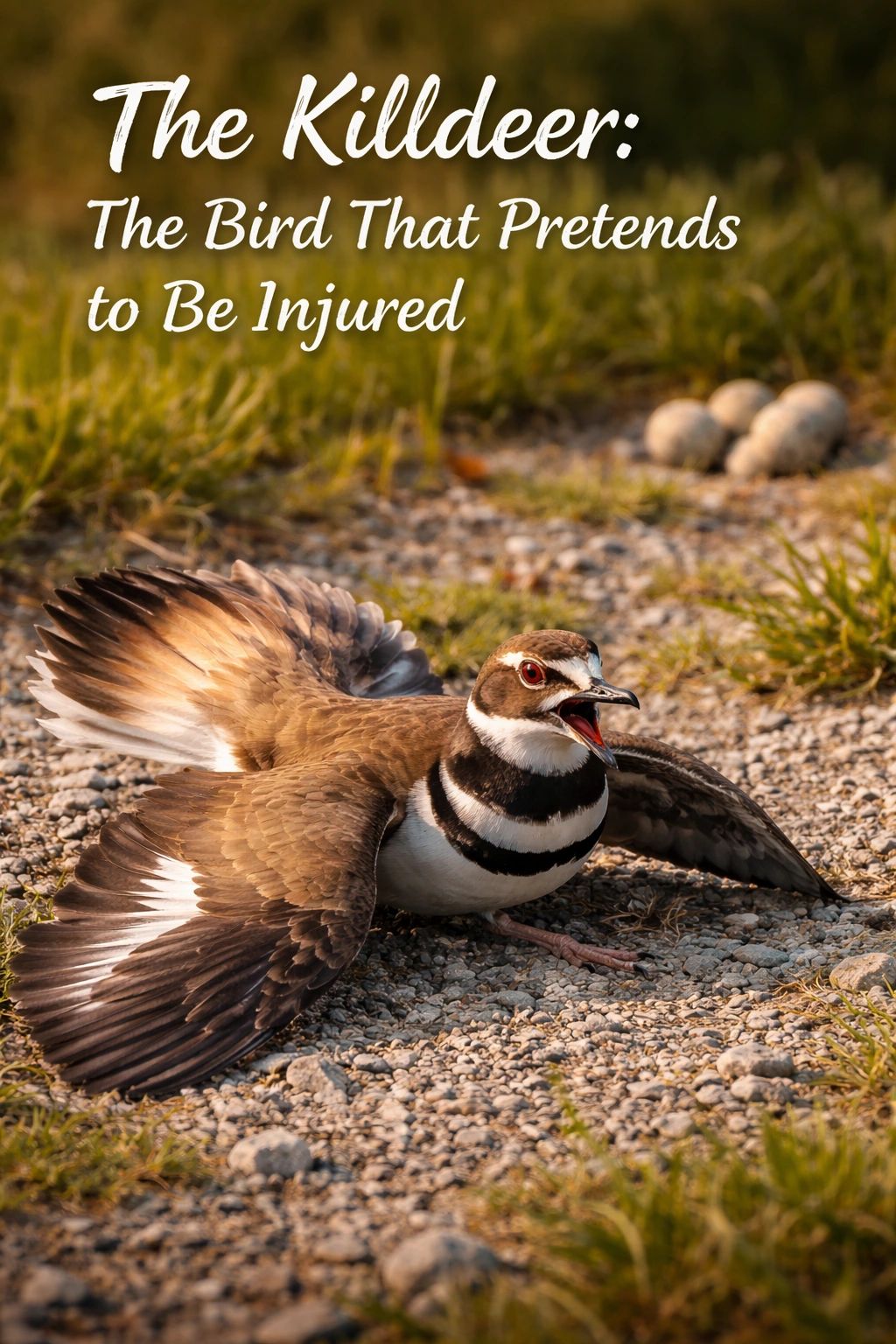
Some birds hide when you get too close.
Some fly away.
Some disappear before you even realize they were there.
But the killdeer does something completely different.
It stays.
And then it does something you don’t expect.
A Sound That Feels Urgent
The first time I noticed it, it wasn’t because I saw anything unusual.
It was the sound.
Sharp.
Loud.
Repeated over and over again in a way that didn’t feel calm or casual. It wasn’t like the soft coo of a mourning dove or the steady rhythm of a wren. This sound felt urgent, almost like a warning that hadn’t yet been understood.
“Kill-deer… kill-deer… kill-deer…”
The call carried across the open space, cutting through everything else around it. It didn’t blend into the background. It demanded attention.
I stopped and listened.
Then I opened the Merlin Bird ID app and let it do the same.
Within seconds, it confirmed it.
Killdeer.
And even before I saw the bird, the name felt familiar—because I had already heard it.
Looking in the Wrong Place
At first, I did what I had done with every other bird.
I looked up.
Into the trees.
Along fence lines.
Toward rooftops and branches where birds usually settle.
But there was nothing there.
The sound continued, just as loud, just as urgent, but it wasn’t coming from above.
It was coming from the ground.
A Bird That Blends Into the Earth
When I finally saw it, it didn’t stand out at first.
In fact, it almost disappeared.
The killdeer stood in an open patch of ground, its colors blending almost perfectly with the dirt and grass around it. Browns, tans, soft contrasts that didn’t draw attention unless you were already looking for it.
Its body was slim.
Its legs long.
Its posture upright in a way that felt alert but not exaggerated.
But what stood out most were the markings.
Two bold black bands across its chest.
A white underside.
And a face marked with sharp contrast that gave it a focused, almost intense expression.
It wasn’t flashy.
But it was precise.
A Behavior That Doesn’t Make Sense
At first, the bird didn’t move much.
It stood there, watching.
Then, suddenly, everything changed.
It began to run—not fly—just run across the ground in quick, uneven bursts. Then it stopped, turned, and made a sound again, louder this time, more insistent.
And then it did something that didn’t make sense.
It dropped one wing.
Dragging it along the ground as if it were broken.
It stumbled forward, uneven, awkward, completely different from the alert bird I had just seen moments before.
For a second, it looked injured.
And that was the point.
The Broken Wing Act
This is what the killdeer is known for.
The “broken wing” display.
According to the Smithsonian Handbooks: Birds of North America (Eastern Region), the killdeer performs this behavior as a defense mechanism, designed to distract predators away from its nest.
It doesn’t attack.
It doesn’t flee.
It pretends.
It creates a moment that feels urgent, convincing enough to draw attention away from what actually matters.
And standing there, watching it happen in real time, it was surprisingly effective.
Even knowing what it was doing, it was hard not to follow it.
What It Was Protecting
The reason for the behavior became clear once I looked more closely at the ground.
That’s where the nest was.
Or more accurately, where it almost wasn’t.
Killdeer don’t build elaborate nests. They don’t hide them in trees or tuck them into dense cover. Instead, they create shallow scrapes in the ground, often in open areas where you wouldn’t expect anything to be.
Gravel.
Dirt.
Open patches of land.
The eggs blend in perfectly—speckled, camouflaged, nearly invisible unless you know exactly what you’re looking for.
Without the distraction, it would be easy to step right past them.
Or worse, not notice them at all.
A Strategy Built on Misdirection
What makes the killdeer so fascinating isn’t just the behavior itself.
It’s how effective it is.
The bird doesn’t rely on strength or speed.
It relies on perception.
It changes the focus of the moment, pulling attention away from the nest and toward itself. It becomes the problem, the distraction, the thing that feels urgent.
And once you follow it, once you move away from the nest, the act stops.
The wing lifts.
The posture changes.
And the bird returns to normal, as if nothing had happened.
A Life on Open Ground
Unlike many birds that rely on trees or water, the killdeer lives out in the open.
Fields.
Lawns.
Parking lots.
Gravel areas.
Places that feel exposed rather than protected.
At first, that seems like a disadvantage.
But its camouflage and behavior turn that exposure into something else.
A strategy.
According to Smithsonian references, killdeer have adapted to these environments, using visibility and distraction rather than concealment to protect their nests.
And once you see it, it makes sense.
Movement That Matches the Space
Watching the killdeer move, there is a rhythm to it.
It runs in short bursts.
Stops.
Tilts its head slightly.
Then runs again.
This stop-and-go movement gives it a kind of alert presence, as if it is constantly evaluating its surroundings.
It doesn’t stay still for long.
And yet, it never feels rushed.
A Voice That Matches Its Behavior
The call of the killdeer is as distinctive as its behavior.
Loud.
Sharp.
Repeated.
It carries across open spaces in a way that makes it easy to locate, even when the bird itself blends into the ground.
Field guides often describe its call as a clear “kill-deer,” which is where the bird gets its name.
And hearing it in person, it’s hard to mistake.
It sounds exactly like what it is.
The Moment Merlin Made It Clear
Like the other birds in this series, everything started with that moment of recognition.
Before Merlin, the sound felt urgent but unclear.
After Merlin, it had context.
The call wasn’t random.
The behavior wasn’t strange.
It was purposeful.
And that understanding changed how I saw the entire interaction.
A Different Kind of Awareness
The killdeer doesn’t just change what you see.
It changes how you move.
Once you realize how easily its nest can be missed, you start paying more attention to the ground beneath you. Open spaces don’t feel empty anymore.
They feel active.
Alive with things that are easy to overlook.
A Bird That Teaches You to Look Twice
What makes the killdeer stand out isn’t just its call or its behavior.
It’s what it teaches you.
To slow down.
To look more carefully.
To question what you think you’re seeing.
Because sometimes, what looks like an injured bird is something else entirely.
Something intentional.
Conclusion: The Illusion That Protects Life
The killdeer is not the most colorful bird.
It is not the quietest.
It is not the easiest to overlook once you hear it.
But it is one of the most clever.
It survives not by hiding completely, but by controlling attention.
It creates an illusion.
A moment that feels real enough to follow.
And once you understand it—once you see past the act—you realize something simple.
Not everything is what it appears to be.
Sometimes, what looks like weakness is actually strategy.
And sometimes, the most important things are the ones hidden in plain sight.
Bibliography
Cornell Lab of Ornithology. All About Birds: Killdeer.
Smithsonian Institution. Smithsonian Handbooks: Birds of North America (Eastern Region).
National Audubon Society. Killdeer.
Sibley, David Allen. The Sibley Guide to Birds.
Florida Fish and Wildlife Conservation Commission. Florida Bird Species Information.
Originally published at the live site .