
Maritime ·
The Mourning Dove: The Sound That Slows Everything Down
Not every bird announces itself.
By Rebecca "Madam Chronicler" Ryan
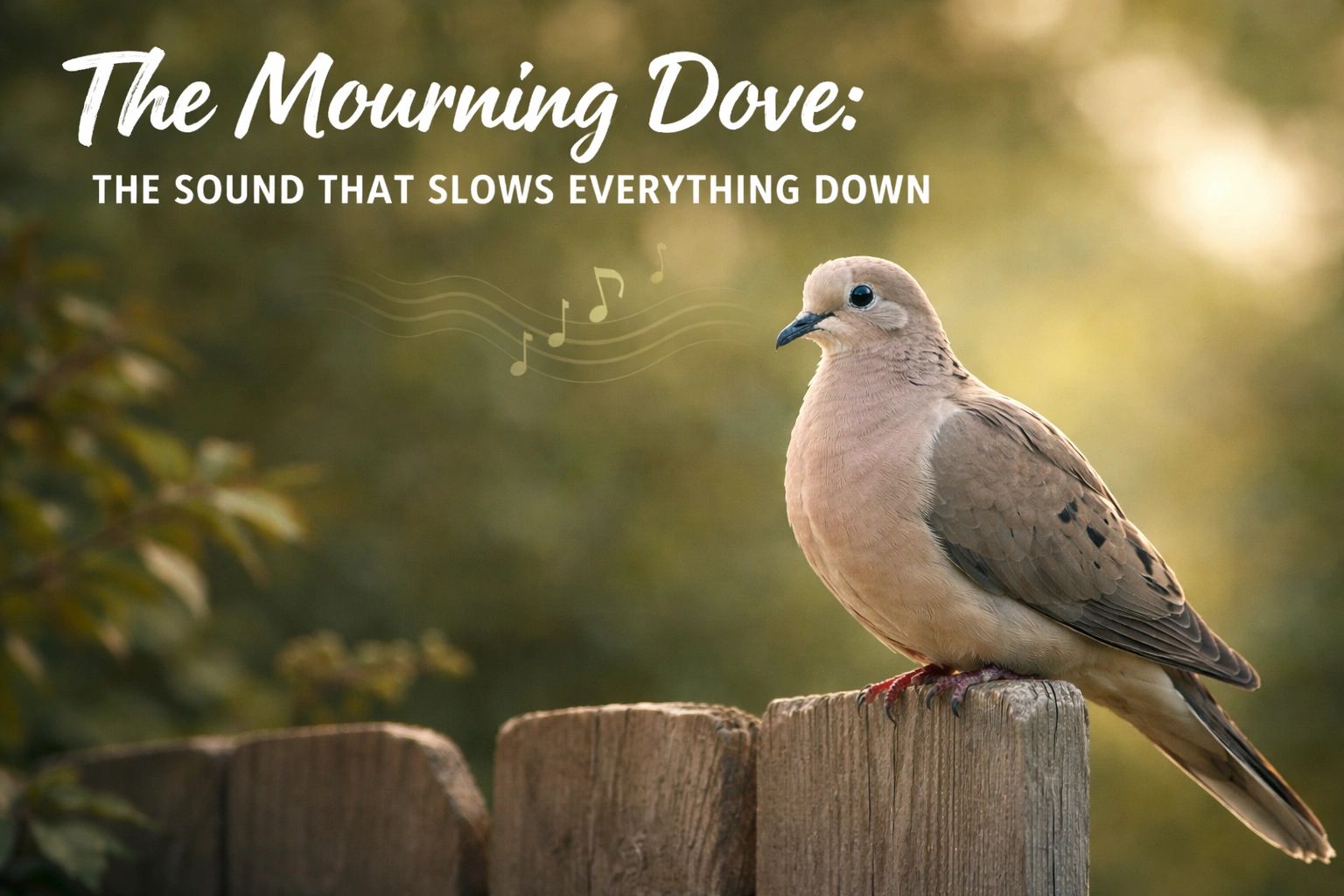
Not every bird announces itself.
Some don’t need to.
Some don’t cut through the air with sharp calls or bright flashes of color. They don’t demand attention or compete for space. Instead, they settle into the background so completely that you almost forget they’re there at all.
Until something shifts.
Until you finally notice.
The mourning dove is one of those birds.
A Sound That Changes the Moment
The first time I really noticed it, I wasn’t looking for anything.
I had stepped outside expecting the usual rhythm of the yard—the quiet that isn’t really quiet, just a blend of wind, distant movement, and familiar sounds that fade together when you stop paying attention.
But that day, something stood apart.
It wasn’t loud.
It wasn’t sharp.
It didn’t interrupt the moment so much as reshape it.
A soft, low call drifted across the yard, drawn out and steady, repeating in a way that felt almost echo-like. It lingered just long enough to make you pause, even if you didn’t realize why.
At first, it didn’t feel like a bird at all.
It felt like part of the atmosphere.
Still, something about it stood out just enough that I reached for my phone and opened the Merlin Bird ID app, letting it listen.
Within seconds, it gave the answer.
Mourning Dove.
And once I saw the name, the sound changed.
Recognizing What Was Always There
That was the moment everything clicked.
Not because the sound was new, but because it wasn’t.
I had heard it before—countless times, most likely. It had been part of early mornings, quiet afternoons, and moments where I hadn’t been paying attention at all.
It had always been there.
I just hadn’t noticed it.
But now that it had a name, it stood out in a completely different way. What had once blended into the background now felt distinct, almost intentional.
It wasn’t just sound anymore.
It was presence.
Finding the Bird Behind the Sound
Unlike some of the other birds I had been writing about, the mourning dove didn’t hide.
Once I knew what I was looking for, it wasn’t difficult to find.
It wasn’t tucked into shrubs like the Carolina wren or moving unpredictably like a blue jay. Instead, it sat out in the open, as if it had no reason to conceal itself at all.
Perched along a fence.
Resting on a power line.
Balanced quietly on the edge of a roof.
When I finally spotted one, it wasn’t moving much at all. It was simply there, still and composed, as if it had been watching the space long before I started paying attention.
A Bird of Quiet Detail
At first glance, the mourning dove doesn’t seem like a bird that would draw attention.
Its coloring is soft—muted shades of gray and tan that blend easily into the surroundings. There are no bold contrasts or bright flashes that immediately stand out.
But the longer you look, the more you notice.
A faint pink tone across the chest.
Small black spots scattered along the wings.
A subtle blue ring around the eye.
Its body is slender, almost streamlined, with a long, tapered tail that becomes especially noticeable when it takes flight.
Nothing about it is loud or dramatic.
And that feels consistent with everything else about the bird.
A Voice That Carries Without Urgency
The mourning dove’s call is one of the most recognizable sounds in North America, but it doesn’t feel like it’s trying to be recognized.
It doesn’t push itself forward.
It doesn’t compete.
Instead, it repeats gently, its low, drawn-out coos creating a rhythm that feels steady rather than demanding.
Field guides, including the Smithsonian Handbooks: Birds of North America (Eastern Region), describe the sound as melancholic, and it’s easy to understand why.
There’s something reflective about it.
Not necessarily sad, but quiet in a way that invites you to slow down.
To listen.
To stay in the moment a little longer than you might have otherwise.
Stillness That Defines the Space
What stands out just as much as the sound is the bird’s stillness.
While other birds move constantly—darting, hopping, reacting—the mourning dove often remains in place. It doesn’t rush from branch to branch or shift its position without reason.
It sits.
It watches.
It exists within the space rather than moving through it.
And that stillness changes the way the yard feels.
It softens it.
A Sudden Contrast in Flight
But that calm presence doesn’t mean the mourning dove lacks movement entirely.
When it takes off, it does so suddenly.
There’s a quick burst of motion, and with it comes a sharp, whistling sound created by air passing through its wings. It’s unexpected—especially after the quiet stillness that usually defines the bird.
According to Smithsonian descriptions, this wing whistle can act as a signal, alerting nearby birds to sudden movement or potential danger.
It’s a brief moment of intensity.
Then it’s gone.
And the quiet returns.
Living Close Without Being Noticed
Like many of the birds in your yard, the mourning dove lives close.
Closer than you might realize.
It nests in trees, shrubs, and occasionally on man-made structures, often choosing locations that are visible rather than hidden. Its nests are simple—loose arrangements of twigs that seem almost too fragile to hold together.
And yet, they do.
This simplicity feels consistent with everything else about the bird.
Nothing excessive.
Nothing complicated.
Just enough.
A Life Spent on the Ground
When it isn’t perched, the mourning dove is often on the ground.
It walks slowly, moving through open areas as it searches for seeds. Its head bobs slightly as it moves, scanning the surface in a way that feels calm and unhurried.
Unlike birds that pick through branches or hover at feeders, the mourning dove stays grounded—literally.
Its diet is simple.
Its movements are steady.
Its presence is quiet but constant.
The Role of Sound in Awareness
What makes the mourning dove so meaningful in this series is how it reinforces something that keeps coming up again and again.
Sound changes everything.
Before Merlin identified that call, it was just part of the background—something I had heard but never truly noticed. After that moment, it became something specific.
Something recognizable.
Something that added depth to the environment.
It didn’t change the yard.
It changed how I experienced it.
A Different Kind of Presence
Compared to birds like the blue jay or the Carolina wren, the mourning dove feels almost like the opposite.
It doesn’t demand attention.
It doesn’t compete for space.
It doesn’t try to stand out.
And yet, once you recognize it, it becomes one of the most noticeable parts of the environment.
Not because it forces you to notice it.
But because it changes how everything else feels.
The Feeling That Remains
There is something about the mourning dove that lingers.
Not just its sound, but the effect it has.
It creates space.
It slows the pace of a moment.
It makes you aware of stillness in a way that is easy to overlook.
And once you notice that, it’s hard to ignore.
Conclusion: The Sound That Was Always There
The mourning dove is not the loudest bird in the yard.
It is not the most colorful.
It is not the most active.
But it is one of the most constant.
Its call carries in a way that changes how everything feels.
Its presence softens the space around it.
And once you recognize it—once you connect that gentle, repeating sound to the bird sitting quietly in the distance—you realize something simple.
It was always there.
You just hadn’t stopped long enough to hear it.
Bibliography
Cornell Lab of Ornithology. All About Birds: Mourning Dove.
Smithsonian Institution. Smithsonian Handbooks: Birds of North America (Eastern Region).
National Audubon Society. Mourning Dove.
Sibley, David Allen. The Sibley Guide to Birds.
Florida Fish and Wildlife Conservation Commission. Florida Bird Species Information.
Originally published at the live site .