
Stories ·
The Red-Bellied Woodpecker: The Hidden Drummer in the Trees
Some birds are seen before they are heard.
By Rebecca "Madam Chronicler" Ryan
Some birds are seen before they are heard.
Others are heard long before you ever find them.
The Red-Bellied Woodpecker belongs to the second group.
A Sound That Comes From Everywhere
The first time Merlin picked up the Red-Bellied Woodpecker in my yard, I wasn’t looking at anything in particular.
I was listening.
At first, it didn’t even sound like a bird.
It was a sharp, rolling call—almost mechanical in rhythm, like something echoing through the trees rather than coming from a single source. It carried farther than expected, bouncing between branches and making it difficult to tell exactly where it was coming from.
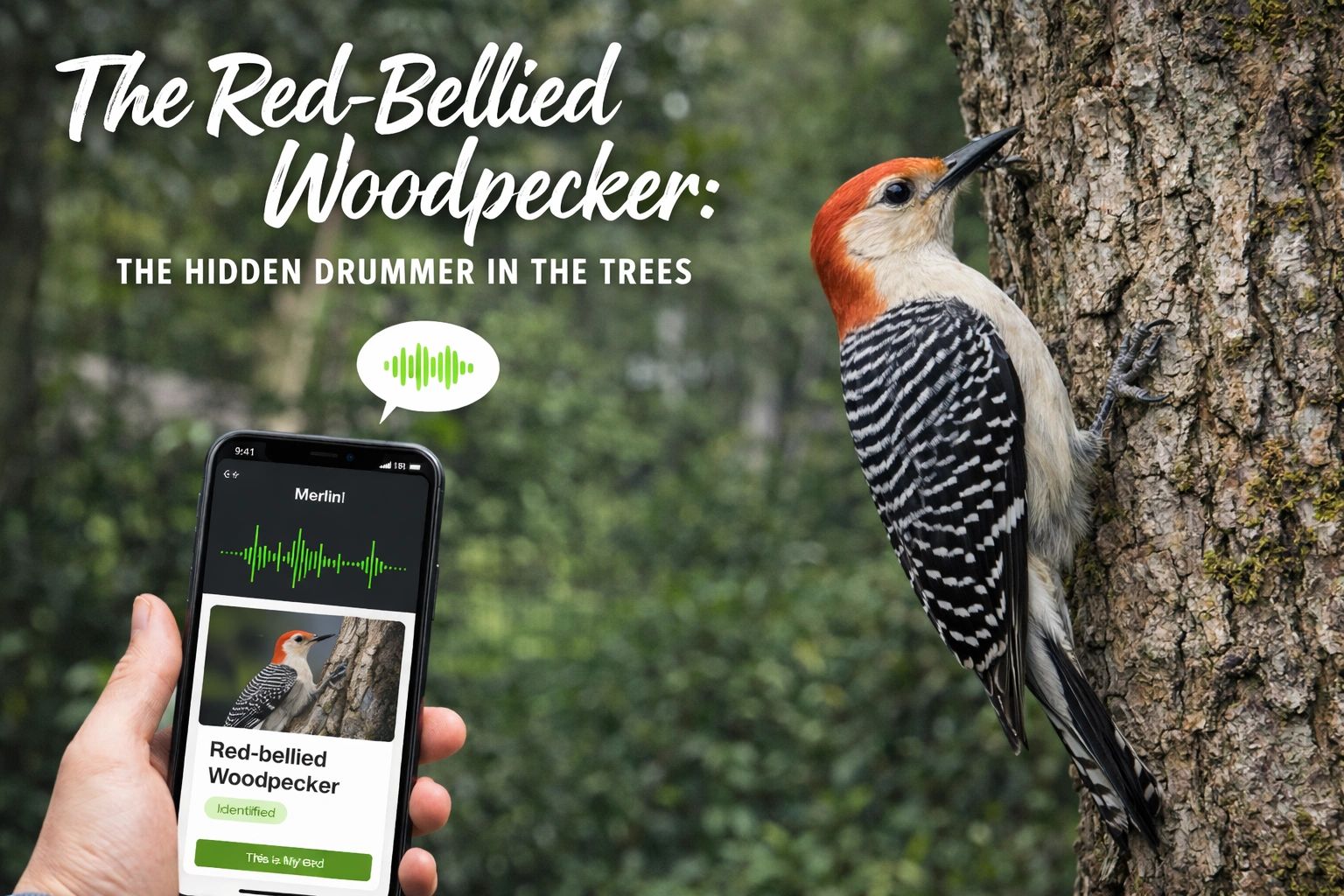
So I opened the Merlin Bird ID app and let it listen.
Within seconds, it confirmed it.
Red-Bellied Woodpecker.
The name felt familiar, but the sound didn’t match what I had imagined.
And that made me look closer.
Searching the Trees
Finding the bird wasn’t immediate.
Unlike a blue jay, which often perches in plain sight, the Red-Bellied Woodpecker blends into its surroundings in a way that makes it surprisingly difficult to spot.
Its back is patterned with black-and-white barring, a design that mirrors the texture of tree bark. When it moves along a trunk, it doesn’t stand out—it disappears.
At first, all I could see was movement.
A shift along the side of a tree.
A quick repositioning.
Then I found it.
Clinging vertically to the trunk, steady and balanced, using its stiff tail feathers for support.
A Bird Built for Climbing
The way a woodpecker moves is different from almost every other bird.
It doesn’t hop along branches.
It climbs.
Upward.
Sideways.
Around the trunk in small, deliberate movements.
Its feet grip tightly, with two toes facing forward and two backward, giving it stability on vertical surfaces. Its tail acts as a brace, pressing against the bark to hold it in place.
Everything about its body is designed for this kind of movement.
Watching it, there is a sense of control.
Nothing is rushed.
Every motion has purpose.
The Unexpected Name
One of the most interesting things about the Red-Bellied Woodpecker is its name.
At first glance, it doesn’t seem to make sense.
The most noticeable feature isn’t its belly at all—it’s the bright red cap that runs along the back of its head. On males, this red extends from the bill all the way to the neck, while females have a more subtle pattern.
The “red belly” is actually faint, often difficult to see unless the lighting is just right.
It’s a detail that can easily be missed.
And yet, it’s the name the bird carries.
More Than Just Drumming
When people think of woodpeckers, they often think of drumming—the rapid tapping against trees that echoes through the woods.
And the Red-Bellied Woodpecker does this.
But that’s only part of its behavior.
It also calls.
Frequently.
Its voice is loud and rolling, a series of sharp notes that carry across the yard. It doesn’t sing in a melodic way. It communicates in bursts, in patterns that feel more like signals than songs.
Sometimes, the drumming replaces the call.
A rapid series of taps against a hollow surface—tree bark, a branch, even a nearby structure—creating a sound that travels far beyond the immediate area.
A Constant Presence
Unlike some birds that come and go with the seasons, the Red-Bellied Woodpecker is a year-round resident in Florida.
That means it becomes part of the daily environment.
Its calls repeat over time.
Its movements become familiar.
But like many common species, it can still go unnoticed.
Because it blends.
Because it stays just out of clear view.
Because it reveals itself slowly.
Feeding in Plain Sight
Once I began watching it more closely, its behavior became easier to understand.
It wasn’t just climbing randomly.
It was searching.
Its long, slightly curved bill tapped and probed along the bark, looking for insects hidden beneath the surface. Occasionally, it paused, listening or feeling for movement before striking more deliberately.
But its diet isn’t limited to insects.
Red-Bellied Woodpeckers are surprisingly adaptable. They also eat fruits, nuts, and seeds, and they are frequent visitors to backyard feeders.
This flexibility allows them to thrive in both natural and suburban environments.
A Bird That Stores for Later
One behavior that stands out is caching.
Like Blue Jays, Red-Bellied Woodpeckers store food for later use. They tuck seeds and nuts into crevices in bark, fence posts, or other surfaces, creating small hidden reserves.
This behavior reflects a level of planning.
An awareness that resources change.
That what is available now might not be later.
Intelligence in Action
Woodpeckers are not often grouped with corvids like jays and crows, but watching the Red-Bellied Woodpecker suggests a similar kind of awareness.
It pauses.
Observes.
Adjusts its behavior based on what it encounters.
It doesn’t just react.
It evaluates.
That intelligence shows up in how it finds food, how it navigates its environment, and how it interacts with other birds.
Returning to the Sound
What stayed with me the most wasn’t just seeing the bird.
It was hearing it.
That initial call—the one that didn’t sound quite like a bird at first—became something recognizable over time.
Once Merlin identified it, the sound changed.
It became a signal.
A marker of presence.
Something I could place within the environment.
The Role of Merlin
Like the other birds in this series, the Red-Bellied Woodpecker became more meaningful because of that moment of identification.
Merlin didn’t just name the bird.
It changed how I experienced it.
It turned a background sound into something specific.
Something I could follow.
Something I could understand.
A Bird That Stays Hidden
Even after identifying it, the Red-Bellied Woodpecker never felt as obvious as the blue jay or as visually striking as the cardinal.
It stayed partially hidden.
Moving along trunks.
Disappearing behind branches.
Revealing itself in pieces rather than all at once.
And that made each sighting feel more intentional.
More earned.
The Rhythm of the Yard
Over time, the presence of the Red-Bellied Woodpecker became part of the rhythm of the yard.
Not constant.
But consistent.
A call here.
A tapping sound there.
A brief glimpse of movement along a tree.
It didn’t dominate the space.
It added to it.
More Than Just a Woodpecker
It would be easy to categorize the Red-Bellied Woodpecker simply as a woodpecker and move on.
But like the other birds in this series, it reveals more the longer you observe it.
It is not just tapping on trees.
It is searching.
Communicating.
Adapting.
It is part of a larger system, interacting with its environment in ways that are easy to overlook at first.
The Value of Paying Attention
What this bird reinforces, more than anything, is the importance of paying attention.
Not everything stands out immediately.
Not everything announces itself clearly.
Some things require listening.
Watching.
Returning to the same space and noticing what has changed—or what has always been there.
Conclusion: The Sound Behind the Trees
The Red-Bellied Woodpecker is not always the most visible bird in the yard.
But it is one of the most distinctive.
Its call carries.
Its tapping echoes.
Its movement, though subtle, is constant.
It is a bird that exists just behind the obvious, just beyond the first glance.
And once you recognize it—once you connect the sound to the bird—you begin to notice it everywhere.
Not because it suddenly appeared.
But because you finally learned how to find it.
Bibliography
Cornell Lab of Ornithology. All About Birds: Red-Bellied Woodpecker.
Smithsonian Institution. Smithsonian Handbooks: Birds of North America (Eastern Region).
National Audubon Society. Red-Bellied Woodpecker.
Sibley, David Allen. The Sibley Guide to Birds.
Florida Fish and Wildlife Conservation Commission. Florida Bird Species Information.
Originally published at the live site .