
Maritime ·
When the Reed Stands Alone
The Waterline Chronicles — Entry 03
By Rebecca "Madam Chronicler" Ryan
The Waterline Chronicles — Entry 03
Executive Summary
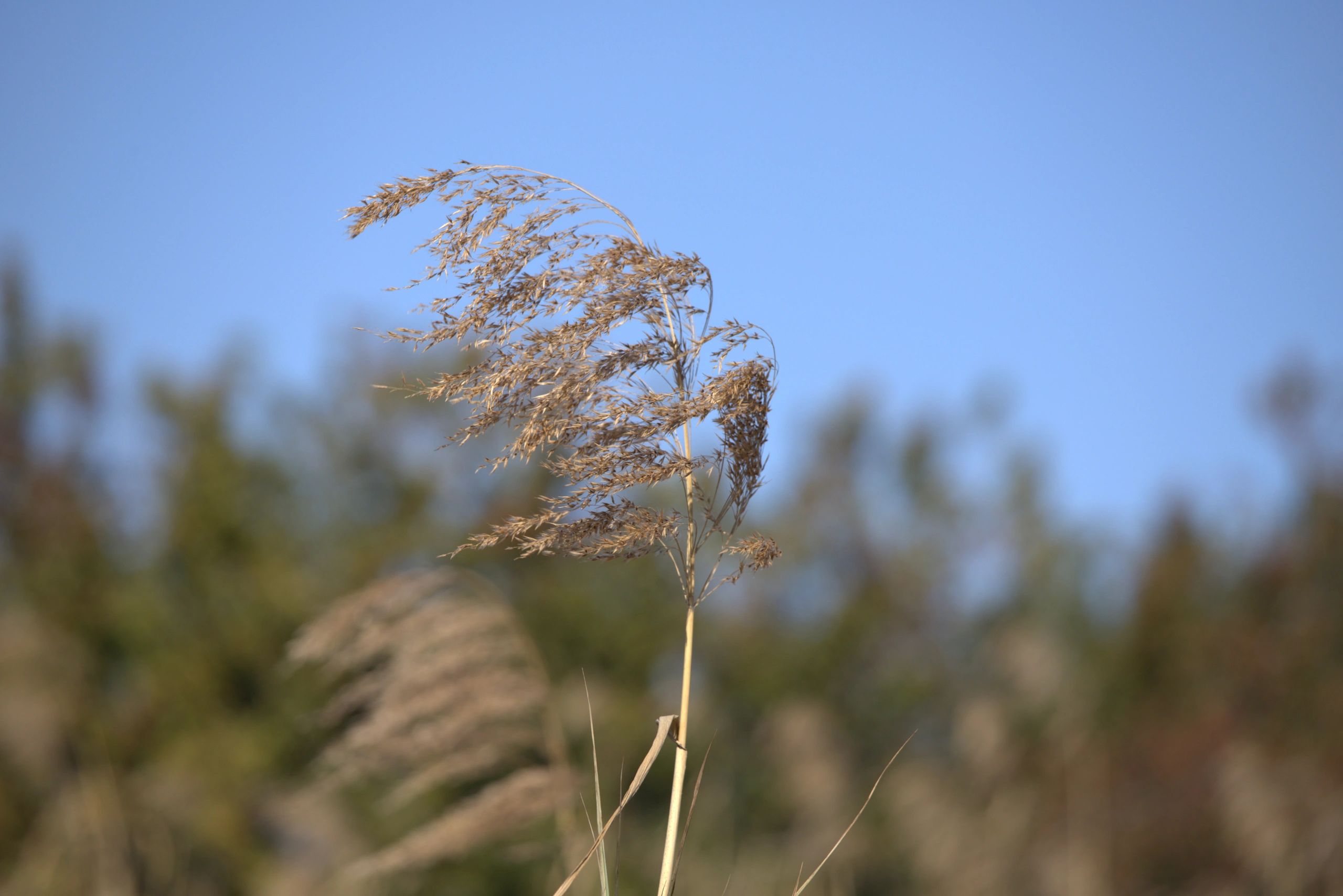
A single reed rises above a Florida marsh, its feathery seed head gently bending beneath an open sky. The plant is likely common reed (Phragmites australis), a species found in wetlands across the globe. In North America, it represents both continuity and controversy: some lineages are native and well-integrated into marsh ecosystems, while others are introduced and capable of transforming landscapes. This entry reflects on the ecological role of marsh grasses, the complexity of labeling a species as invasive, and the importance of documenting subtle changes in transitional environments like wetlands. Through observation rather than assumption, the reed becomes a marker within a larger, unfolding ecological story, rather than a symbol of certainty.
Observed Conditions
The photograph centers on a single, upright grass stem. Tall and slender, it rises cleanly from the blurred marsh below. At its apex, a plume-like cluster of seeds spreads outward in delicate strands. The seed head has turned a muted golden hue, indicating late-season maturity. Fine branchlets radiate from a central axis, giving the inflorescence an airy, feathered texture.
The stem bends slightly, yielding to the wind rather than resisting it. Behind it, the landscape softens into indistinct forms, suggesting additional grasses and perhaps low marsh vegetation stretching toward a flat horizon. Above, the sky appears clear and uninterrupted.
There is no visible sign of crowding or overwhelming density. The reed stands distinct in the frame, isolated enough to draw attention but not overly dominant. It appears neither invasive nor endangered, neither aggressive nor fragile. It is simply present.
Based on its structure—the height of the culm and the characteristic plume—the plant is most consistent with common reed, Phragmites australis.
A Species With a Complicated Story
Common reed is one of the most widespread wetland plants globally, thriving in temperate and subtropical regions. It can be found in marshes, riverbanks, estuaries, and pond margins. In Florida, it occupies both freshwater and brackish wetlands, often found at the edges of impoundments and in transition zones where water levels fluctuate.
What complicates its identity in North America is lineage. Research has shown that multiple genetic lineages of Phragmites australis occur on this continent (Saltonstall, 2002). One lineage is native and has long existed within North American marsh systems. A different lineage, introduced from Europe in the nineteenth century, has demonstrated invasive behavior in many regions, especially in the northeastern United States.
The two lineages are visually similar. Field identification is challenging without careful examination of subtle morphological differences or genetic analysis. This ambiguity means that the presence of common reed alone does not confirm invasion.
In Florida, both reed forms can be found. Some stands are well-integrated within diverse marsh systems, while others show signs of expansion in disturbed areas.
It is impossible to determine the reed’s lineage from this single image, and for the purposes of this documentation, it is unnecessary. The uncertainty itself becomes part of the ecological narrative.
The Architecture of a Marsh Grass
To grasp the significance of this reed, it’s beneficial to explore the broader role of marsh grasses in general.
Wetlands are shaped by movement—of water, sediment, nutrients, and wind. Plants that survive here must tolerate change, and common reed does more than tolerate it; it responds dynamically.
Its root system extends beneath the surface via horizontal rhizomes. These underground stems enable lateral plant spread, allowing new shoots to emerge some distance from the original stem. This strategy fosters resilience; if one stem is damaged by fire or flood, the network remains intact underground.
Above ground, tall stems efficiently capture sunlight, often rising above neighboring vegetation. The leaves extend outward in long blades, maximizing exposure while allowing wind to pass through without damage.
The plume-like seed head facilitates reproduction through seed dispersal. Wind carries the lightweight seeds across the marsh, with some settling nearby while others travel further, influenced by air currents and landscape features.
These adaptations, working in concert, make common reed exceptionally well-suited to fluctuating environments.
Building and Stabilizing Wetlands
Marsh grasses are not passive occupants of wetlands; they actively shape them.
As water moves through a marsh, stems slow its velocity, allowing sediment to settle. Over time, this accumulation builds soil, and plant matter—fallen leaves and stems—adds organic material, gradually increasing surface elevation (Mitsch & Gosselink, 2015).
In coastal wetlands, sediment capture is particularly crucial. Rising sea levels and storm surges continually stress marsh ecosystems. Grasses that trap sediment enhance resilience.
Roots bind the soil together, reducing erosion during storms. The underground network strengthens the marsh platform, anchoring it against tidal flow and heavy rain.
In this context, the reed is not just growing in the marsh; it’s actively helping to build it.
Habitat and Shelter
Vertical structure in wetlands creates habitat complexity. Birds utilize tall grasses for nesting and cover, insects cling to leaves, and amphibians and small mammals find shelter beneath stems, protected from predators.
Even when dormant, the standing remains of marsh grasses provide shelter. The persistence of stems through winter offers refuge when other vegetation recedes.
When common reed is part of a mixed plant community, it contributes to layered habitat rather than replacing it.
Ecological concern arises when density increases to the point of exclusion.
The Question of Invasion
In certain regions of North America, especially along the Atlantic coast, introduced Phragmites has expanded significantly, creating dense stands that displace native marsh plants (Chambers et al., 1999). These monocultures can alter bird habitats and reduce plant diversity.
Yet, invasion is not defined by potential; it is defined by ecological effect.
A single stem does not constitute invasion, nor does a scattered presence. The defining features of invasive expansion are scale, density, and displacement.
Is the reed crowding out other species? Is it forming a near-continuous canopy? Is plant diversity declining as a result?
Such questions require broader observation beyond a single frame.
In Florida, hydrology, fire regimes, and nutrient levels influence whether common reed expands aggressively or remains part of a balanced system.
Disturbance and Opportunity
Wetlands are susceptible to disturbances. Altered water flow from canals, nutrient enrichment from runoff, and the suppression of natural fire cycles can create conditions that favor the growth of fast-growing species.
Common reed responds quickly to such changes. Its rhizomes exploit exposed sediments, and its height allows it to outcompete shorter plants for sunlight.
In this way, invasive species often reflect deeper shifts in environmental conditions. A plant’s expansion may signal altered hydrology rather than inherent aggression.
The reed in this image is situated within this larger context, and its future—whether it remains a single stem or contributes to a denser stand—hinges on the surrounding landscape and its management.
Fire in Marsh Systems
Fire plays a complex role in Florida ecosystems. Many upland and transitional habitats depend on periodic burns to maintain species diversity, and in marshes, fire can remove accumulated biomass and stimulate new growth.
Dense stands of invasive reeds in other regions have been associated with altered fire behavior, sometimes producing hotter burns due to accumulated dry material (Chambers et al., 1999). Yet, fire dynamics vary by region and density.
The single reed shows no sign of recent burn, and its mature seed head suggests a full growing cycle completed without major disturbance.
The Value of Repetition
One image captures a moment; repeated images reveal patterns.
Within The Waterline Chronicles, our aim is not immediate classification, but rather longitudinal awareness regarding plants like this reed. If future photographs reveal increasing density, reduced diversity, or expanded coverage, the earlier record will take on added significance.
If, instead, the reed remains one of many species sharing the marsh, its presence reflects continuity rather than transformation.
Environmental change is rarely dramatic in its early stages; it accumulates subtly through slight increases in density, gradual shifts in boundary lines, or the quiet replacement of one species by another.
Documentation enables the recognition of these changes.
The Aesthetics of Resilience
There is something visually compelling about a single reed against an open sky. Its simplicity highlights its structure, and its bend in the wind suggests flexibility rather than rigidity.
Wetland plants survive not by resisting every force, but by accommodating it. Flexibility reduces breakage; adaptability increases survival.
The reed’s posture embodies this principle; it doesn’t stand rigidly upright, but leans, adjusts, and continues.
Presence Without Conclusion
Ecology resists easy narratives. Not every plant is a hero or a villain; some exist within systems quietly, performing essential functions without drawing attention.
The reed in this image encourages a measured response. It doesn’t call for alarm, nor does it demand celebration. It simply exists.
Is it native? Possibly. Is it introduced? Possibly. Is it part of a stable marsh or an early indicator of expansion? That depends on what follows.
Observation precedes judgment.
Wetlands as Ongoing Stories
Wetlands are dynamic, transitional landscapes, constantly shifting between water and land, seasons, and states of disturbance and recovery.
Plants like common reed thrive in that in-between space; they are specialists in fluctuation.
The reed’s seed head releases potential into the wind. Some seeds will not germinate, while others will take root, and over time, their fate will shape the density and composition of the marsh.
The photograph captures not a conclusion, but a moment within a cycle.
Closing Reflection
The reed sways, its seed head gleaming against the blue sky. The marsh, veiled in the distance, seems to hold the larger story close.
For now, the plant stands alone, representing presence without certainty.
In wetlands, certainty emerges slowly—through repeated observation, careful comparison, and patience.
When the reed stands alone, it reminds us that environmental understanding begins not with immediate classification, but with sustained attention.
References
Chambers, R. M., Meyerson, L. A., & Saltonstall, K. (1999). Expansion of Phragmites australis into tidal wetlands of North America. Aquatic Botany, 64(3–4), 261–273. https://doi.org/10.1016/S0304-3770(99)00055-8
Mitsch, W. J., & Gosselink, J. G. (2015). Wetlands (5th ed.). John Wiley & Sons.
Saltonstall, K. (2002). Cryptic invasion by a non-native genotype of the common reed, Phragmites australis, into North America. Proceedings of the National Academy of Sciences, 99(4), 2445–2449. https://doi.org/10.1073/pnas.032477999
Originally published at the live site .