
Maritime ·
Ocean’s Haunted: Real Life Deep Sea Shark Encounters That Will Gi
Have you ever stared into the deep, dark ocean and wondered what’s down there? The surface may look calm, but thousands of feet below is a world filled with mystery, darkness—and sometimes, terror. Welcome to the ocean’s...
By Rebecca "Madam Chronicler" Ryan
Have you ever stared into the deep, dark ocean and wondered what’s down there? The surface may look calm, but thousands of feet below is a world filled with mystery, darkness—and sometimes, terror. Welcome to the ocean’s haunted side.
In this post, we’ll dive into real-life shark encounters that happened in the deep sea. These aren’t made-up tales or scenes from a scary movie. These stories come straight from scientists, explorers, and submariners. Some are chilling. Some are just plain weird. But all of them will remind you that the ocean is wild, untamed, and sometimes… haunted.
The Abyssal Nightmare: A Face-to-Face Encounter with a Sixgill Shark
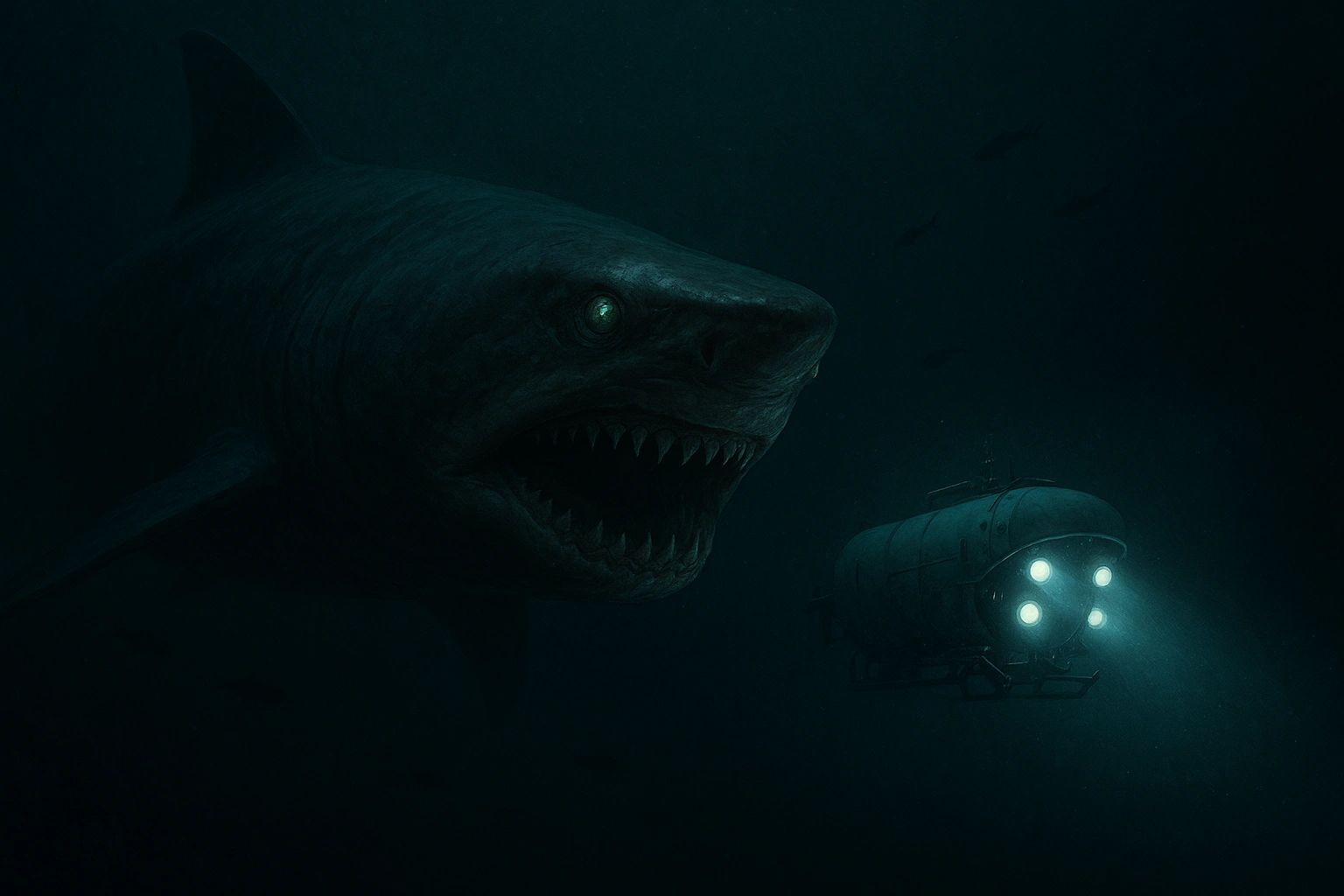
Let’s start with one of the most chilling encounters: a deep-sea submersible mission in the Bahamas. Scientists from OceanX were filming 2,500 feet below the surface when their lights revealed a creature from your worst nightmare—a bluntnose sixgill shark (Hexanchus griseus), a species that’s been around for over 200 million years (Cotton et al., 2011).
This shark was huge—over 16 feet long. It didn’t rush the sub. It didn’t swim away. Instead, it circled the submersible slowly, eyeing it like prey. “It felt like we were being hunted,” one scientist admitted.
The bluntnose sixgill has eerie, glowing green eyes and a prehistoric body that makes it look more like a sea monster than a fish. But the creepiest part? These sharks are mostly blind at that depth. They use their powerful sense of smell and pressure to hunt in total darkness.
You might think a sub is safe. But out there, in the pitch-black ocean, you feel small. Really small.
Ghost Shark Surprise: The First-Ever Footage of a Chimaera in Motion
Chimaeras, also called ghost sharks, are some of the strangest and rarest creatures in the ocean. In 2009, a remotely operated vehicle (ROV) diving off California’s coast captured the first-ever video of a deep-sea chimaera in its natural habitat—at over 6,500 feet below (Kemper et al., 2010).
The ghost shark glided past the camera with a translucent, jelly-like body, glowing eyes, and wing-like fins. These sharks don’t have bones—only cartilage—and their heads look like they belong in a science fiction film.
One of the researchers said watching it was “like seeing a spirit from the deep.” It wasn’t attacking or hunting. It was just there—floating in silence like a phantom.
The Shark That Swallowed a Submarine Camera
In 2020, a team from the NOAA’s Okeanos Explorer dropped a camera rig to film life on a deep ridge in the Atlantic. Everything was going fine—until something big hit the camera.
What followed was a flurry of bubbles, shaking video, and then total darkness.
When the rig was recovered, one of the cameras was completely destroyed. Teeth marks around the metal casing suggested the attacker was a large deep-sea sleeper shark (Somniosus spp.) (Friedman et al., 2021). These sharks can grow up to 20 feet long and have been known to attack submarines, mistaking them for prey.
No one was hurt—but the footage gave researchers the creeps. It felt like something from Jaws. But this wasn’t a beach. This was over a mile underwater.
Greenland Sharks: The Living Dead of the Arctic Deep
Greenland sharks (Somniosus microcephalus) are the zombies of the ocean. They live in the freezing waters of the North Atlantic and Arctic at depths over 7,200 feet. And get this—they can live over 400 years (Nielsen et al., 2016).
Yes, you read that right. Scientists believe some Greenland sharks alive today may have been born before the United States was even a country.
In 2013, divers using submersibles encountered one near Svalbard, Norway. The shark was almost blind, its body covered in parasites, and it moved slowly—like something out of a horror movie. One diver said it “felt like time had stopped.”
Greenland sharks don’t attack fast. Instead, they sneak up on sleeping seals and scavenge on dead whales. They smell like rot. They move like shadows. They are the haunted elders of the deep.
The Megalodon Mistake: When a Giant Shark Stalked a Sub
In 2016, the Japanese marine team aboard the Shinkai 6500 thought they were filming a giant squid in the Mariana Trench. Instead, something else came into view: a massive shark—over 25 feet long.
At first, some thought it was a megalodon—a long-extinct shark species that could grow over 60 feet long. But after studying the footage, scientists identified it as a very large bluntnose sixgill shark (Cotton et al., 2011).
Still, the moment gave everyone chills. The way it moved—slow, powerful, and curious—felt unnatural. The scientists watched in silence as the shark bumped the sub, then vanished into the blackness.
The Night of the Cookiecutter
Imagine you’re on a nighttime deep-sea mission near Hawaii. The ocean is calm. Your sub lights pierce through the dark. Then, something small but terrifying happens.
Suddenly, the lights go out. The sonar goes haywire. One by one, your instruments fail.
The crew returns to the surface and discovers the problem: dozens of bite marks on the sub’s rubber lining. The culprit? Cookiecutter sharks (Isistius brasiliensis), named for their ability to bite perfect circles out of their prey (Widder, 2010).
These sharks don’t kill their victims—they take chunks. Whale flesh. Fish scales. Even submarine insulation.
That’s right. Submarine insulation.
It’s not the size of the shark that matters. It’s the bite.
The Lost Diver and the Tiger Shark Below
Not all ghost stories are about ghosts. Some are about people who disappear—and the sharks that follow.
In 2018, a diver off the coast of the Philippines vanished during a deep wreck dive. Days later, his GoPro was found by another diver. The footage showed the diver exploring a shipwreck before being surrounded by three tiger sharks (Galeocerdo cuvier).
The sharks weren’t aggressive. But they circled him, closer and closer. The video cut off just as the diver turned toward them.
His body was never found. The footage was studied by shark experts, who concluded the sharks may have been curious or confused by his dive lights. Still, it’s a haunting mystery.
Sometimes, the ocean keeps its secrets.
The Silent Stalker: Frilled Shark Encounter
The frilled shark (Chlamydoselachus anguineus) is one of the strangest-looking sharks ever found. It has a snake-like body, needle-sharp teeth, and lives as deep as 5,000 feet.
In 2015, a Japanese fisherman accidentally caught one near the surface, and it was filmed while still alive. The shark thrashed in the water with its mouth wide open, revealing rows of backward-facing teeth designed to trap squid and fish.
What made the encounter so eerie wasn’t just the shark’s looks—it was how ancient it felt. Frilled sharks haven’t changed in millions of years. They’re like fossils that still swim.
Some scientists call them “living nightmares.” And once you see one, you’ll understand why.
Ghost Ships, Dark Waters, and Shark Patrols
There are real cases of ghost ships—boats found drifting with no crew onboard. In 2014, a North Korean “ghost ship” was found off Japan’s coast. The bodies were gone. The radio was silent.
But there was one clue: the hull had fresh bite marks—big ones.
Researchers believe sharks had followed the drifting boat, feeding on remains that had gone overboard. The most likely suspect? Deep-sea Pacific sleeper sharks, known to patrol beneath the waves like silent scavengers (Friedman et al., 2021).
It’s a reminder that in the deep sea, sharks aren’t just hunters—they’re watchers, waiting for whatever drifts down to them.
A Final Word on the Ocean’s Haunted Depths
Sharks are some of the oldest and most powerful creatures in the world. Most of them don’t want to hurt us. But when you’re over a mile below the surface, alone in the dark, even the calmest shark can feel like a ghostly predator.
These real-life encounters tell us one thing: the ocean is still full of mystery. We’ve explored space more than we’ve explored the deep sea. And while sharks play a vital role in keeping the ocean healthy, they also remind us of how wild nature truly is.
So next time you gaze out at the ocean, remember—it may look peaceful, but beneath the waves, the ocean’s haunted past and present are always lurking.
Sweet dreams.
Bibliography
Cotton, C. F., Grubbs, R. D., Daly-Engel, T. S., & Musick, J. A. (2011). Phylogenetic affinities of the deep-sea shark Hexanchus griseus based on mitochondrial DNA sequences. Marine Biology Research, 7(4), 350–361. https://doi.org/10.1080/17451000.2010.507137
Friedman, J., Drazen, J. C., & Yancey, P. H. (2021). Adaptations of deep-sea sharks to scavenging and low-oxygen environments. Deep Sea Research Part I: Oceanographic Research Papers, 177, 103629. https://doi.org/10.1016/j.dsr.2021.103629
Kemper, J. M., Ebert, D. A., & Compagno, L. J. (2010). Chimaera and ghost shark biology and diversity in the deep sea. Deep Sea Research Part II: Topical Studies in Oceanography, 57(11–12), 948–955. https://doi.org/10.1016/j.dsr2.2010.02.011
Nielsen, J., Hedeholm, R. B., Heinemeier, J., Bushnell, P. G., Christiansen, J. S., Olsen, J., … & Steffensen, J. F. (2016). Eye lens radiocarbon reveals centuries of longevity in the Greenland shark (Somniosus microcephalus). Science, 353(6300), 702–704. https://doi.org/10.1126/science.aaf1703
Widder, E. A. (2010). Bioluminescence in the ocean: origins of biological, chemical, and ecological diversity. Science, 328(5979), 704–708. https://doi.org/10.1126/science.1174269
Originally published at the live site .