
Stories ·
The Night of the Cookiecutter
The ocean at night is an entirely different world. Beneath the waves, darkness rules, and life moves to a rhythm far removed from the sunlit bustle above. Many creatures emerge under cover of night—some to feed, some to ...
By Rebecca "Madam Chronicler" Ryan
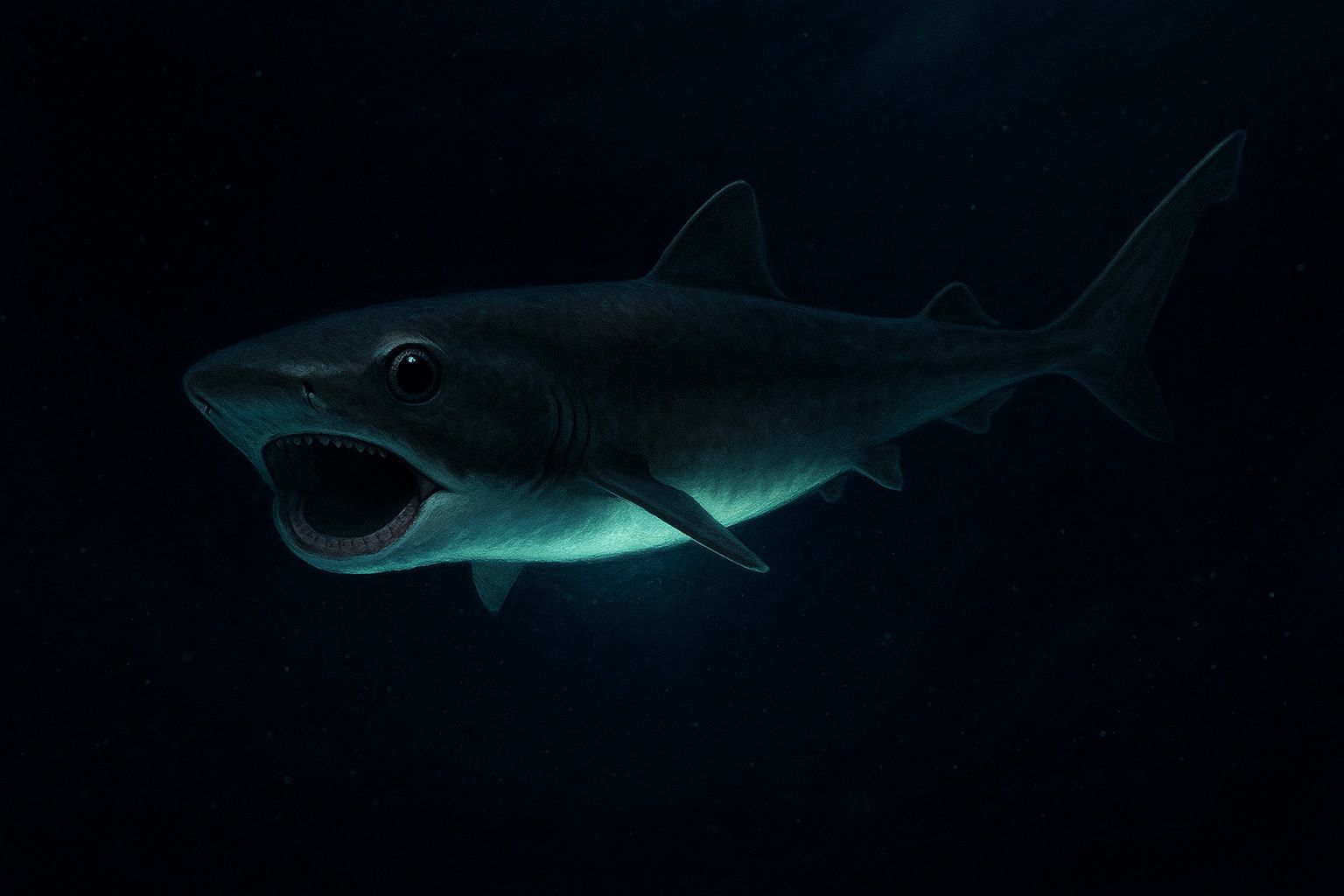
The ocean at night is an entirely different world. Beneath the waves, darkness rules, and life moves to a rhythm far removed from the sunlit bustle above. Many creatures emerge under cover of night—some to feed, some to hide, and some to hunt in ways that seem almost otherworldly. Among these nighttime hunters, one tiny shark with a strange, surgical feeding style reigns supreme: the cookiecutter shark.
The name might sound cute—almost like a kitchen utensil—but the reality is far more eerie. This is a predator that leaves perfectly round wounds on its victims, as though scooped out with a cookie cutter. And on certain nights in certain parts of the world, this little shark’s presence can turn a tranquil swim or deep-sea dive into something unforgettable.
Welcome to the Night of the Cookiecutter.
A Small Shark with a Big Bite
The cookiecutter shark, Isistius brasiliensis, is not a giant by any means. Adults reach only about 16–22 inches long, making them smaller than most household cats. They are slender and cigar-shaped, perfectly adapted to life in the open ocean. Their size is deceptive—they might be small, but they are equipped with one of the most specialized feeding strategies in the shark world.
They live in deep tropical and subtropical oceans across the globe. During the day, they lurk thousands of feet below the surface, safe from larger predators and hidden in the cold, dark water. But at night, they rise toward the surface in what scientists call “vertical migration,” following other marine creatures that also come up to feed. This nightly ascent is the key to their hunting success.
Masters of the Glow
If you were to see a cookiecutter shark in the wild, you might notice a faint greenish glow along its belly. This isn’t a trick of the light—it’s bioluminescence. Their skin is dotted with specialized light-producing organs called photophores, which create an even glow that helps them blend in with the dim light filtering down from above. This camouflage technique is known as counter-illumination, and it makes the shark’s body nearly invisible from below.
But the cookiecutter has another, more sinister trick. Just below its head is a dark, unlit band—often called a “collar.” Against the glowing belly, this dark band can look like the silhouette of a small fish or squid. Large predators are drawn in, thinking they’ve found an easy meal. Instead, they’ve fallen for one of the ocean’s oldest bait-and-trap tricks.
How to Take the Perfect Bite
When a cookiecutter shark feeds, it doesn’t swallow its prey whole. Instead, it uses suction to attach to the skin of its target—whether that’s a tuna, dolphin, whale, or even another shark. Its lips form a tight seal, its small upper teeth grip the surface, and then its powerful lower jaw goes to work.
The lower jaw is lined with large, triangular teeth arranged in a continuous band. These teeth are razor-sharp, and the shark uses them like a circular saw. By twisting its body, it carves out a neat, round plug of flesh, muscle, or even blubber. The resulting wound is unmistakable—a perfect circle about the size of a silver dollar.
The shark then swallows both the meat and any dislodged teeth. This isn’t wasteful—it’s recycling. By swallowing its own shed teeth, the cookiecutter shark can reclaim calcium and other minerals to help grow new ones.
Who’s on the Menu?
Almost anything that swims through the cookiecutter shark’s hunting grounds can end up on the menu. Large fish like tuna, swordfish, and marlin often bear their trademark wounds. Marine mammals such as seals, dolphins, and even sperm whales have been documented with dozens of these bites. Sea turtles, squid, and other sharks aren’t safe either.
Interestingly, cookiecutters don’t kill their prey outright. Their feeding style is parasitic—they take a chunk and let the animal swim away. But these wounds can cause stress, infection, and reduced swimming efficiency. In rare cases, repeated bites may contribute to a larger animal’s decline.
Humans and the Cookiecutter Shark
While cookiecutters don’t see humans as regular prey, there have been documented bites on people. Most cases involve long-distance swimmers or divers in deep waters, often at night, and sometimes near artificial lights. The glow may mimic the bioluminescence of other prey, drawing the sharks closer.
One famous case occurred during the 1970s, when the U.S. Navy reported cookiecutter bites on the neoprene coverings of submarine sonar domes. The damage was so consistent and precise that engineers first thought it was caused by a mechanical tool. It wasn’t until later that scientists identified the true culprit.
In rare incidents, swimmers have reported sudden pain, followed by a bleeding circular wound. While these bites are usually not life-threatening, they’re a stark reminder of the cookiecutter’s efficiency and boldness.
A Night in the Life
Picture this: It’s midnight in the tropical Pacific. The surface is calm, the moon casting silver light over the waves. Beneath you, the dark water seems endless. Then, faint glows begin to rise from below—jellyfish, lanternfish, and squid making their nightly ascent.
Among them swims a small, glowing figure. It moves smoothly, conserving energy, its eyes scanning for silhouettes. A flicker above—something large approaches, drawn by the dark collar beneath the glow. The cookiecutter positions itself carefully. In a flash, it darts upward, latches on, twists, and is gone. Its prey swims away with a stinging new wound, while the shark disappears back into the darkness.
This scene repeats thousands of times across the ocean every night, unseen by most of the world.
Why the Cookiecutter Thrives
Part of the cookiecutter shark’s success lies in its versatility. It can feed on a wide range of animals, from small fish to the largest whales. Its deep-sea habitat protects it from many predators, and its small size allows it to remain stealthy.
It also reproduces in a way that ensures steady population growth. Females carry developing embryos inside their bodies until they are ready to swim away fully formed. This live-bearing strategy, combined with a long gestation period, produces healthy, capable young.
The International Union for Conservation of Nature (IUCN) currently lists the species as Least Concern, meaning it is not considered endangered. Its deep habitat and lack of commercial fishing interest provide a natural buffer against many human threats.
Cookiecutter Science: Research in the Dark
Studying the cookiecutter shark is no easy task. They live in deep water and only come up at night, making them difficult to observe directly. Most research relies on specimens caught in deep-sea nets or on analyzing the wounds they leave on other animals.
Biologists have also used submersibles and remote-operated vehicles to capture rare video footage of cookiecutters in their natural habitat. These glimpses have confirmed many theories about their hunting behavior, though mysteries remain—such as how they choose their targets and how far they migrate.
Lessons from the Night
The cookiecutter shark is a reminder that size isn’t everything in the ocean. It doesn’t have the bulk of a great white or the speed of a mako, but it thrives through stealth, strategy, and an unusual way of eating.
Its story also illustrates the delicate balance of ocean ecosystems. Every creature, no matter how strange or small, plays a role. Cookiecutters help shape the behavior of larger species, forcing them to adapt and avoid certain areas or depths at night.
For humans, they are both a curiosity and a caution. They show us that even in the most remote parts of the ocean, life has evolved to take advantage of every opportunity—even if it means carving a perfect circle out of a passing giant.
The Final Word
The Night of the Cookiecutter is a nightly event in oceans around the world. It’s not marked on any calendar, and you won’t see it from shore, but it’s happening right now—somewhere in the dark, far beneath the waves. A tiny shark is swimming upward, its belly aglow, its jaw ready. It will strike and vanish, leaving only a small round mark and another reminder that the ocean’s most fascinating stories often belong to its smallest and most mysterious inhabitants.
Bibliography
Compagno, L. J. V., Dando, M., & Fowler, S. (2005). Sharks of the world. Princeton University Press.
Dolgan, E. (2018). Suction feeding of the cookiecutter shark (Isistius brasiliensis). Journal of Fish Biology, 93(5), 882–890. https://doi.org/10.1111/jfb.13780
Jones, E. C. (1971). Isistius brasiliensis, a squaloid shark, the probable cause of crater wounds on fishes and cetaceans. Fishery Bulletin, 69(4), 791–798.
Papastamatiou, Y. P., & Meyer, C. G. (2015). A review of the functional morphology and ecology of the cookiecutter shark (Isistius brasiliensis). Marine and Freshwater Research, 66(5), 465–480. https://doi.org/10.1071/MF14186
Widder, E. A. (2010). Bioluminescence in the ocean: Origins of biological, chemical, and ecological diversity. Science, 328(5979), 704–708. https://doi.org/10.1126/science.1174269
Originally published at the live site .