
Stories ·
A Dive into Deep Time
Sharks have been ruling the oceans for hundreds of millions of years, and every now and then, scientists uncover fossils that open a window into their fascinating evolutionary story. One such recent discovery in Peru has...
By Rebecca "Madam Chronicler" Ryan
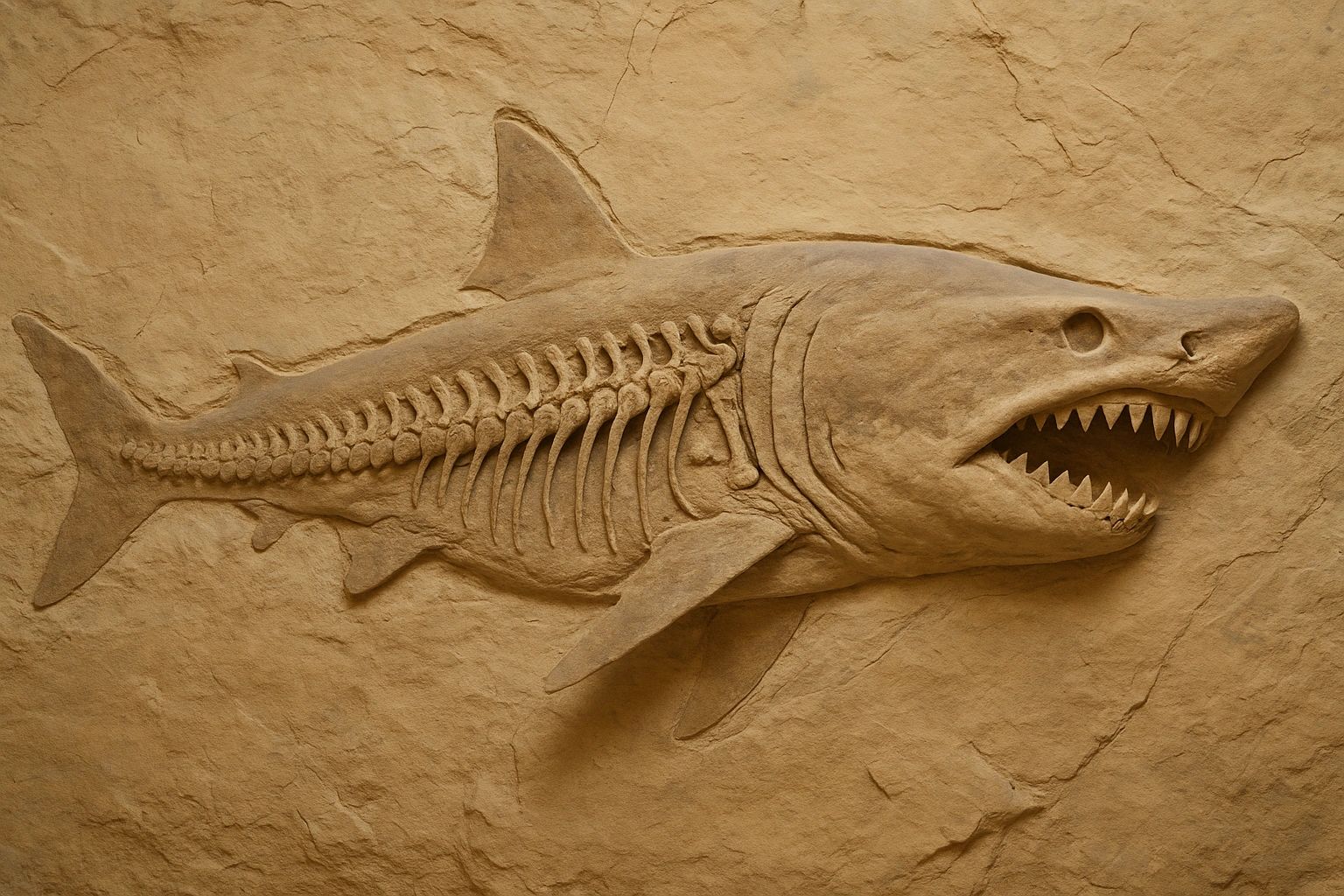
Sharks have been ruling the oceans for hundreds of millions of years, and every now and then, scientists uncover fossils that open a window into their fascinating evolutionary story. One such recent discovery in Peru has thrilled paleontologists worldwide—a nearly complete fossil of a 9-million-year-old shark that appears to be a close ancestor of the modern great white shark.
The Discovery
The fossil belongs to Cosmopolitodus hastalis, an extinct shark species that lived during the Late Miocene epoch. It was found in the Pisco Basin of southern Peru, about 235 kilometers south of Lima. This region is now a dry desert, but 9 million years ago it was part of a thriving marine ecosystem teeming with life.
What makes this fossil truly remarkable is its exceptional preservation. Most shark skeletons are made of cartilage, which decomposes quickly after death, leaving only teeth and occasional vertebrae behind. Complete shark fossils are rare, and those with such clear anatomical details are even rarer. This specimen, unearthed by researchers from Peru’s Geological, Mining, and Metallurgical Institute (INGEMMET), includes not just teeth but large sections of the skeleton—something scientists almost never see in shark paleontology.
Size and Power
Based on the fossil’s proportions, adult C. hastalis could reach lengths of up to seven meters—comparable to a modern great white shark. Its teeth, some measuring up to 8.9 centimeters (about 3.5 inches) long, were broad and triangular, perfect for grabbing slippery prey. These teeth are so distinctive that they have been found in marine sediments all over the world, from North America to Europe to New Zealand.
In this Peruvian fossil, researchers found something even more exciting: the preserved remains of sardines in the shark’s stomach area. This is a rare form of fossil evidence called “stomach content preservation” that offers a direct glimpse into the animal’s diet. Sardines, it turns out, were abundant in the region’s Miocene seas, while anchovies—the great white’s modern snack—hadn’t evolved yet. This insight not only tells us what this shark was eating but also helps reconstruct the ancient food web.
A Window into Ancient Oceans
The Pisco Basin is one of the most important paleontological sites in South America. Its sedimentary layers preserve an incredible variety of marine life from the Miocene and Pliocene epochs, including giant sperm whales with massive teeth, marine crocodiles, ancient penguins, and even marine sloths. Each fossil discovery here adds a new piece to the puzzle of what life was like in the prehistoric Pacific.
Nine million years ago, this area was a shallow coastal sea rich in nutrients, much like the upwelling zones off Peru’s coast today. Cold, nutrient-rich waters supported vast schools of fish, which in turn fed large predators like C. hastalis. These sharks likely hunted by cruising through open water, using their speed and size to ambush prey. The abundance of marine mammals in the fossil record suggests they may have also hunted small whales or scavenged carcasses.
Evolutionary Connections to the Great White Shark
For decades, scientists debated the origins of the great white shark (Carcharodon carcharias). Some believed it descended from the massive megatooth sharks such as Carcharocles megalodon. Others suggested a closer relationship to mako sharks. Fossils like C. hastalis are helping to clarify the picture.
Cosmopolitodus hastalis is considered by many researchers to be part of the great white’s evolutionary lineage. Its tooth shape and size bridge the gap between earlier mako sharks and the modern great white. In 2012, the discovery of Carcharodon hubbelli—a species showing traits of both C. hastalis and today’s great white—provided further evidence of this link. The Peruvian fossil fits neatly into this evolutionary chain, showing how great white sharks may have evolved from fast-swimming fish-eaters into the powerful apex predators we know today.
Why Complete Shark Fossils Are Rare
To appreciate just how special this find is, it’s worth understanding why shark fossils are so scarce. Sharks have skeletons made mostly of cartilage, a lightweight, flexible tissue that doesn’t fossilize as easily as bone. After a shark dies, its body usually decays quickly or is eaten by scavengers, leaving only hard parts like teeth behind. In fact, most of what we know about prehistoric sharks comes from teeth, which are incredibly durable and can survive for millions of years.
For a complete skeleton to fossilize, a shark must be buried rapidly in sediment, in a low-oxygen environment that prevents decay and deters scavengers. The Pisco Basin’s ancient seabed offered just those conditions. The same environment that preserved whales and penguins also occasionally captured sharks in extraordinary detail.
Life in the Miocene Seas
The Late Miocene epoch, between about 11.6 and 5.3 million years ago, was a time of significant change in Earth’s oceans. Global temperatures were cooling, ice sheets were expanding in Antarctica, and ocean currents were shifting. These changes altered nutrient flows and marine ecosystems worldwide.
In the Pacific, upwelling zones along the South American coast created rich feeding grounds for fish, seabirds, and marine mammals. Large predators like C. hastalis thrived in this environment. Fossils from the Pisco Formation show that this was also a time of incredible marine biodiversity, with species that no longer exist today. This snapshot of life offers scientists a baseline for understanding how climate and oceanographic changes affect marine ecosystems.
The Legacy ofCosmopolitodus hastalis
The great white shark is one of the ocean’s most famous predators, but it didn’t appear out of nowhere. Its lineage stretches back millions of years, shaped by changing oceans, shifting prey, and evolutionary pressures. C. hastalis represents a crucial stage in that history—a large, fast-moving shark adapted to hunting schooling fish in nutrient-rich waters.
By studying fossils like the one from Peru, scientists can trace how body shape, tooth form, and hunting strategies evolved over time. These insights also help us understand how modern sharks might respond to environmental changes in the future.
How This Changes Our Understanding of Shark Evolution
The Peruvian find supports the view that great white sharks evolved from mako-like ancestors rather than from giant megatooth sharks. This challenges older ideas that placed great whites in the same family as megalodon. Instead, it seems they share a closer relationship with speedy fish-eaters, gradually adapting to tackle larger prey.
The evolutionary path likely involved intermediate species like Carcharodon hubbelli, which had a mix of narrow and serrated teeth—perfect for a varied diet. Over time, these traits became more specialized, leading to the fully serrated teeth of modern great whites, which can slice through the flesh of large marine mammals.
A Discovery That Resonates Today
Beyond the scientific importance, this discovery captures the imagination. It’s awe-inspiring to think of a massive shark patrolling the Pacific millions of years ago, chasing schools of sardines through waters that are now a dry Peruvian desert. Fossils like this are time capsules, freezing a moment in Earth’s history and giving us a direct connection to a world long gone.
For conservationists, these finds are also reminders of the long evolutionary history that modern sharks represent. Great white sharks are now considered vulnerable, facing threats from overfishing, habitat loss, and climate change. Understanding their past can help us protect their future.
The Road Ahead for Research
Paleontologists will continue studying the Peruvian C. hastalis fossil to learn more about its anatomy, growth patterns, and ecological role. Advanced imaging techniques like CT scanning could reveal details of its internal structures, while isotopic analysis of its teeth might shed light on its migratory patterns and preferred habitats.
The Pisco Basin likely holds many more secrets. As fieldwork continues, researchers hope to find additional shark fossils that could further illuminate the great white’s family tree. Each discovery adds to the rich story of life in the Miocene seas and the predators that ruled them.
Final Thoughts
The 9-million-year-old Cosmopolitodus hastalis from Peru is more than just a fossil—it’s a direct link to the evolutionary story of one of the ocean’s most iconic predators. Its nearly complete skeleton is a rare gift from the past, offering unparalleled insight into shark biology, ecology, and evolution.
Standing in the desert where this shark once swam, you can almost picture the ancient Pacific waves, the glittering schools of sardines, and the powerful shadow of a predator gliding just below the surface. In that moment, the divide between past and present feels a little smaller, and the story of the great white shark comes into sharper focus.
References
- Reuters. (2025, January 20). Great white shark’s 9-million-year-old ancestor found in Peru. Reuters.
- Forbes. (2025, February 15). Why a 9-million-year-old great white shark ancestor was found in a desert—a biologist explains. Forbes.
- Latin American Post. (2025, January 22). Peru unearths ancient relative of great white shark. Latin American Post.
- Hubbell, G., Ehret, D. J., & MacFadden, B. J. (2012). Transition from C. hastalis to Carcharodon carcharias: Evidence from fossil teeth and anatomy. Journal of Vertebrate Paleontology.
- Lambert, O., Bianucci, G., & Salas-Gismondi, R. (2010). The Pisco Formation: Fossil marine vertebrates of the Miocene of Peru. Geological Society, London, Special Publications, 343(1), 87–108.
Originally published at the live site .