
Maritime ·
Bite Like No Other: How Powerful a Shark’s Jaws Really Are
Introduction: The Ocean’s Ultimate Chompers
By Rebecca "Madam Chronicler" Ryan
Introduction: The Ocean’s Ultimate Chompers
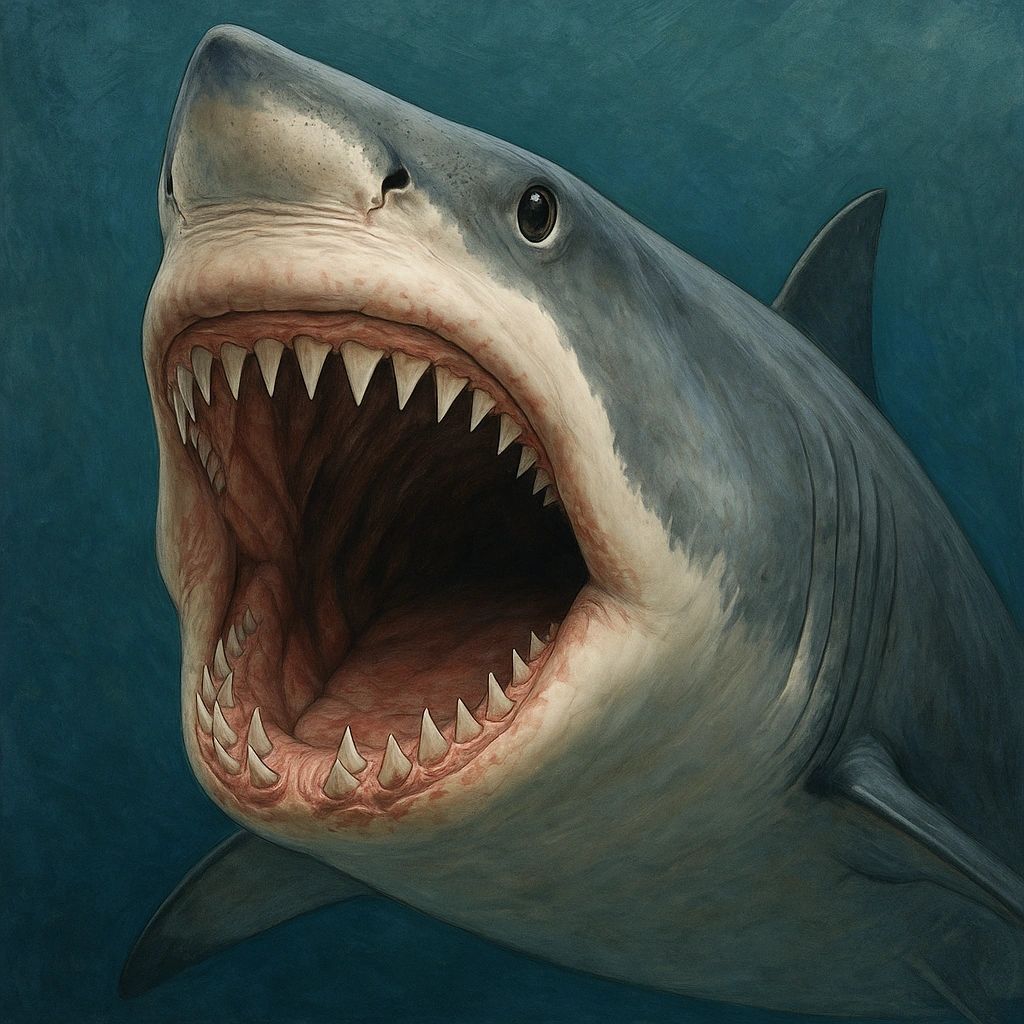
Sharks have fascinated people for centuries. These sleek, mysterious predators glide through the oceans with one of nature’s most incredible hunting tools—their jaws. While sharks are famous for their rows of sharp teeth, it’s the power behind those teeth that truly sets them apart. A shark’s bite isn’t just a snap; it’s an evolutionary marvel designed for survival, hunting, and sheer efficiency.
In this article, we’ll explore just how strong a shark’s jaws are, how scientists measure that power, and why different species have different bite strengths. We’ll also look at what makes their jaws so unique and how these adaptations allow sharks to rule the ocean as apex predators.
The Great White Shark: A Champion in Bite Force
The great white shark often takes the crown for bite force among fish. Scientists using three-dimensional computer models and CT scans of great white skulls have estimated its maximum bite force at an incredible 18,000 newtons, which is roughly 4,000 pounds of force.
To put that into perspective, the average human bite force is only about 720 newtons (around 162 pounds). This means a great white’s bite is more than 25 times stronger than a human’s. That’s enough to chomp through the thick blubber and muscle of seals, sea lions, and even smaller whales.
Why Is It So Powerful?
The great white’s bite strength comes from a combination of unique adaptations:
- Reinforced Jaw Cartilage: Unlike most animals with bones, sharks have skeletons made of cartilage, which is lighter and more flexible. In the jaws, this cartilage is strengthened with small mineralized tiles called tesserae. In large great whites, there can be two to five layers of these, giving the jaws extra durability.
- Massive Muscles: The muscles that power the jaws are incredibly strong and well-anchored, allowing explosive snaps.
- Serrated Teeth: Their triangular teeth have serrated edges, functioning like steak knives to slice through tough flesh.
- Unfused Upper Jaw: A great white’s upper jaw can move independently from its skull. This mobility lets the shark thrust its jaws forward to grab prey, increasing bite efficiency.
Shark Bite Force by Species
Not every shark has the same bite strength. Some are built for speed, others for crushing shells, and some for sheer bite power. Here’s a breakdown of a few notable species:
Shark Species Estimated Bite Force
Great White Shark ~18,000 N (~4,000 lbf)
Shortfin Mako Shark ~13,000 N
Bull Shark ~5,900 N
Horn Shark ~200 N (but very strong for size)
Shortfin Mako Shark
The shortfin mako is the fastest shark in the ocean, reaching speeds over 45 miles per hour. While it’s famous for speed, it also has a powerful bite measured at about 13,000 newtons. This allows it to catch and eat fast-moving prey like tuna and swordfish.
Bull Shark
Bull sharks are known for their adaptability—they live in both saltwater and freshwater. Their bite force of nearly 6,000 newtons is incredibly high for their size. This power allows them to tackle a wide range of prey, from fish to turtles.
Horn Shark
At first glance, the horn shark doesn’t seem like a powerhouse. It’s small and slow, but its jaws are specialized for crushing. With a measured bite force of up to 200 newtons, it can crack open hard-shelled prey like crabs, sea urchins, and mollusks. Relative to its size, the horn shark’s bite is one of the strongest in the shark family.
How Scientists Measure Shark Bite Force
Measuring a shark’s bite isn’t as simple as asking it to bite down on a bathroom scale. Researchers use two main approaches:
Computer Modeling
For large and dangerous species like great whites, scientists use CT scans of the skull to create detailed 3-D models. By simulating muscle attachments and jaw movements, they can estimate the maximum force the shark could generate. This method was used to calculate the great white’s legendary bite force.
Direct Measurement
For smaller or more manageable species, researchers use a bite force transducer—a device with pressure-sensitive plates. Sharks bite down on the device, and the force is recorded. This has been done with species like the blacktip shark and horn shark, giving real-world bite force data.
The Role of Bite Force in Shark Hunting
Bite force is more than just raw power—it’s a reflection of a shark’s hunting style and diet.
- Great Whites: These sharks use an ambush strategy, often attacking from below. They deliver a massive initial bite to immobilize prey, then back off to let the prey weaken before returning to feed.
- Bull Sharks: In murky waters, bull sharks rely on their strong bites to grab and hold prey immediately, preventing escape.
- Horn Sharks: Their bite is less about speed and more about crushing, perfect for cracking open shells.
Evolutionary Engineering: The Anatomy of a Shark’s Jaw
Shark jaws have evolved over hundreds of millions of years to become one of nature’s most efficient killing tools. Key features include:
- Cartilage Structure: Lighter than bone but reinforced for strength.
- Multiple Tooth Rows: Teeth are constantly replaced—some sharks go through 20,000 teeth in a lifetime.
- Forward-Protruding Bite: The upper jaw can extend forward, allowing a wider reach.
- Specialized Tooth Shapes: From serrated blades in great whites to flat crushing plates in horn sharks, tooth design matches diet.
Comparing Sharks to Other Animals
When it comes to bite force, sharks hold their own against some of the animal kingdom’s toughest biters:
- Saltwater Crocodile: Around 16,000 newtons—slightly lower than the great white’s estimate.
- Hippopotamus: About 8,000 newtons.
- Lion: Roughly 4,500 newtons.
This means great white sharks may have the most powerful bite of any living predator in terms of sheer force.
Bite Force in Prehistoric Sharks
If modern sharks are impressive, their prehistoric cousins were even more fearsome. The extinct Megalodon is estimated to have had a bite force of up to 180,000 newtons—ten times that of the great white. With jaws big enough to swallow two adults side-by-side, megalodon was the undisputed bite king of all time.
Why Bite Force Matters for Humans
For humans, understanding shark bite forces isn’t about competition—it’s about safety and conservation.
- Safety: Knowing how strong a shark’s bite is helps scientists design better protective gear for divers and researchers.
- Conservation: Studying jaw structure and bite force gives insight into shark health and feeding habits, which is important for protecting threatened species.
Fun Facts About Shark Bites
- A shark’s teeth aren’t attached to its jaw; they sit in the gums and are replaced like a conveyor belt.
- Some sharks can open their jaws nearly 60 degrees.
- Great whites don’t chew—they tear chunks off and swallow them whole.
- Bull sharks have the highest bite force of any shark relative to body size.
- Sharks’ jaw muscles can contract faster than a blink of an eye.
Conclusion: Masters of the Ocean’s Bite
A shark’s jaw is a masterpiece of natural engineering. From the massive power of the great white to the crushing grip of the horn shark, these predators have evolved to dominate their environments through bite force.
Understanding that power helps us appreciate sharks not just as fearsome hunters, but as vital parts of marine ecosystems. Their bite isn’t just about hunting—it’s a symbol of millions of years of adaptation and survival.
Sharks’ jaw power is one of the many reasons they deserve both our respect and protection. They’re not mindless eating machines—they’re highly specialized, perfectly adapted predators that keep our oceans in balance.
Bibliography
- Wroe, S., et al. (2008). Three-dimensional computer analysis of white shark jaw mechanics: How hard can a great white bite? Journal of Zoology.
- Huber, D. R., et al. (2005). Bite force in the blacktip shark Carcharhinus limbatus. Journal of Experimental Biology, 208(20), 3671–3683.
- Ferrara, T. L., et al. (2011). Mechanics of biting in great white sharks: A theoretical analysis. Journal of Anatomy, 218(3), 305–317.
- Motta, P. J., et al. (2002). Feeding biomechanics of sharks: Differences in the structure of the jaw muscles. Environmental Biology of Fishes, 65(2), 159–169.
- Pimiento, C., & Balk, M. A. (2015). Body-size trends of the extinct giant shark Carcharocles megalodon: A deep-time perspective on marine apex predators. Paleobiology, 41(3), 479–490.
Originally published at the live site .