
Maritime ·
Deep in the Darkness: Shark Fossils Found in a Kentucky Cave Rewr
When you think of sharks, you probably picture sharp teeth slicing through ocean waves, maybe somewhere tropical or far offshore. But would you ever expect to find shark fossils buried deep in the heart of Kentucky—hundr...
By Rebecca "Madam Chronicler" Ryan
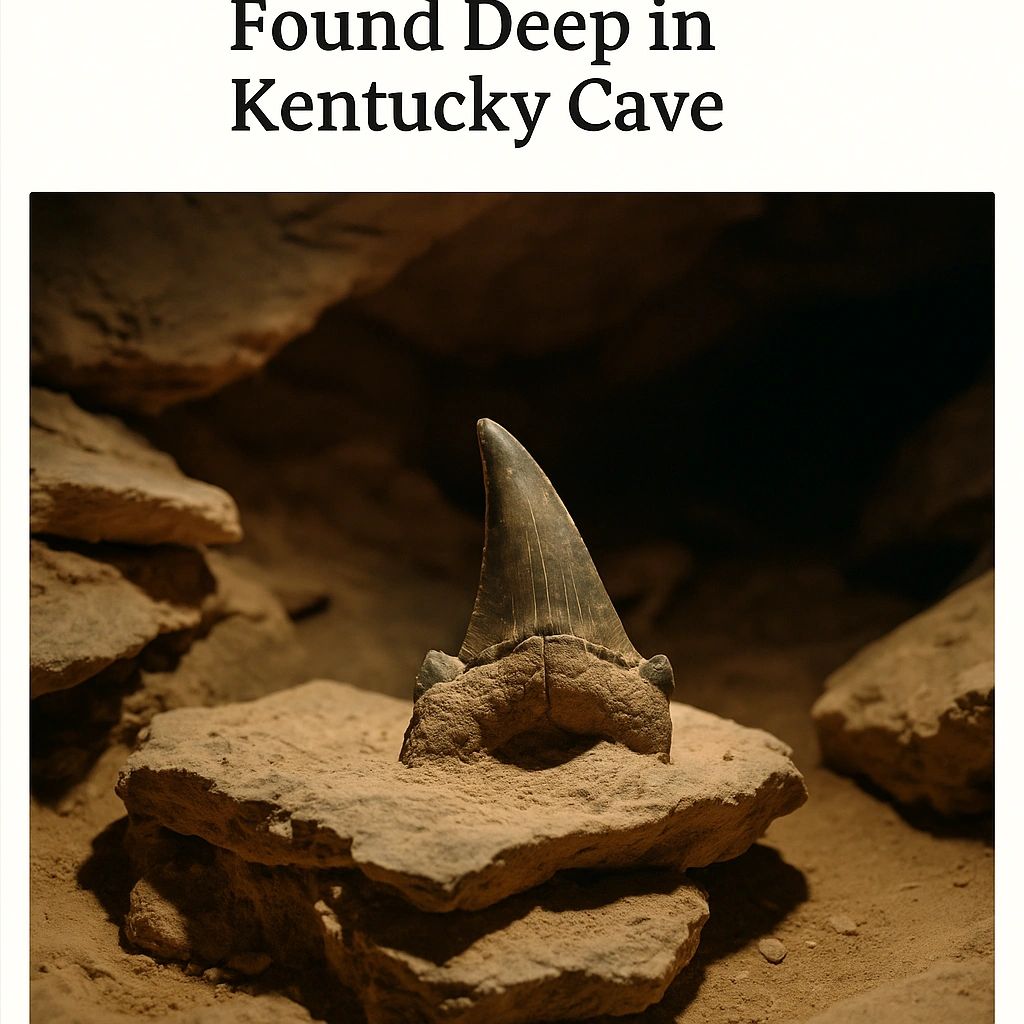
When you think of sharks, you probably picture sharp teeth slicing through ocean waves, maybe somewhere tropical or far offshore. But would you ever expect to find shark fossils buried deep in the heart of Kentucky—hundreds of feet below ground in a dark, winding cave?
That’s exactly what happened in Mammoth Cave National Park, where scientists uncovered a truly jaw-dropping discovery. Hidden in one of the world’s longest cave systems were the fossilized remains of prehistoric sharks that once ruled a long-lost sea. It sounds like something straight out of a sci-fi movie, but this amazing find is real—and it’s changing how we think about Kentucky’s ancient past.
In this blog, we’ll dive into the mystery of the sharks that lived millions of years ago, explore how their fossils ended up in a cave, and meet the scientists behind this thrilling discovery. So grab a flashlight and join us as we go deep underground into Kentucky’s fossil-filled past!
The Unexpected Discovery in Mammoth Cave
Mammoth Cave in central Kentucky is famous for its twisting underground passages and rich history of exploration. With over 400 miles of mapped tunnels, it’s the longest known cave system in the world. But in 2019, researchers and cave explorers found something completely unexpected: fossilized remains of ancient sharks embedded in the limestone walls of the cave.
At first, it was just a few teeth. Then came parts of skulls, jaws, and cartilage—pieces of creatures that hadn’t swum the seas for hundreds of millions of years. These weren’t just any sharks either. The remains included rare species from the Paleozoic Era, a time long before the dinosaurs.
Paleontologist John-Paul Hodnett, one of the lead researchers, described it as “a paleontologist’s dream.” Working with cave scientists and National Park staff, he helped identify at least 10 different kinds of fossil sharks. And some of them were giants.
Meet the Sharks from Kentucky’s Ancient Seas
The sharks found in Mammoth Cave date back to the Mississippian Period, about 325 million years ago. During that time, the area we now call Kentucky was completely underwater. Instead of cornfields and rolling hills, it was a warm, shallow sea filled with marine life.
One of the most exciting finds was the fossil of a shark called Saivodus striatus. This now-extinct species was thought to reach nearly 30 feet in length—almost the size of a modern-day great white shark. Researchers uncovered a well-preserved jaw section with multiple rows of teeth, giving them new insights into how this ancient predator hunted and fed.
Another incredible discovery was fossil material from Symmorium, a shark-like fish known for its odd-shaped fins and mysterious head structure. These creatures were part of a group called symmoriiforms, and they looked very different from modern sharks. Their fossils are extremely rare, and finding them in Kentucky caves was a huge scientific win.
Even more fascinating were some of the cartilage structures that survived fossilization. Unlike bones, shark cartilage rarely fossilizes because it’s soft and breaks down easily. But in the cool, mineral-rich cave environment, some of it was preserved well enough for scientists to study.
How Did Sharks End Up in a Cave?
Here’s where things get really interesting. You might be wondering—how in the world did shark fossils end up inside a cave system in Kentucky?
The answer lies in geology.
Over 300 million years ago, the land that is now Mammoth Cave was part of a shallow inland sea. Over time, layers of sediment built up on the seafloor, trapping the remains of sea creatures like sharks, crinoids, and corals. These layers hardened into limestone, locking the fossils in place.
Millions of years later, water began to carve tunnels through that limestone, creating the Mammoth Cave system. As erosion wore away the rock, some of those ancient fossils became exposed along cave walls and ceilings. It’s like nature built a hidden museum underground, just waiting for someone to stumble across it.
A Fossil Time Capsule
The fossil site in Mammoth Cave is one of the most important of its kind in the world. It’s not just the size or the number of fossils that makes it special—it’s the condition they’re in.
Most of the time, fossils are found in pieces or squished flat by rock layers. But in Mammoth Cave, many of the shark remains were found in three dimensions, meaning they kept their original shape. This gives scientists a much clearer picture of what these sharks looked like when they were alive.
Because the fossils were found deep underground, they were also protected from weathering, erosion, and even fossil hunters. The cave acted like a natural time capsule, preserving the sharks for hundreds of millions of years.
The Role of Modern Technology
Finding fossils in a dark cave is tricky enough. But studying them without damaging the delicate limestone or the surrounding environment is even tougher.
That’s where technology comes in. Scientists used 3D laser scanning, high-resolution photography, and even photogrammetry (a way to turn pictures into 3D models) to document the fossils in place. This allows researchers to study the fossils in great detail without removing them from the cave.
In some cases, digital models of the shark fossils can be printed on 3D printers, letting scientists and students hold exact replicas of bones and teeth that are millions of years old.
Why This Discovery Matters
You might be wondering—why should we care about some old shark bones in a cave?
Well, fossil finds like these help scientists understand how life on Earth has changed over time. Each shark species tells us something about ancient oceans, ecosystems, and even climate.
For example, the presence of large predators like Saivodus shows that the seas around ancient Kentucky were thriving environments with plenty of prey. Fossils of other animals found alongside the sharks—like armored fish, ancient coral, and sea lilies—add even more pieces to the puzzle.
And because shark skeletons are mostly cartilage, finding fossils like these is incredibly rare. It fills in a gap in the fossil record and gives us a better view of prehistoric life in North America.
Exploring the Cave, Preserving the Past
Mammoth Cave National Park is already a protected site, but discoveries like these remind us why preservation is so important. Fossils are fragile, and removing them without the right tools and knowledge can cause permanent damage.
The park service works closely with paleontologists to ensure that these fossils are studied and protected. Some parts of the cave where fossils were found are now restricted to researchers only, to prevent accidental harm.
But the park also sees the value in sharing these finds with the public. Educational displays and 3D-printed fossil replicas are helping to tell the story of Kentucky’s prehistoric sharks to visitors from around the world.
What Other Secrets Are Still Underground?
One of the most exciting things about this discovery is that researchers believe there’s still more to find. The cave system is massive, and only a small fraction has been fully explored for fossils.
Scientists are continuing to scan new parts of the cave, hoping to uncover more fossils from the ancient sea. With each new find, we get a clearer picture of the underwater world that once covered the heart of North America.
Who knows—maybe the next big discovery is just around the next dark corner.
Sharks in Kentucky? Believe It!
It might sound strange, but the idea of Kentucky being home to sharks isn’t science fiction—it’s science fact. Long before people walked the Earth, huge sharks swam where we now drive our cars, build our homes, and walk through fields.
The fossils found in Mammoth Cave aren’t just cool to look at—they’re clues to a time when the world looked completely different. They help us imagine a prehistoric sea filled with ancient predators, strange fish, and ocean mysteries we’re only beginning to uncover.
So the next time you think of sharks, don’t just picture the ocean. Remember that deep beneath the hills of Kentucky, in the world’s longest cave, the past is still waiting to be discovered.
Bibliography (APA Format)
Hodnett, J.-P. M., & Macalady, J. (2020). Documentation and analysis of Paleozoic vertebrate fossils in Mammoth Cave, Kentucky. Geological Society of America Annual Meeting Abstracts.
Mammoth Cave National Park. (2020). Fossil Sharks of Mammoth Cave. U.S. National Park Service. https://www.nps.gov/maca/learn/news/fossil-sharks.htm
Sallan, L. C., & Coates, M. I. (2010). End-Devonian extinction and a bottleneck in the early evolution of modern jawed vertebrates. Proceedings of the National Academy of Sciences, 107(22), 10131–10135. https://doi.org/10.1073/pnas.0914000107
Maisey, J. G. (2012). What is an “elasmobranch”? The impact of paleontology in understanding elasmobranch phylogeny and evolution. Journal of Fish Biology, 80(5), 918–951. https://doi.org/10.1111/j.1095-8649.2012.03245.x
Originally published at the live site .