
Stories ·
Fahlo: The Bracelet That Helps Save Wildlife
What if wearing a bracelet could help save an elephant, a sea turtle, or even a shark? Sounds too good to be true, right? But that’s exactly what Fahlo does! Fahlo (pronounced follow) is a company with a mission. When yo...
By Rebecca "Madam Chronicler" Ryan
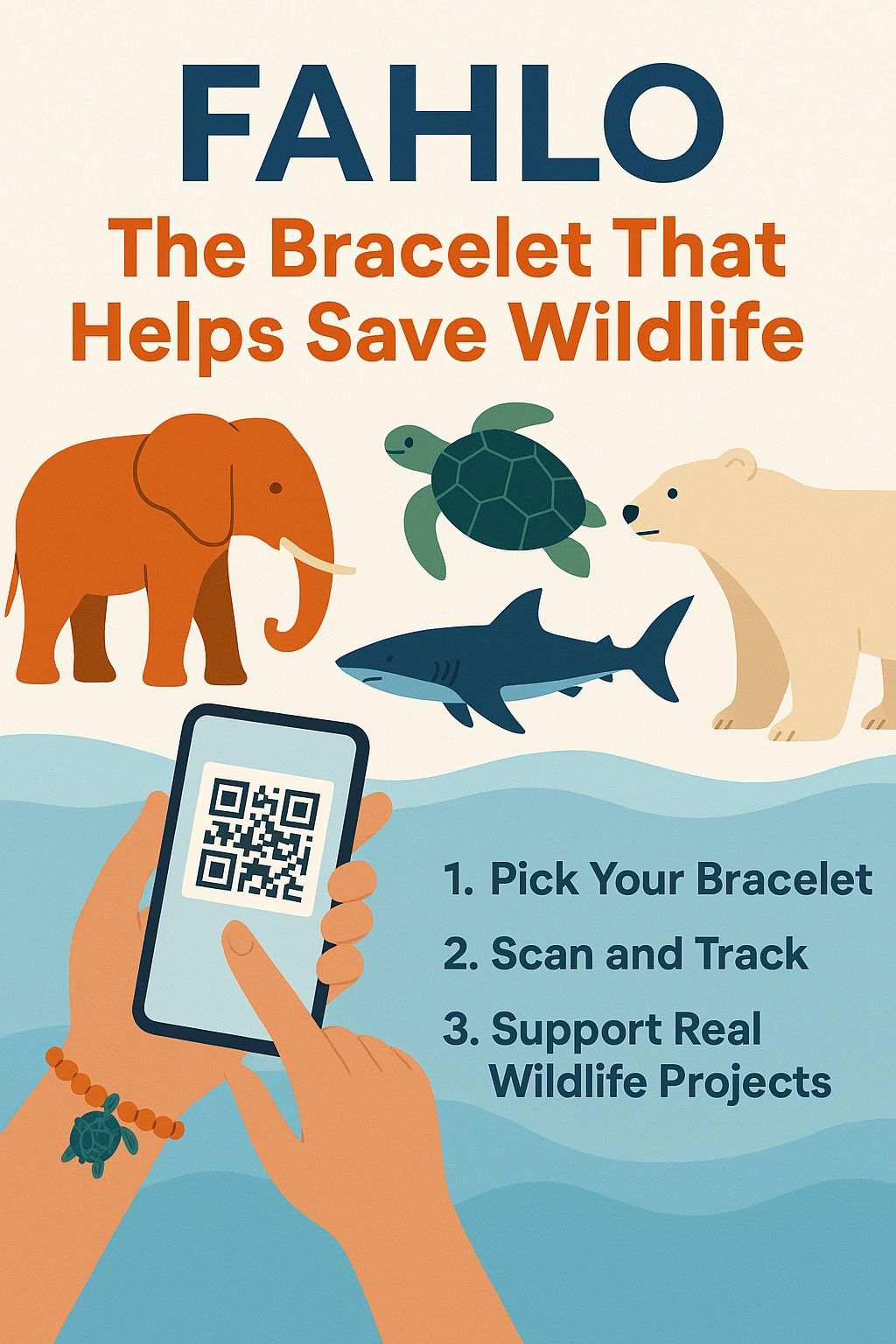
What if wearing a bracelet could help save an elephant, a sea turtle, or even a shark? Sounds too good to be true, right? But that’s exactly what Fahlo does! Fahlo (pronounced follow) is a company with a mission. When you buy one of their colorful bracelets, you’re not just getting something stylish—you’re joining a movement that protects wildlife around the world.
Let’s dive into the wild world of Fahlo, explore how it works, and see how something as simple as a bracelet is helping make the planet a better place for animals and people alike.
What Is Fahlo?
Fahlo is a wildlife conservation company that sells adventure bracelets connected to real-life animals. Each bracelet comes with a QR code you can scan to track an animal in the wild. Whether it’s a polar bear in the Arctic, a lion in Africa, or a shark in the ocean, your bracelet links you to their journey.
Fahlo partners with real conservation groups to protect endangered animals. Their bracelets are not just fun to wear—they fund research, rescue, and education that helps animals survive.
How Does It Work?
1. Pick Your Bracelet
Fahlo offers different bracelets for different animals. Each bracelet is named after a cause:
- The Voyage Bracelet – Tracks sea turtles
- The Expedition Bracelet – Tracks elephants
- The Trek Bracelet – Tracks lions
- The Journey Bracelet – Tracks sharks
- The Passage Bracelet – Tracks penguins
- The Wander Bracelet – Tracks polar bears
- The Venture Bracelet – Tracks giraffes
- The Guardian Bracelet – Tracks orcas
You pick which animal you want to support. Each bracelet comes in different colors and is made with beads and an animal-shaped charm.
2. Scan and Track
Inside the package is a card with a QR code. Scan it with your phone and meet your animal! You’ll get its name, photo, story, and location updates. You can even follow the animal’s movements on a live map. Every time your animal moves, you’ll see where they go and learn something new.
3. Support Real Wildlife Projects
Fahlo donates part of the profit from every bracelet to wildlife conservation organizations. These groups work in the field to protect animals from poaching, pollution, habitat loss, and climate change.
Here’s the cool part: these are not random donations. Fahlo teams up with trusted scientists who track the animals with GPS. You’re following a real, living creature thanks to research supported by your purchase!
Who Are Fahlo’s Conservation Partners?
Fahlo only works with licensed and respected wildlife groups. Some of their partners include:
- Sea Turtle Conservancy (STC): Founded in 1959, STC is the oldest group in the world that protects sea turtles. They work in Florida, the Caribbean, and Central America to help turtles nest safely and avoid threats like plastic pollution and fishing gear entanglement (Witherington, 2006).
- Save the Elephants: Based in Kenya, this organization uses elephant tracking and data to prevent poaching and protect habitats. Their research has saved countless elephants in Africa (Wittemyer et al., 2014).
- Polar Bears International: This group uses satellite collars to track polar bears and study how melting sea ice affects them due to climate change. They also push for climate action to protect Arctic ecosystems (Laidre et al., 2020).
- Saving the Blue: A marine research group that works with sharks and other ocean predators. They help track migration patterns, understand shark behavior, and educate the public about why sharks are important (Gallagher et al., 2021).
- The Orca Research Trust: Based in New Zealand, they monitor orcas to understand their social structure, feeding patterns, and threats like boat noise and pollution (Visser, 1999).
Every dollar you spend helps these scientists stay in the field, saving animals one tracking collar or GPS tag at a time.
Why Does Tracking Animals Matter?
GPS tracking sounds high-tech, but why is it important?
🔍 It Helps Scientists Understand Behavior
When researchers know where animals go, they can understand their migration, hunting, and breeding patterns. That knowledge is used to create safe zones, like marine sanctuaries and national parks.
⚠️ It Identifies Danger Zones
Tracking shows where animals are most at risk. For example, if a sea turtle always passes through an area filled with fishing boats, scientists can push for safer fishing laws or warn boaters to slow down.
🌎 It Helps With Climate Change Planning
Climate change is moving animal habitats. Polar bears are losing sea ice. Penguins are changing nesting sites. Tracking helps scientists adapt and make conservation plans that work in a warming world.
How Fahlo Inspires People
Fahlo does something special that many groups don’t—it makes conservation personal.
When you follow an animal like “Maple” the sea turtle or “Zipper” the shark, you feel a connection. Suddenly, you’re not just reading about endangered species—you’re cheering for your turtle to reach her nesting beach or your shark to swim safely past fishing lines.
🌟 Great for Kids and Families
Fahlo bracelets are a fun way to teach kids about nature. They can learn geography by seeing where their animal travels. They also learn empathy and responsibility by caring about the animal’s safety.
A 2022 study found that children who were emotionally attached to a specific animal were more likely to support conservation causes later in life (Jacobs et al., 2022). Fahlo makes that emotional connection easy and fun.
📱 Engaging with Technology
Instead of just playing games or watching videos, kids and teens can use their phones to track real animals. This brings wildlife into their world in a way that’s interactive and meaningful.
Fahlo’s Impact So Far
Since launching in 2018, Fahlo has made a big splash in conservation.
- Over 2 million bracelets sold
- Partnered with dozens of scientific tracking projects
- Donated millions of dollars to research and animal protection
Their bracelets have helped fund:
- Nesting site protections for sea turtles
- Anti-poaching patrols for elephants and lions
- Polar bear migration studies
- Ocean tracking for sharks and orcas
It’s not just about money. Fahlo builds awareness. Every bracelet is a mini billboard for wildlife. When you wear one, people ask about it—and you get to tell them about your animal and how they can help, too.
Stories That Inspire
Here are just a few amazing animals people have tracked through Fahlo:
- Maple the Sea Turtle: Tracked by the Sea Turtle Conservancy, Maple traveled hundreds of miles through the Gulf of Mexico after nesting in Florida. She dodged storms, boats, and fishing gear to reach her feeding grounds.
- Zipper the Shark: A great hammerhead shark tracked by Saving the Blue, Zipper stunned researchers by traveling deep into the Gulf Stream, helping scientists learn about shark migration paths between Florida and the Bahamas.
- Tikki the Polar Bear: Tracked by Polar Bears International, Tikki showed how sea ice patterns were changing in real-time due to climate change, guiding new conservation strategies in the Arctic.
These aren’t just animals—they’re ambassadors for their species.
Fahlo’s Bigger Mission
Fahlo wants to do more than sell bracelets. Their goal is to create a world where everyone feels connected to wildlife. They call it “tracking with purpose.”
Their social media is full of animal facts, user stories, and conservation updates. They work with teachers, homeschoolers, scout groups, and zoos to spread awareness. They’ve even been featured on platforms like National Geographic and Discovery.
How You Can Help
Want to get involved? Here’s how:
✅ Buy a Bracelet
Every purchase supports real conservation work. Plus, they make awesome gifts!
✅ Share Your Animal
Post on social media about your animal’s journey. Use the hashtag #fahlo and tag @thefahlo.
✅ Learn More
Check out the websites of Fahlo’s partners to read research papers, watch videos, and get involved.
✅ Live Sustainably
Protecting animals means protecting the planet. Reduce plastic use, recycle, avoid products made with palm oil, and support clean energy.
Final Thoughts: Small Bracelets, Big Impact
Fahlo is proof that little actions can lead to big changes. A simple bracelet can help fund a conservation scientist, protect an endangered animal, and teach someone to care about nature.
When you wear a Fahlo bracelet, you’re not just accessorizing—you’re adventuring, learning, and helping the wild stay wild.
So the next time someone says, “Cool bracelet!”—you can say, “Thanks, I’m tracking a shark!”
Bibliography
Gallagher, A. J., Serafy, J. E., Cooke, S. J., & Hammerschlag, N. (2021). Evaluating the protective capacity of marine protected areas for highly mobile predators: A synthesis of current understanding and research needs. Animal Conservation, 24(2), 138–150. https://doi.org/10.1111/acv.12632
Jacobs, M. H., Vaske, J. J., & Dubois, S. (2022). Emotional attachment to wildlife and support for conservation behavior: A meta-analysis. Conservation Biology, 36(3), e13873. https://doi.org/10.1111/cobi.13873
Laidre, K. L., Stern, H. L., Kovacs, K. M., Lowry, L., Moore, S. E., Regehr, E. V., … & Ugarte, F. (2020). Quantifying the sensitivity of Arctic marine mammals to climate-induced habitat change. Ecological Applications, 30(2), e02075. https://doi.org/10.1002/eap.2075
Visser, I. N. (1999). Benthic feeding in orcas (Orcinus orca): Predation on stingrays. Aquatic Mammals, 25(2), 71–82. https://www.aquaticmammalsjournal.org/
Witherington, B. E. (2006). Sea turtle responses to artificial lighting. In Biology and Conservation of Sea Turtles (pp. 555–563). CRC Press.
Wittemyer, G., Northrup, J. M., Blanc, J., Douglas-Hamilton, I., Omondi, P., & Burnham, K. P. (2014). Illegal killing for ivory drives global decline in African elephants. Proceedings of the National Academy of Sciences, 111(36), 13117–13121. https://doi.org/10.1073/pnas.1403984111
Originally published at the live site .