
Maritime ·
Gearing Up for Shark Week 2026: Sharks, Science, and the Stories
Every summer, millions of people around the world prepare for one of television’s most recognizable events: Shark Week. For more than three decades, the annual programming block has captivated audiences with breaching gr...
By Rebecca "Madam Chronicler" Ryan
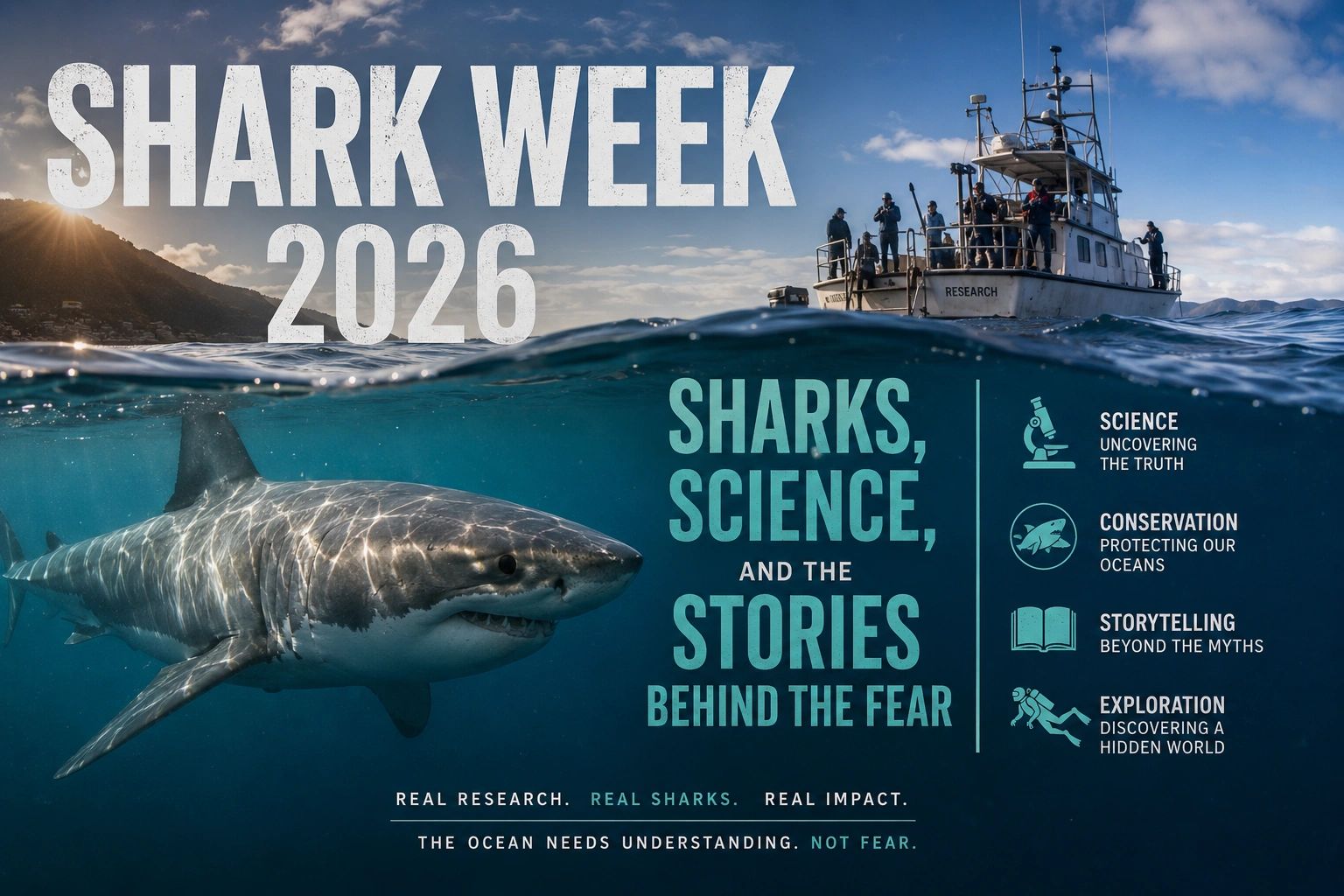
Every summer, millions of people around the world prepare for one of television’s most recognizable events: Shark Week. For more than three decades, the annual programming block has captivated audiences with breaching great whites, deep-sea encounters, close calls, and dramatic underwater footage. Shark Week has become more than just entertainment—it has become part of popular culture.
But Shark Week 2026 arrives during a major shift in how people view sharks.
For decades, sharks were portrayed almost exclusively as terrifying predators. Movies, news headlines, and television specials often focused on attacks, danger, and fear. Yet today, marine scientists are working harder than ever to change that narrative. Research now reveals sharks as highly evolved, ecologically vital animals that play a critical role in maintaining healthy oceans.
At the same time, shark populations around the world are under growing pressure from overfishing, habitat destruction, climate change, and negative public perception. Many species are now threatened or endangered, and conservationists argue that fear remains one of the biggest obstacles to protecting them.
This creates an interesting paradox. Sharks are among the most feared animals on Earth, yet they are also among the most misunderstood.
As Shark Week 2026 approaches, conversations about sharks are becoming less about monsters and more about science, conservation, and coexistence. The fascination is still there, but audiences increasingly want facts alongside the adrenaline.
The real story of sharks has become far more compelling than the myths ever were.
How Sharks Became the Ocean’s Most Feared Predator
Human fear of sharks did not begin with modern television. Stories about giant sea predators have existed for centuries. Sailors told tales of massive sharks circling ships and consuming victims lost at sea. Early newspaper reports often exaggerated shark encounters, turning rare incidents into terrifying legends.
But no single piece of media shaped shark fear more than Steven Spielberg’s Jaws in 1975.
The film permanently altered public perception of sharks, especially great whites. Beaches emptied after the movie’s release. Recreational shark fishing increased. Sharks became symbols of unstoppable terror lurking beneath the ocean surface.
Even Spielberg later acknowledged that the movie unintentionally contributed to fear and misunderstanding surrounding sharks.
The legacy of Jaws still influences shark media today.
When Shark Week debuted on Discovery Channel in 1988, its original goal was education and conservation. Producers wanted audiences to better understand sharks and appreciate their ecological importance. However, dramatic storytelling quickly became part of the formula. Titles emphasizing danger and attack scenarios often attracted larger audiences than purely educational programming.
Over time, critics argued that shark documentaries sometimes prioritized entertainment over accuracy.
Studies examining Shark Week programming found that many episodes relied heavily on fear-based language, dramatic reenactments, and attack-centered narratives. Researchers from Allegheny College noted that sharks were frequently portrayed as threats rather than complex wildlife species.
Yet despite the criticism, Shark Week also introduced millions of people to shark science and marine conservation. It sparked public fascination that helped inspire future marine biologists, divers, photographers, and conservationists.
That tension between fear and fascination continues to define shark media today.
Sharks Are Far More Complex Than Their Reputation
The reality is that most sharks are nothing like the monsters often portrayed on television or in movies.
There are more than 500 known shark species worldwide, and only a very small number have ever been involved in serious incidents with humans. Great whites, tiger sharks, and bull sharks account for most documented unprovoked bites, but even those encounters are incredibly rare.
According to the Florida Museum’s International Shark Attack File, the odds of being seriously injured or killed by a shark remain extremely low compared to many everyday risks.
Most sharks pose little or no danger to people at all.
Some species are small enough to fit in the palm of a hand. Others feed almost entirely on plankton, squid, or crustaceans. Whale sharks, the largest fish in the ocean, are gentle filter feeders despite growing longer than many school buses.
Sharks are also highly specialized predators shaped by hundreds of millions of years of evolution.
Their sensory systems are extraordinary. Sharks can detect tiny electrical signals emitted by prey animals through specialized organs called ampullae of Lorenzini. They are capable of sensing vibrations over long distances and tracking chemical cues through moving water with remarkable precision.
Researchers increasingly recognize that sharks are intelligent and behaviorally complex animals.
Modern studies have documented migration patterns, habitat preferences, social interactions, and even personality differences among individual sharks. Some species repeatedly return to the same coastal areas year after year. Others travel thousands of miles across entire ocean basins.
Far from being mindless killers, sharks are highly adapted marine predators performing important ecological functions.
Why Sharks Matter to Ocean Ecosystems
Sharks are not just fascinating animals. They are essential to the health of marine ecosystems.
As apex predators, sharks help regulate populations of prey species and maintain balance within ocean food webs. Their presence influences the behavior and distribution of other marine animals, helping stabilize ecosystems from coral reefs to seagrass meadows.
Scientists refer to these effects as trophic cascades.
When shark populations decline, the consequences can spread throughout entire ecosystems. In some regions, the loss of sharks has led to increases in mid-level predators that overconsume shellfish, reef fish, or other important species.
This imbalance can damage fisheries, coral reef health, and biodiversity.
Research published in Nature Communications demonstrated how tiger sharks influence grazing behavior in seagrass ecosystems. Their presence alters the movement patterns of herbivores like sea turtles and dugongs, indirectly helping preserve seagrass habitats that store carbon and support marine life.
Healthy shark populations often indicate healthy oceans.
That is why scientists and conservation organizations increasingly emphasize shark protection as part of broader ocean conservation strategies.
Yet sharks are particularly vulnerable to human activity.
Unlike many fish species, sharks reproduce slowly. Some take more than a decade to reach maturity, and many produce relatively few offspring. This means populations recover very slowly once depleted.
Overfishing remains one of the greatest threats.
Millions of sharks are killed every year through targeted fisheries and accidental bycatch. Shark finning, illegal trade, habitat destruction, and pollution continue to threaten numerous species worldwide.
According to the International Union for Conservation of Nature (IUCN), many sharks and rays are now facing elevated extinction risk.
This is one reason why public perception matters so much.
When people view sharks only as dangerous predators, conservation becomes more difficult. Fear can reduce support for marine protections, fisheries regulations, and shark conservation policies.
Scientists increasingly argue that changing the public narrative around sharks is essential for their survival.
Shark Science Is Advancing Faster Than Ever
One reason Shark Week 2026 feels different is because shark science itself has entered a new era.
Modern researchers now have tools that previous generations of marine biologists could only imagine.
Satellite tagging technology allows scientists to track sharks across entire oceans in near real time. Researchers can monitor migration routes, diving behavior, temperature preferences, and habitat use over thousands of miles.
Drones now provide aerial views of shark behavior near coastlines without disturbing the animals. Environmental DNA sampling allows scientists to detect shark presence using microscopic genetic traces left behind in seawater.
Artificial intelligence is also beginning to play a role in shark research. Some scientists are using machine learning to identify individual sharks by analyzing dorsal fin shapes and body markings.
These technologies are transforming how researchers study marine predators.
Scientists now know that some shark species travel incredible distances between feeding and breeding grounds. Great whites have been tracked migrating between North America and Hawaii. Whale sharks cross international boundaries regularly, highlighting the need for global conservation cooperation.
Researchers are also learning more about shark behavior near populated coastlines.
Studies conducted in Florida waters have examined how urbanization, boating activity, pollution, and climate change influence shark movements near beaches and estuaries.
Climate change is becoming a major focus of shark research as well.
Warming oceans are already affecting shark distributions. Some species are appearing farther north than historically expected, while others are shifting migration timing in response to changing water temperatures.
These changes could reshape marine ecosystems in ways scientists are only beginning to understand.
The Psychology Behind Shark Fear
Despite scientific progress, fear of sharks remains deeply ingrained in human psychology.
Part of this fear is instinctive.
Humans are naturally cautious around large predators, especially in environments where we are vulnerable. Water adds another psychological layer because visibility is limited and people often feel less in control beneath the surface.
The ocean itself represents uncertainty.
Most shark encounters occur out of sight. People imagine what might be below them rather than what they can actually see. That uncertainty fuels anxiety and amplifies fear.
Psychologists often note that humans tend to focus disproportionately on dramatic but statistically rare dangers. Shark bites are uncommon, but they are emotionally powerful events that receive intense media coverage.
News outlets frequently highlight shark incidents using sensational language, dramatic imagery, and alarming headlines.
Social media intensifies this effect. Videos of shark encounters spread rapidly online because fear-driven content generates attention and engagement.
At the same time, sharks also inspire fascination and awe.
For many people, sharks symbolize wildness and mystery. They represent one of the last truly untamed forces in nature. In a heavily developed world, sharks remind people that parts of the ocean still operate beyond human control.
That mix of fear, respect, and curiosity explains why sharks continue to dominate documentaries, movies, and television specials.
Shark Week succeeds because it taps into all of those emotions simultaneously.
The Evolution of Shark Week
Shark Week itself has evolved considerably over the years.
Earlier seasons often emphasized danger, attacks, and dramatic speculation. Programs involving giant sharks, mysterious predators, and exaggerated scenarios sometimes blurred the line between science and entertainment.
One of the most controversial examples was Megalodon: The Monster Shark Lives, which presented fictional material in a documentary-style format. Scientists criticized the program for misleading audiences and spreading misinformation.
Since then, however, Discovery has gradually shifted toward more science-focused programming.
Recent Shark Week specials increasingly feature real researchers, conservation projects, tagging expeditions, and ecological studies. Modern episodes often explore shark behavior, migration, reproduction, and conservation challenges rather than focusing solely on attacks.
Marine scientists are also becoming more directly involved in production and storytelling.
This change reflects evolving audience expectations. Viewers today are more interested in authenticity and scientific credibility than purely sensational programming.
Conservation-focused storytelling has become more popular across nature media in general.
Audiences want to understand how animals live, how ecosystems function, and how human activity affects wildlife. Shark Week has slowly adapted to that shift.
That does not mean the excitement has disappeared.
Breaching great whites, underwater encounters, and close-range footage remain central to Shark Week’s appeal. But increasingly, the drama comes from real science and exploration rather than exaggerated fear.
The New Generation of Shark Scientists
One of the most important changes in shark media is the growing visibility of scientists themselves.
Marine biologists are no longer hidden behind academic papers and research institutions. Many now communicate directly with the public through documentaries, podcasts, YouTube channels, and social media platforms.
Researchers such as Dr. Neil Hammerschlag, Dr. Greg Skomal, Dr. Jess Cramp, and many others have helped make shark science more accessible to general audiences.
Their work highlights a critical point:
Understanding sharks is far more interesting than fearing them.
Scientists are also working to improve diversity and representation within marine science. Historically, shark media often featured a narrow range of voices and perspectives. Today, more women, younger researchers, and international scientists are helping shape public conversations about ocean conservation.
This broader representation matters because conservation is ultimately about people as much as wildlife.
Protecting sharks requires public engagement, policy changes, fisheries management, and international cooperation. None of that is possible without effective communication.
That is why storytelling remains so important.
Sharks and the Future of Ocean Conservation
As Shark Week 2026 approaches, sharks are increasingly becoming symbols of larger environmental challenges.
Ocean ecosystems are changing rapidly due to climate change, pollution, habitat loss, and overfishing. Sharks sit near the top of marine food webs, meaning they are directly affected by disruptions throughout the ocean environment.
Protecting sharks often means protecting entire ecosystems.
Marine protected areas, sustainable fisheries management, bycatch reduction technology, and international trade regulations all play major roles in shark conservation.
Public support is essential for those measures to succeed.
This is where media platforms like Shark Week can make a significant difference.
Television reaches audiences far beyond traditional scientific circles. Millions of viewers who may never read marine biology journals still watch shark documentaries every summer.
That visibility creates opportunity.
If Shark Week continues moving toward science-based storytelling while maintaining its entertainment value, it could become one of the most influential conservation communication platforms in the world.
The key is balance.
Audiences still want excitement and adventure, but they also want truth. The future of shark storytelling depends on presenting sharks honestly—not as monsters, but not as harmless pets either.
Sharks deserve respect grounded in science, not fear driven by myth.
Looking Ahead to Shark Week 2026
Shark Week 2026 represents more than another season of television programming.
It reflects a broader cultural shift in how humans relate to the ocean and its predators.
For decades, sharks were defined primarily by fear. Today, they are increasingly understood through science, ecology, and conservation. Researchers are uncovering new discoveries every year about shark behavior, migration, intelligence, and ecosystem importance.
At the same time, shark populations face serious global threats that require urgent attention.
The future of sharks may depend as much on public perception as scientific research. People protect what they understand, and understanding begins with education.
That is why the stories surrounding sharks matter so much.
The best shark documentaries do more than entertain. They inspire curiosity, challenge misconceptions, and encourage people to see sharks as vital parts of healthy oceans rather than mindless predators.
As viewers gear up for Shark Week 2026, perhaps the most important takeaway is this:
The real story of sharks is not one of terror.
It is a story of survival, evolution, ecological balance, and humanity’s complicated relationship with the natural world.
And in many ways, that story is only just beginning.
Bibliography and Primary Sources
Primary Sources
- NOAA Fisheries. Shark Conservation. U.S. National Oceanic and Atmospheric Administration. https://www.fisheries.noaa.gov/international-affairs/shark-conservation
- Shiffman, David S., et al. “Inaccurate and Biased Global Media Coverage Underlies Public Misunderstanding of Shark Conservation Threats and Solutions.” iScience, vol. 23, no. 6, 2020. https://pmc.ncbi.nlm.nih.gov/articles/PMC7327713/
- Macdonald, Catherine C., et al. “Values, Attitudes, and Media Exposure: Public Perception of Sharks and Their Conservation.” Biological Conservation, 2023. https://www.sciencedirect.com/science/article/pii/S0006320723004068
- O’Donnell, Katie. Shark Week and Public Perceptions of Sharks. Duke University Nicholas School of the Environment, 2019. https://dukespace.lib.duke.edu/items/e7dae305-c9d7-405b-877a-f4bbaf7d102e
- University of Miami Shark Research & Conservation Program. Scientific Publications Archive. https://sharkresearch.earth.miami.edu/research/scientific-publications/
- Hammerschlag, Neil, et al. “Evaluating the Landscape of Fear Between Apex Predatory Sharks and Mobile Sea Cow Grazers Across a Large Dynamic Seascape.” Nature Communications, 2022. https://www.nature.com/articles/s41467-022-30912-w
- International Union for Conservation of Nature (IUCN). The IUCN Red List of Threatened Species: Sharks and Rays. https://www.iucnredlist.org/
- Florida Museum of Natural History. International Shark Attack File (ISAF). https://www.floridamuseum.ufl.edu/shark-attacks/
- Save Our Seas Foundation. Shark Conservation Research and Education. https://saveourseas.com/
- National Geographic Society. Why Sharks Matter to Ocean Ecosystems. https://www.nationalgeographic.com/animals/fish/facts/sharks-1
Originally published at the live site .