
Maritime ·
Greenland Sharks: The Living Dead of the Arctic Deep
An ancient giant of the Arctic—the Greenland shark—moving slowly through the cold darkness.
By Rebecca "Madam Chronicler" Ryan
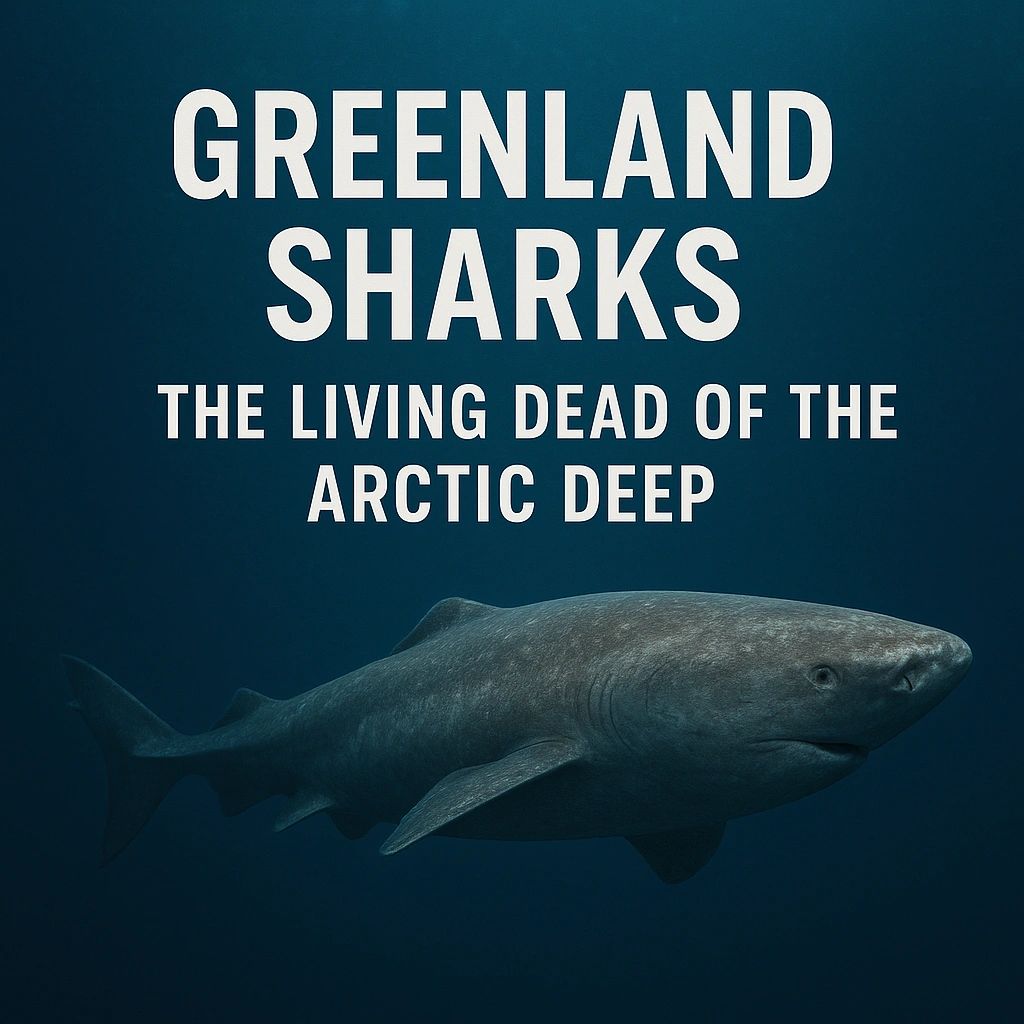
An ancient giant of the Arctic—the Greenland shark—moving slowly through the cold darkness.
If there were an award for the most mysterious creature in the ocean, the Greenland shark would win it hands down. Living in some of the coldest, darkest waters on Earth, these massive sharks have been quietly swimming through centuries—literally. They are the longest-living vertebrates on the planet, with lifespans that can stretch up to 500 years. That’s right, some Greenland sharks alive today may have been born before the United States even existed.
Let’s dive into the shadowy world of these “living dead” of the Arctic deep and discover why scientists are so fascinated by them.
1. Meet the Greenland Shark
The Greenland shark (Somniosus microcephalus) is a true giant. Adults often grow between 13 and 20 feet long, with some record individuals reaching over 21 feet and weighing more than 2,000 pounds. Despite their size, they are incredibly slow movers, earning them nicknames like “sleeper shark.”
Their range stretches across the icy Arctic and North Atlantic waters, from Greenland and Iceland to parts of Canada and even Norway. Unlike most large sharks, they prefer the frigid depths—often swimming between 600 and 2,400 feet below the surface, where the sun barely penetrates.
Distribution of the Greenland shark across the Arctic and northern Atlantic.
2. Why They’re Called the “Living Dead”
The nickname “living dead” comes from more than just their slow movements and ancient lifespans. These sharks often carry parasitic copepods attached to their eyes, which dangle like tiny streamers. In many cases, the parasites damage their corneas so severely that the shark becomes partially or completely blind.
But here’s the eerie part—they don’t seem to mind. Their sense of smell is so acute they can easily find food in the pitch-black Arctic waters, sight or no sight.
3. The Slowest Growers in the Shark World
Greenland sharks grow at a glacial pace—about 1 centimeter (less than half an inch) per year. Scientists believe this is one of the secrets to their long lives. Growing slowly means less strain on the body over time, and living in near-freezing waters keeps their metabolism extremely low.
It’s estimated that Greenland sharks don’t reach sexual maturity until they’re at least 150 years old. This is one of the slowest reproductive timelines in the animal kingdom.
4. How Old Are They Really?
Scientists use the eye lens to estimate the shark’s age.
In 2016, scientists used radiocarbon dating of proteins in the eye lens to determine their ages. One female was estimated to be about 392 years old—give or take 120 years. This means she could have been born sometime between 1504 and 1744. Imagine the history she silently witnessed as she swam the cold depths.
This incredible longevity makes the Greenland shark not just a marvel of nature, but also a valuable subject for studying aging in vertebrates. Researchers hope understanding their biology could unlock secrets about slowing aging in humans.
5. Slow Lovers: Their Reproductive Strategy
When Greenland sharks finally reach maturity, their reproductive output is impressive. Scientists estimate females may give birth to 200–300 pups at a time, each about 14 to 18 inches long. But because they reproduce so late in life, their populations are extremely vulnerable—if too many are removed from the ecosystem, it takes centuries to recover.
6. What Do Greenland Sharks Eat?
Despite their slow speed, Greenland sharks are opportunistic predators and scavengers. Their diet includes:
- Fish
- Squid
- Crustaceans
- Seals
- Dead whales
- Occasionally terrestrial animals like reindeer or polar bear remains (likely scavenged from the water)
They rely heavily on their incredible sense of smell to detect prey from far away.
Greenland sharks aren’t picky—anything that drifts into their territory could be a meal.
7. Life in the Arctic Deep
The environment of the Greenland shark is extreme. Water temperatures are often below freezing, and food can be scarce. This cold, stable habitat may be one of the keys to their longevity—it slows down their metabolism and reduces cell damage over time.
Interestingly, Greenland sharks are also capable of swimming into shallower waters in winter and can sometimes be found near the surface, especially in fjords.
8. Genetic Secrets of Longevity
Recent DNA studies have revealed that Greenland sharks have unusually large genomes compared to other sharks. Scientists believe certain genetic traits may contribute to their remarkable lifespan, such as enhanced DNA repair mechanisms and resistance to age-related diseases.
These findings could have implications not just for marine biology, but for medical science as well.
9. Threats They Face
For centuries, Greenland sharks were hunted for their liver oil, which was used in lamps and industrial lubricants. Today, commercial hunting has mostly stopped, but they still face threats:
- Bycatch: They’re often accidentally caught in deep-sea fishing gear.
- Climate change: Warming Arctic waters could shrink their habitat.
- Pollution: Over their long lives, they accumulate high levels of mercury and PCBs in their tissues.
- Slow reproduction: Their late maturity means recovery from population declines is painfully slow.
Bycatch is one of the biggest dangers to these slow-breeding giants.
10. The Human Connection
In Greenland, the shark’s meat is traditionally prepared in a special way before being eaten—fresh meat is toxic due to high levels of trimethylamine oxide (TMAO), which causes severe illness if consumed raw. After fermentation or drying, the meat becomes safe to eat and is considered a delicacy called hákarl in Iceland.
But beyond being a cultural food source, Greenland sharks are important to Arctic ecosystems as both predators and scavengers, helping to recycle nutrients in the cold ocean.
11. Why We Need to Protect Them
Protecting Greenland sharks means preserving a species that has roamed the oceans since before the Industrial Revolution, before the light bulb, even before many modern nations existed. They are living time capsules, carrying genetic and ecological stories that could benefit science and conservation.
12. Final Thoughts: A Ghost of the Deep
An ancient survivor moving through centuries of ocean history.
The Greenland shark is a creature that defies the normal rules of life—growing slowly, living for centuries, and thriving in one of the harshest environments on Earth. They are a reminder that the ocean still holds mysteries we’ve only begun to uncover.
If we protect them now, these “living dead” could continue gliding through the Arctic deep for centuries more, silently witnessing the next chapters of our shared history.
Bibliography
Christiansen, J. S., et al. (2020). Assessing the reproductive biology of the Greenland shark (Somniosus microcephalus). PLoS ONE, 15(10), e0238986. https://doi.org/10.1371/journal.pone.0238986
Edwards, J. E., Hiltz, E., Broell, F., Bushnell, P. G., Campana, S. E., Christiansen, J. S., … Hussey, N. E. (2019). Advancing research for the management of long-lived species: A case study on the Greenland shark. Frontiers in Marine Science, 6, Article 87. https://doi.org/10.3389/fmars.2019.00087
Kuta, S. (2025, March 5). Greenland sharks can live for 400 years. Scientists are using DNA to unravel their longevity secrets. Smithsonian Magazine. https://www.smithsonianmag.com/smart-news/greenland-sharks-can-live-for-400-years-scientists-are-using-dna-to-unravel-their-longevity-secrets-180986168/
Le Monde. (2024, August 14). The mysteries of the Greenland shark, the giant fish that lives for centuries in icy waters. Le Monde. https://www.lemonde.fr/en/science/article/2024/08/14/the-mysteries-of-the-greenland-shark-the-giant-fish-that-lives-for-centuries-in-icy-waters_6714992_10.html
Nielsen, J., et al. (2016). Eye lens radiocarbon reveals centuries of longevity in the Greenland shark (Somniosus microcephalus). Science, 353(6300), 702–704. https://doi.org/10.1126/science.aaf1703
Phys.org. (2025, March). Exploring the Greenland shark’s secret to extreme longevity. Phys.org. https://phys.org/news/2025-03-exploring-greenland-shark-secret-extreme
Originally published at the live site .