Rivers ·
Invaders of the Suwannee: How Non-Native Species Threaten It.
The Suwannee River flows like a green ribbon through Georgia and Florida, carving its way past limestone cliffs, ancient springs, swamps, and cypress forests before spilling into the Gulf of Mexico. It’s one of the most ...
By Rebecca "Madam Chronicler" Ryan
The Suwannee River flows like a green ribbon through Georgia and Florida, carving its way past limestone cliffs, ancient springs, swamps, and cypress forests before spilling into the Gulf of Mexico. It’s one of the most iconic rivers in the southeastern United States, celebrated in song, story, and natural beauty. But like so many waterways in North America, the Suwannee faces a hidden challenge: invasive species.
Invasive species are plants, animals, or even microbes that don’t naturally belong in an ecosystem but have been introduced by people—sometimes accidentally, sometimes intentionally. Once they establish themselves, they can spread aggressively, disrupting the balance of native habitats. The Suwannee, with its diverse mix of freshwater springs, floodplains, and wetlands, is especially vulnerable.
In this blog, we’ll dive into the invasive species threatening the Suwannee River, how they got here, the damage they cause, and what people are doing to fight back.
What Makes the Suwannee Special
Before we can understand the invaders, we need to appreciate what’s at stake. The Suwannee is a blackwater river, famous for its dark, tannin-rich waters. It stretches about 246 miles, originating from the Okefenokee Swamp in southern Georgia before winding its way into northern Florida. Along its path, it connects ecosystems ranging from wetlands and swamps to hardwood hammocks and freshwater springs.
This variety of habitats supports an amazing diversity of life. The river is home to Gulf sturgeon, Suwannee bass (a fish found nowhere else on Earth), manatees, turtles, and countless bird species. It’s also a major recharge zone for the Floridan aquifer, which supplies drinking water to millions of people.
But such a rich ecosystem also makes it an attractive target for opportunistic outsiders.
What Is an Invasive Species?
Not every non-native species is considered invasive. For example, tomatoes are not native to Florida, but we don’t call them invasive because they don’t spread aggressively into natural habitats. An invasive species is one that:
- Is not native to the ecosystem.
- Causes ecological or economic harm, or threatens human health.
- Spreads on its own once introduced.
These species often thrive because they lack natural predators in their new environment. They outcompete native plants and animals for resources, change habitats, and sometimes even directly prey on native species.
Aquatic Invaders of the Suwannee
1. Flathead Catfish (Pylodictis olivaris)
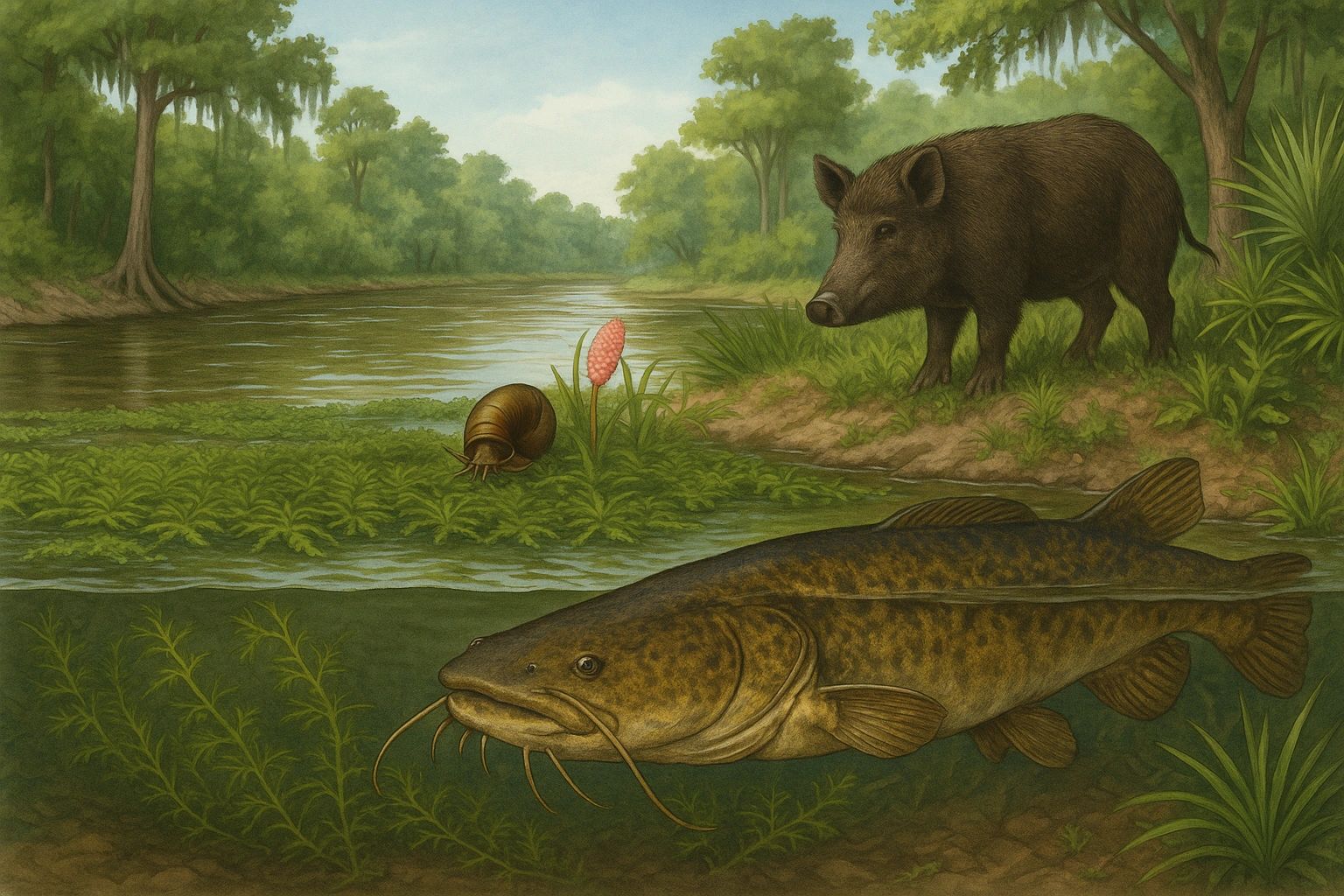
Flathead catfish are one of the most notorious invasive species in the Suwannee River. Originally native to the Mississippi River basin, they were introduced into Florida waters in the 1980s by anglers who valued them as sportfish.
The problem? Flatheads are voracious predators. They feed heavily on native fish, especially sunfish and bullhead catfish. Studies in the Suwannee and Apalachicola rivers have shown sharp declines in native fish populations where flatheads become established. Because they can grow over 100 pounds, they can dominate entire sections of the food web.
2. Blue Catfish (Ictalurus furcatus)
Blue catfish are another giant invader, also native to the Mississippi drainage. Like flatheads, they were introduced for sport fishing but quickly spread. They compete with flatheads and other predators but also feed on mussels and crayfish, putting pressure on native invertebrate populations.
3. Hydrilla (Hydrilla verticillata)
If you’ve ever tried boating through a mat of hydrilla, you know what a menace it is. This fast-growing aquatic plant was introduced from Asia through the aquarium trade in the 1950s. By the 1990s, hydrilla had spread widely through Florida rivers, including the Suwannee.
Hydrilla grows in thick mats that block sunlight from reaching native plants. It clogs waterways, makes swimming and boating difficult, and reduces oxygen levels, which can kill fish. While some wildlife can use hydrilla for shelter, the overall effect is a decline in biodiversity.
4. Apple Snails (Pomacea maculata)
Apple snails are large freshwater snails originally from South America. They were brought to Florida through the aquarium and food trades. Their neon-pink egg clutches can often be seen on vegetation near the water.
Apple snails strip aquatic plants bare, altering habitats for fish and birds. Their presence also threatens the survival of native apple snail species, which are the primary food of the endangered snail kite, a raptor found in Florida wetlands.
Terrestrial Invaders That Impact the River
1. Feral Hogs (Sus scrofa)
Few invaders are as destructive as feral hogs. These animals, descended from domestic pigs introduced by Spanish explorers in the 1500s, now roam the floodplains and forests of the Suwannee watershed.
Feral hogs root up soil in search of food, causing erosion and damaging sensitive wetland plants. They destroy ground-nesting bird habitats and compete with deer, turkeys, and other wildlife. Their wallowing also muddies streams and rivers, degrading water quality.
2. Cogongrass (Imperata cylindrica)
This tall grass, native to Southeast Asia, was introduced as packing material and later used for erosion control. Unfortunately, it quickly spread into wildlands. Along the Suwannee’s uplands and floodplains, cogongrass forms dense mats that crowd out native plants. Its leaves are sharp, and it burns hot during wildfires, increasing the risk of severe fire damage to forests.
3. Chinese Tallow Tree (Triadica sebifera)
Sometimes called the “popcorn tree” for its white, waxy seeds, this invasive tree was introduced from China as an ornamental plant. It grows quickly and produces dense shade that smothers native vegetation along riverbanks. Its leaves and fruit are also toxic to many animals.
How Do Invasives Get Here?
Invasive species usually arrive in one of three ways:
- Intentional release. Anglers introduced flathead catfish for sport. Gardeners planted Chinese tallow trees. People released aquarium plants like hydrilla.
- Accidental introduction. Apple snails and other aquatic organisms often hitchhiked through the aquarium trade. Seeds of cogongrass were mixed into shipments of packing material.
- Natural spread after introduction nearby. Once invasive species take root in one waterway, they can spread to others through floods, boats, and even birds.
The Suwannee is connected to larger ecosystems through springs, tributaries, and its estuary. That means once an invader enters, it has many ways to move.
Why Invasives Are So Damaging
The effects of invasive species on the Suwannee River are widespread:
- Biodiversity loss. Flathead catfish reduce native fish populations. Cogongrass and Chinese tallow crowd out diverse plant communities.
- Habitat changes. Hydrilla changes oxygen and light levels in the water. Feral hogs alter soil structure and water quality.
- Food web disruption. Apple snails outcompete native snails, threatening the birds that depend on them.
- Economic costs. Hydrilla removal costs millions in Florida each year. Feral hog damage to agriculture is also costly.
- Human impacts. Hydrilla can block boat traffic, while feral hogs pose risks to drivers and farmers.
What makes these impacts worse is that the Suwannee River system is already sensitive. Because it’s connected to the Floridan aquifer, pollution and habitat degradation have ripple effects on drinking water and spring health.
Fighting Back: Control and Management
Managing invasive species is challenging, but scientists, agencies, and local communities are working together.
1. Flathead Catfish Removal
Biologists regularly conduct electrofishing surveys to remove flathead catfish from the Suwannee. While it’s impossible to eliminate them entirely, targeted removal can help keep populations down. Some fishing tournaments even encourage anglers to catch and remove invasives.
2. Hydrilla Control
Mechanical harvesters, herbicides, and biological controls (like introducing hydrilla-eating insects) are used in different parts of Florida. Management must be careful, though—herbicides can harm native plants, and removing hydrilla too quickly can release nutrients that fuel algae blooms.
3. Feral Hog Hunting
State and private landowners organize hunts and trapping programs to reduce hog numbers. Though eradication is unlikely, population control can limit damage.
4. Public Education
Many invasives spread because people don’t know the risks. Campaigns like “Don’t Let It Loose” remind aquarium owners not to release pets into the wild. Boaters are encouraged to clean their equipment to prevent spreading plants and snails between waterways.
The Role of Climate Change
One complication is that climate change may give invasive species an even bigger advantage. Warmer waters could expand the range of tropical invaders like apple snails. Increased flooding could help plants like cogongrass and hydrilla spread faster. And stressed native species may be less able to compete.
This means controlling invasives isn’t just about local management—it’s part of a bigger picture of resilience in a changing climate.
What You Can Do
You don’t have to be a biologist to make a difference. Here are a few ways locals and visitors can help protect the Suwannee River:
- Report sightings. Apps like IveGot1 (a Florida invasive species reporting app) let you log invasive plant and animal sightings.
- Don’t release pets or plants. If you can’t keep an aquarium fish or plant, return it to a store or find a new owner. Never dump it in the river.
- Clean boats and gear. Before moving from one body of water to another, wash your equipment to avoid spreading invasives.
- Volunteer. Join local river cleanups or wildlife groups that remove invasives.
- Support research and conservation. Donations to organizations working on invasive species management go a long way.
Why This Matters
The Suwannee River is more than just a waterway—it’s a living heritage. Its springs are windows into the aquifer. Its floodplains shelter rare plants and animals. Its waters provide recreation, drinking water, and cultural inspiration.
Allowing invasive species to overrun this ecosystem would mean losing part of what makes the Suwannee unique. But with careful management, community effort, and science-based strategies, the river can stay resilient.
Protecting the Suwannee isn’t just about saving one river—it’s about preserving a symbol of wild Florida and the connections between people and water.
Conclusion
Invasive species are one of the greatest challenges facing the Suwannee River today. From giant flathead catfish to mats of hydrilla and destructive feral hogs, these outsiders threaten to reshape the river’s ecosystems. Yet there’s hope. Scientists, land managers, and everyday citizens are working together to control the invaders and restore balance.
The Suwannee has always been a river of resilience, carving its path for thousands of years through limestone and swamp. With effort and awareness, we can ensure it continues to flow wild and free, supporting both its native species and the people who love it.
Bibliography
- Bonvechio, K. I., & Bonvechio, T. F. (2006). Population dynamics of introduced flathead catfish in rivers of the Southeast USA. Fisheries Management and Ecology, 13(2), 117–124. https://doi.org/10.1111/j.1365-2400.2006.00483.x
- Cordeiro, R., Call, E., & Darby, P. (2017). Effects of invasive apple snails (Pomacea maculata) on aquatic vegetation in Florida wetlands. Aquatic Botany, 139, 45–53. https://doi.org/10.1016/j.aquabot.2017.02.003
- Engeman, R. M., Mayer, J., & Pipas, M. (2013). Feral swine damage in the United States and options for management. Wildlife Research, 40(1), 1–9. https://doi.org/10.1071/WR12164
- Glisson, W. J., Wahl, D. H., & Philipp, D. P. (2018). Impacts of invasive catfishes on native fish communities in southeastern rivers. Transactions of the American Fisheries Society, 147(2), 257–272. https://doi.org/10.1002/tafs.10011
- Langeland, K. A. (1996). Hydrilla verticillata (L.f.) Royle (Hydrocharitaceae), “The perfect aquatic weed.” Castanea, 61(3), 293–304.
- Miller, J. H., & Mitchell, R. J. (2017). Cogongrass (Imperata cylindrica) invasion and management in the southern United States. Invasive Plant Science and Management, 10(3), 181–192. https://doi.org/10.1017/inp.2017.19
- USDA Forest Service. (2014). Invasive plants of the southeastern United States: Identification and control. Southern Research Station General Technical Report SRS-119.
Originally published at the live site .