
Maritime ·
JAWS VS. MEGA CROC: WHO WINS IN A CLASH OF TITANS?
Get ready for the ultimate showdown between two of the most powerful predators ever to roam Earth and sea! On one side, we have the Great White Shark, famously known as “Jaws,” the top predator of today’s oceans. On the ...
By Rebecca "Madam Chronicler" Ryan
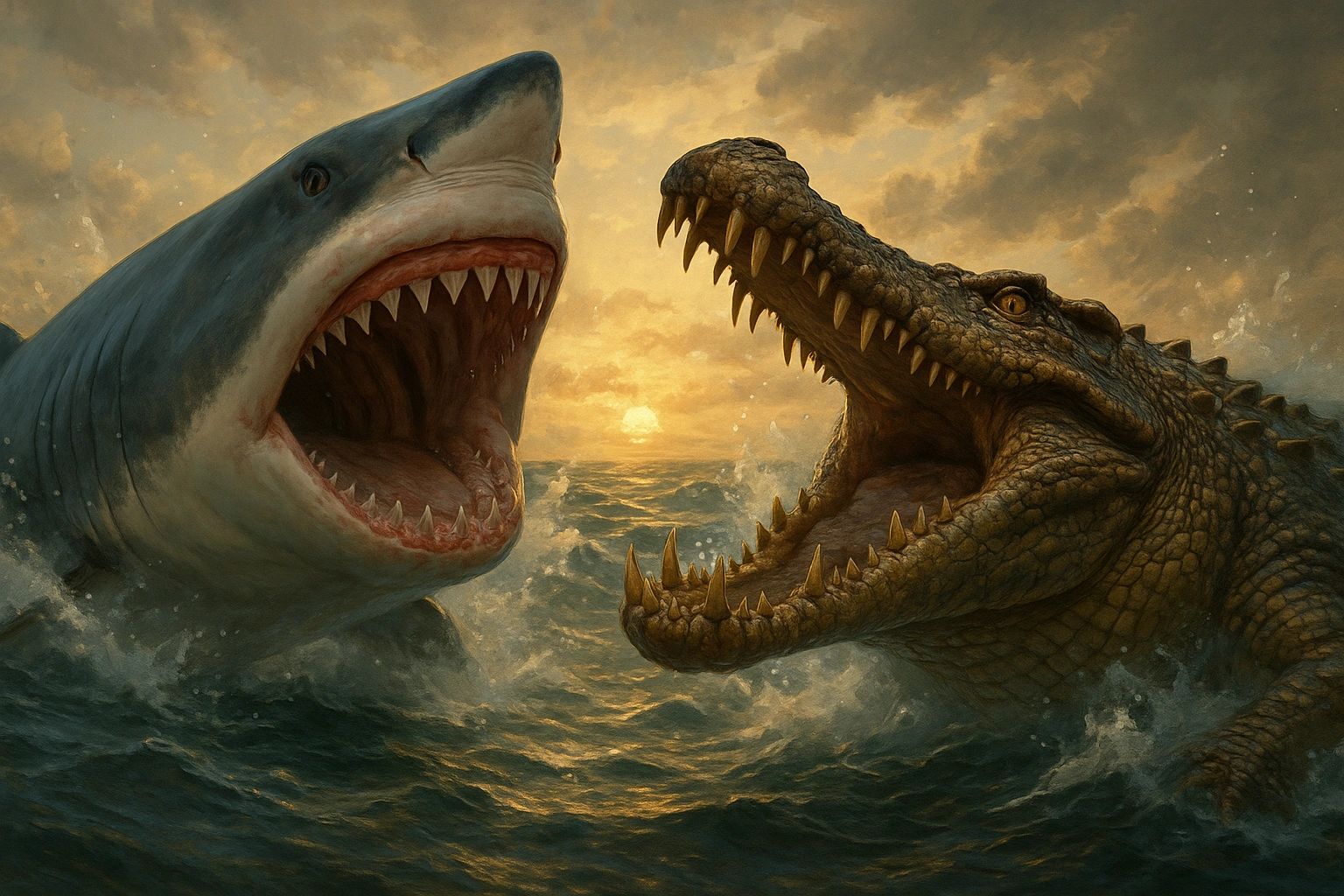
Get ready for the ultimate showdown between two of the most powerful predators ever to roam Earth and sea! On one side, we have the Great White Shark, famously known as “Jaws,” the top predator of today’s oceans. On the other, we have Sarcosuchus imperator, also called “SuperCroc” or the “Mega Croc,” one of the largest crocodile-like reptiles to ever exist.
While these two incredible creatures never crossed paths in real life—since Sarcosuchus lived over 100 million years ago and Great White Sharks roam modern oceans—it’s fun to imagine what might happen if they ever faced off! Let’s dive deep into this amazing match-up and see which predator would come out on top.
MEET THE PREDATORS
Great White Shark (Carcharodon carcharias)
The Great White Shark is the largest predatory fish alive today. It can grow up to 20 feet long and weigh around 2,000 pounds. These sharks are fast, sleek, and built for hunting. They rule the seas in many parts of the world, especially in coastal waters where they hunt seals, sea lions, and large fish.
Their sharp, triangular teeth are perfect for slicing through flesh, and they can detect even the smallest drops of blood from miles away. Great White Sharks are well-known for their speed, able to burst through the water at up to 25 miles per hour. Their hunting technique involves ambushing prey from below, striking quickly, and retreating while the prey weakens.
Sarcosuchus imperator (“SuperCroc”)
Sarcosuchus was a prehistoric reptile that lived around 110 million years ago during the Early Cretaceous period. It wasn’t exactly a crocodile, but it looked very similar. However, it was far bigger—some estimates say it reached lengths of up to 40 feet and weighed as much as 17,500 pounds!
Sarcosuchus ruled ancient river systems in what is now Africa. It likely hunted large fish but was also strong enough to take down dinosaurs that came near the water’s edge. Its jaw was loaded with over 100 conical teeth designed to grip and crush prey. It would likely ambush animals near the shoreline, using its massive jaws to grab and drown them.
BITE FORCE BATTLE
Both animals had extremely powerful bites, but there’s a huge difference between them.
The Great White Shark has one of the most powerful bites in the ocean, with scientists estimating its bite force to be around 4,000 pounds. That’s strong enough to bite through thick bones and metal-like fish scales. Its serrated teeth can saw through flesh and bone with terrifying efficiency.
But Sarcosuchus? Its bite force is estimated to have reached up to 18,000 pounds! That’s more than four times stronger than the Great White’s bite. This Mega Croc could crush almost anything that came too close, from thick-boned dinosaurs to armored fish.
In the bite force department, Sarcosuchus wins by a landslide.
TEETH AND JAW DESIGN
Great White Shark
The Great White’s teeth are its main weapons. They’re sharp, serrated, and shaped like triangles—perfect for cutting through flesh. A Great White can have up to 300 teeth arranged in rows, and when one tooth falls out, another quickly replaces it. This shark’s jaws can extend forward when biting, allowing it to deliver a more devastating attack.
Sarcosuchus
Sarcosuchus’s teeth were very different. They were long, conical, and designed for gripping rather than slicing. Its jaws were massive and super strong, shaped to grab onto prey and never let go. Its jaw structure was designed to clamp down with incredible force, making it almost impossible for anything to escape once it was caught.
HUNTING TECHNIQUES
Great White Shark
Great Whites are fast, agile hunters. They use surprise to their advantage by ambushing their prey from below, rocketing upward with incredible speed. They usually strike hard and fast, biting and then backing off to wait for their prey to weaken from blood loss.
Their hunting relies on speed, precision, and their keen senses—especially their ability to detect electrical fields that other animals produce.
Sarcosuchus
Sarcosuchus was more of an ambush predator. It likely waited near the water’s edge, mostly submerged, before lunging at anything that came too close. Its strategy wasn’t about speed but about patience, stealth, and overwhelming power. Once it grabbed its prey, it would pull it into the water to drown it before eating.
SENSES AND SMARTS
Great White Shark
Great Whites have some of the best senses in the animal kingdom. They have excellent vision, can smell tiny amounts of blood from miles away, and have special organs that can detect the electric fields of other animals. These electroreceptors allow them to “see” animals even in murky water or complete darkness.
Sarcosuchus
Scientists believe Sarcosuchus had good senses too, especially when it came to sight and smell. Its eyes were located high on its head, allowing it to watch above the water while remaining hidden below. It probably had a strong sense of smell, like modern crocodiles, which would have helped it locate prey both in water and on land.
SPEED AND MOBILITY
Great White Shark
Speed is where the Great White truly shines. It can swim at speeds up to 25 miles per hour in short bursts. It’s also extremely agile in the water, able to turn quickly to chase down prey.
Sarcosuchus
Sarcosuchus, on the other hand, wasn’t built for speed. It was massive and heavy, meaning it likely moved slowly on land. In the water, it could move fast enough to lunge at prey, but it relied mostly on ambush rather than chasing.
ARMOR AND DEFENSE
Great White Shark
Great Whites rely mostly on speed and power for protection. They don’t have many natural predators—aside from humans—but younger sharks can fall prey to larger predators, like orcas or bigger sharks.
Sarcosuchus
Sarcosuchus had thick, bony plates called osteoderms covering its back and parts of its body. These acted like armor, making it very tough to injure. Its sheer size also acted as a defense—few creatures in its time would even think about attacking it.
WHAT IF THEY FOUGHT?
Now comes the fun part: What would happen if these two titans fought?
Let’s imagine they met at the mouth of a river, where salty sea water meets fresh river water. In this strange battleground, they’d both have some advantages.
The Great White might strike first, zipping through the water at high speed to bite Sarcosuchus on the softer parts of its body, like the underside. Its sharp teeth would do serious damage, and its agility would allow it to dart away before Sarcosuchus could counterattack.
However, Sarcosuchus wouldn’t be easy prey. If it managed to get a hold of the shark with its crushing jaws, it could easily end the fight in a single bite. Its tough armor would protect it from most attacks, and its massive strength would overwhelm the Great White if they got too close.
The battle would likely depend on who struck first and where the fight happened. In open water, the Great White would have the advantage because of its speed and agility. In shallow water or near the shore, Sarcosuchus would dominate with its crushing jaws and powerful ambush attacks.
WHO WINS?
It’s hard to pick a clear winner because these two predators are so different and live in such different environments.
In deep, open water, the Great White Shark’s speed, sharp teeth, and sensory abilities would make it nearly impossible for the slow-moving Sarcosuchus to compete.
But in the shallows, Sarcosuchus would rule. Its massive bite force and armored body would allow it to dominate anything that came too close—including a shark.
In the end, both of these animals were kings of their own domains. The Great White Shark is the ocean’s top predator today, while Sarcosuchus was the ruler of its rivers millions of years ago.
FINAL THOUGHTS
This imaginary battle shows how amazing and specialized these animals really are. Each one was perfectly designed for its environment and time period.
The Great White Shark relies on speed, senses, and sharp teeth to survive in a fast-moving world full of prey and predators. Sarcosuchus was a tank of a predator, using its massive size and bite to rule the rivers during the age of dinosaurs.
While they’ll never meet in real life, comparing these two monsters is a fun way to appreciate the diversity and power of apex predators across history.
BIBLIOGRAPHY
Erickson, G. M., Lappin, A. K., Parker, T., & Vliet, K. A. (2012). Comparison of bite-force performance between long-term captive and wild American alligators (Alligator mississippiensis). Journal of Zoology, 280(1), 55–61. https://doi.org/10.1111/j.1469-7998.2009.00636.x
Ferrara, T. L., Clausen, P., Huber, D. R., McHenry, C. R., & Wroe, S. (2011). Mechanics of biting in great white and sandtiger sharks. Journal of Biomechanics, 44(3), 430–435. https://doi.org/10.1016/j.jbiomech.2010.09.037
Sereno, P. C., Larsson, H. C. E., Sidor, C. A., & Gado, B. (2001). The Giant Crocodyliform Sarcosuchus from the Cretaceous of Africa. Science, 294(5546), 1516–1519. https://doi.org/10.1126/science.1066521
Wroe, S., Huber, D. R., Lowry, M., McHenry, C., Moreno, K., Clausen, P., … & Summers, A. P. (2008). Three-dimensional computer analysis of white shark jaw mechanics: how hard can a great white bite? Journal of Zoology, 276(4), 336–342. https://doi.org/10.1111/j.1469-7998.2008.00494.x
National Geographic. (2002). SuperCroc’s Jaws Were Superstrong, Study Shows. Retrieved from https://www.nationalgeographic.com/animals/article/crocodile-jaw-bite-animals
Originally published at the live site .