
Maritime ·
Lionfish Invasion: The Silent Threat to Coral Reefs
Beautiful But Deadly: The Truth About the Lionfish Invasion
By Rebecca "Madam Chronicler" Ryan
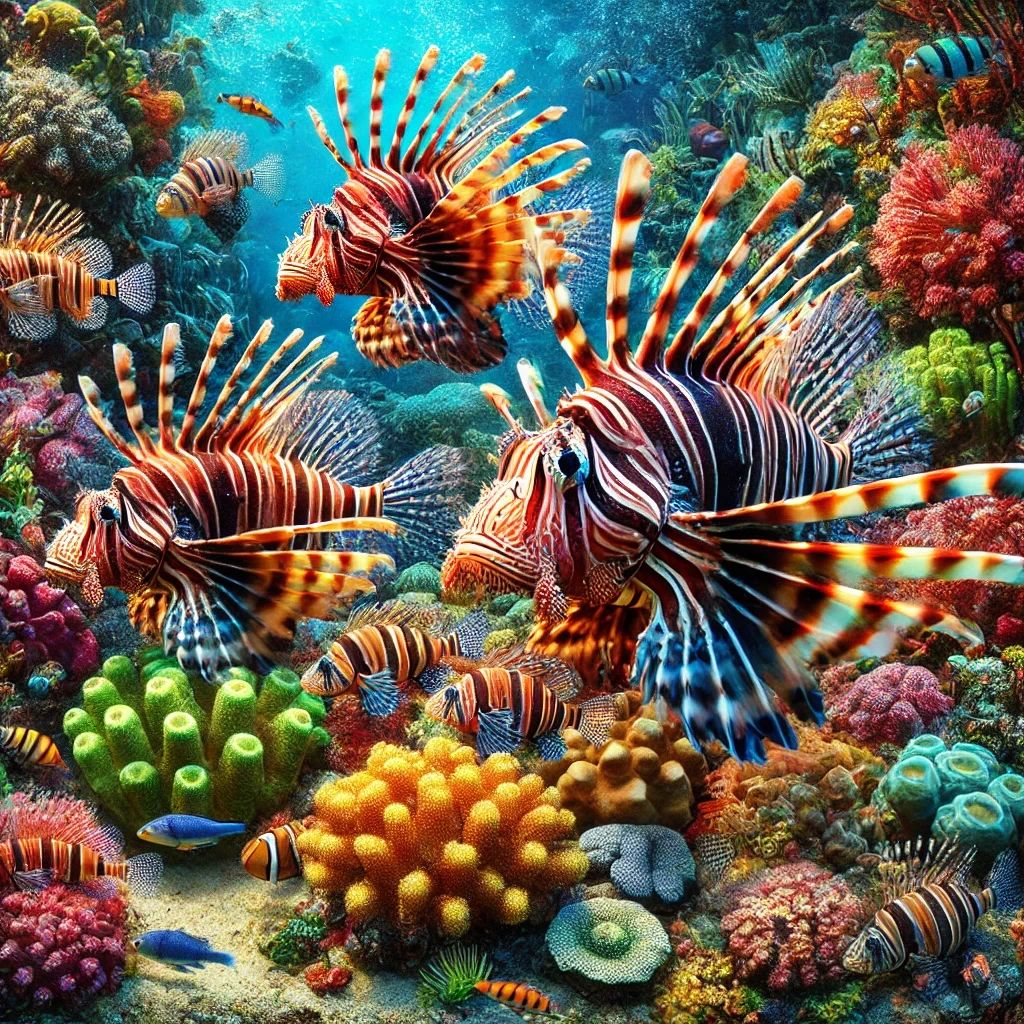
Beautiful But Deadly: The Truth About the Lionfish Invasion
With their exotic stripes, feathery fins, and elegant presence, lionfish look like royalty of the reef. But beneath their beauty lies a growing threat. In the Atlantic and Caribbean, these Indo-Pacific natives—Pterois volitans and Pterois miles—have become one of the most destructive invasive species on the planet.
This article explores the origins of the lionfish invasion, the science behind their spread, and the efforts being made to control their impact on our oceans.
🦁 How Did Lionfish Become an Invasive Species?
Lionfish first appeared off the coast of Florida in the 1980s. Most marine biologists believe their introduction to U.S. waters was due to the release of pet lionfish—either accidentally or intentionally.
Theories Behind the Invasion:
- Hurricane Andrew (1992): A storm-damaged aquarium may have unleashed lionfish into Biscayne Bay.
- Aquarium Trade Releases: Multiple introductions over time, likely linked to the exotic pet trade.
By the 2000s, lionfish had spread throughout the southeastern U.S., Caribbean, and Gulf of Mexico—establishing themselves as apex predators in ecosystems not prepared for them.
🌍 Why Are Lionfish Such a Dangerous Invasive Species?
Several traits make lionfish extraordinarily hard to stop:
TraitImpactHigh ReproductionOne female can produce up to 2 million eggs annually.No Natural PredatorsNative species don’t recognize lionfish as threats—or prey.Opportunistic DietThey consume over 70 species of reef fish and crustaceans.Habitat AdaptabilityFound in reefs, seagrasses, mangroves—even brackish waters.Venomous SpinesDeter predators and make handling dangerous for humans.
Their rapid spread and resilience make them nearly unstoppable in the wild.
🌊 The Ecological Damage of the Lionfish Invasion
Lionfish are doing more than displacing native species—they’re unraveling entire coral reef ecosystems.
1. 🐟 Decline of Native Reef Fish
Lionfish feed on juvenile species like gobies, damselfish, and wrasses—key players in reef maintenance. Their absence disrupts cleaning behaviors and algae control.
2. 🧪 Coral Imbalance & Algae Overgrowth
By eating herbivorous fish, lionfish indirectly promote algae growth that smothers corals. The natural predator-prey balance on reefs collapses.
3. 💸 Impact on Coastal Economies
Healthy reefs support tourism and fishing. Lionfish are threatening the livelihoods of coastal communities from Florida to Belize and beyond.
🎯 How Do Lionfish Hunt?
Lionfish are ambush predators, using their wing-like pectoral fins to herd prey into tight corners before striking with a suction-powered bite. Some even hunt in pairs, working cooperatively like the wolves of the reef.
🛠️ Fighting Back: How Humans Are Combating the Lionfish Invasion
1. Lionfish Derbies & Spearfishing Events
Communities across the Caribbean and Gulf Coast host derbies to remove as many lionfish as possible in a single day. It’s both sport and conservation.
2. Turning Lionfish Into Gourmet Seafood
The slogan “Eat ‘em to beat ‘em” is catching on. Their mild, white flesh is perfect for tacos, ceviche, or grilled dishes. Restaurants and chefs are stepping up.
3. Tech to the Rescue
Underwater robotics like the Guardian LF1 and experimental lionfish traps are being developed to access deep water populations beyond diver reach.
4. Public Education & Responsible Pet Ownership
Campaigns now warn aquarium owners not to release exotic pets into the wild. Outreach and regulation have helped reduce new introductions.
❓ Can We Eliminate Lionfish from the Atlantic?
In short—complete eradication is unlikely. Lionfish reproduce quickly, occupy a range of depths, and thrive in diverse habitats.
However, localized control works. Studies show that consistent removal in key areas can lead to the recovery of native species and coral health.
💡 Lessons from the Lionfish Invasion
This crisis offers a cautionary tale for marine conservation:
- Prevention is cheaper than control.
- Community action matters.
- Aquarium releases can have global consequences.
🌈 Hope on the Horizon
There’s reason to stay optimistic:
- Local populations are bouncing back in areas with regular removal efforts.
- Lionfish are gaining popularity as a food source.
- New tech tools may expand the fight into deeper waters.
Even more importantly, the lionfish invasion has opened new dialogues about marine protection, responsible trade, and ecological balance.
🚀 What You Can Do to Help
You don’t have to be a marine biologist to make a difference:
- 🏊 Join a lionfish hunting dive
- 🍽️ Support restaurants that serve lionfish
- 📚 Educate others about invasive species
- 🐠 Avoid releasing aquarium fish into the wild
Conclusion: Lionfish Invasion Calls for Action, Not Admiration
The lionfish may be mesmerizing, but their threat to our oceans is real. The more we understand, the better we can act. Share this article, get involved, and be part of the movement to protect our reefs from this silent predator.
References
Albins, M. A., & Hixon, M. A. (2008). Invasive Indo-Pacific lionfish Pterois volitans reduce recruitment of Atlantic coral-reef fishes. Marine Ecology Progress Series, 367, 233–238. https://doi.org/10.3354/meps07620
Côté, I. M., Green, S. J., & Hixon, M. A. (2013). Predatory fish invaders: Insights from Indo-Pacific lionfish in the western Atlantic and Caribbean. Biological Conservation, 164, 50–61. https://doi.org/10.1016/j.biocon.2013.04.014
Morris, J. A., Jr., & Whitfield, P. E. (2009). Biology, ecology, control and management of the invasive Indo-Pacific lionfish: An updated integrated assessment. NOAA Technical Memorandum NOS NCCOS 99. National Oceanic and Atmospheric Administration. https://repository.library.noaa.gov/view/noaa/1575
Johnston, M. W., & Purkis, S. J. (2014). Modeling the invasive Caribbean lionfish Pterois volitans population dynamics on natural and artificial reefs. Ecological Modelling, 283, 1–10. https://doi.org/10.1016/j.ecolmodel.2014.03.012
National Oceanic and Atmospheric Administration (NOAA). (n.d.). Lionfish: A Guide to Control and Management. NOAA Coral Reef Conservation Program. https://www.reef.org/sites/default/files/REEF_Lionfish_Guide_Control_Management.pdf
Green, S. J., Akins, J. L., Côté, I. M., Underwood, E. B., & Fraser, G. C. (2012). Invasive lionfish drive Atlantic coral reef fish declines. PLoS ONE, 7(3), e32596. https://doi.org/10.1371/journal.pone.0032596
de León, R., Vane, K., Bertuol, P., Chamberland, V. C., Simal, F., Imms, E., & Vermeij, M. J. (2013). Effectiveness of lionfish removal efforts in the southern Caribbean. Endangered Species Research, 22(2), 175–182. https://doi.org/10.3354/esr00542
Diller, J. L., Frazer, T. K., & Jacoby, C. A. (2014). Lethal lionfish: Predation on native reef fish by invasive lionfish Pterois volitans. Marine Ecology Progress Series, 509, 241–249. https://doi.org/10.3354/meps10814
Akins, J. L. (2012). Control strategies: Tools and techniques for local control. In J. A. Morris Jr. (Ed.), Invasive Lionfish: A Guide to Control and Management (pp. 24–47). Gulf and Caribbean Fisheries Institute. https://www.reef.org/sites/default/files/LionfishGuidetoControlManagement.pdf
About the Author
Rebecca “Madam Chronicler” Ryan is a writer and researcher for The Chronicler Library. She is the co-creator of The Chronicle of Fear and The Waterline Chronicles, and a lead researcher and contributor for The Captain’s War Chronicles and The Captain’s Cellar. Her work blends myth, history, and the natural world with empathy, insight, and intellectual rigor.
Originally published at the live site .