
Rivers ·
Mississippi River Explorers: Journeys Into America’s Mighty Water
The Mississippi River is one of the most legendary waterways in the world. Stretching over 2,300 miles from northern Minnesota to the Gulf of Mexico, it has shaped cultures, communities, and even the future of a nation. ...
By Rebecca "Madam Chronicler" Ryan
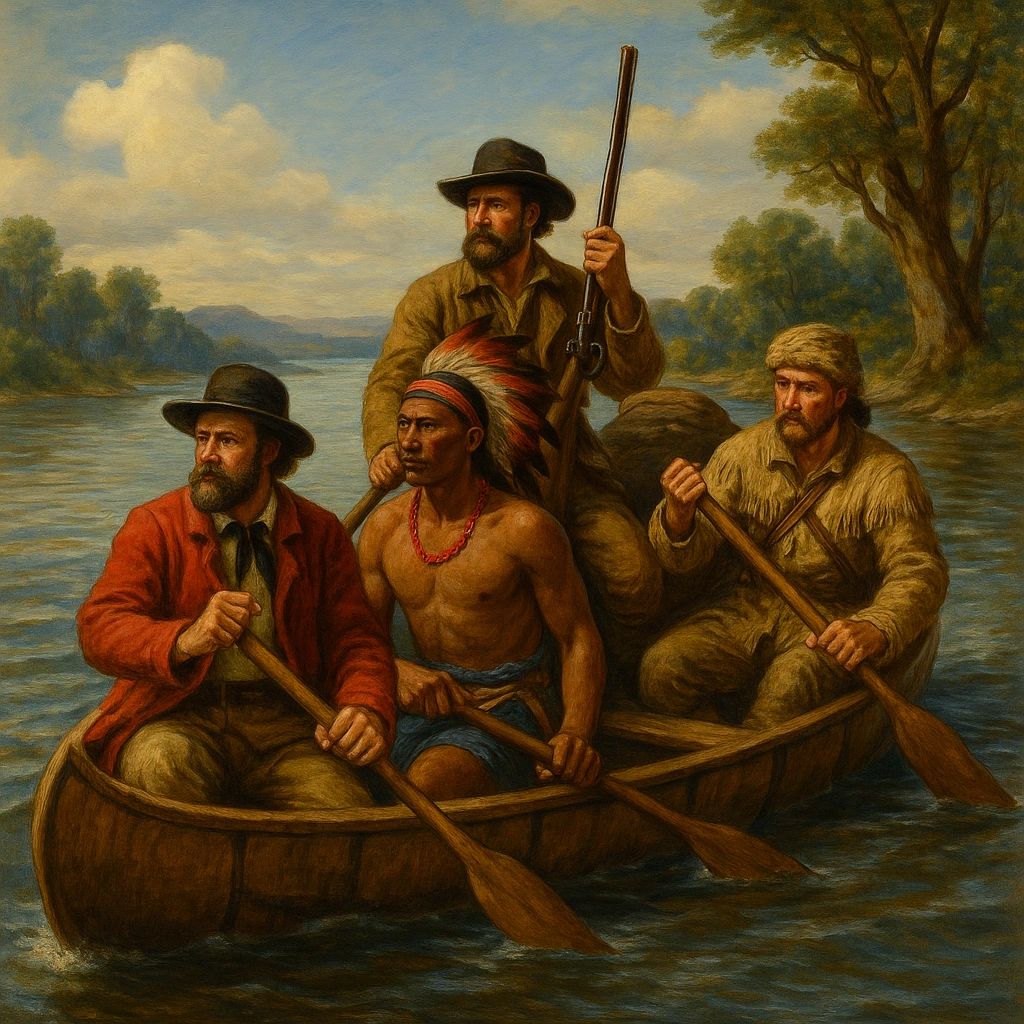
The Mississippi River is one of the most legendary waterways in the world. Stretching over 2,300 miles from northern Minnesota to the Gulf of Mexico, it has shaped cultures, communities, and even the future of a nation. Long before highways and railroads, the Mississippi served as the great highway of North America. For thousands of years, Indigenous peoples thrived along its banks, using it as a source of food, transportation, and cultural connection. Later, European explorers, fur traders, and settlers followed the river’s course, hoping to discover new lands, wealth, and opportunity.
This blog dives into the fascinating stories of the Mississippi River explorers. These adventurers—ranging from Indigenous navigators to French voyageurs, Spanish conquistadors, and American pioneers—each left their mark on this powerful river. Their journeys weren’t just about mapping geography but also about survival, cultural exchange, and the creation of new nations.
Before the Europeans: Indigenous Navigators
Long before Europeans arrived in North America, the Mississippi was home to thriving Indigenous nations. The river was central to their daily lives. Groups like the Mississippians, Choctaw, Chickasaw, Quapaw, and many others used canoes carved from hollowed logs to travel and trade.
Archaeological evidence shows that Native American societies along the Mississippi were skilled engineers and traders. The Mississippian culture, centered at Cahokia near present-day St. Louis, built massive earthen mounds that rivaled the pyramids of Egypt in size and complexity. These communities used the Mississippi River as a highway of commerce, connecting tribes across thousands of miles.
When European explorers first floated down the Mississippi, they didn’t discover an “untouched wilderness.” Instead, they entered a world already full of vibrant nations with deep knowledge of the river’s currents, floods, and resources. Indigenous peoples became guides, translators, and sometimes rivals in the centuries that followed.
Hernando de Soto: The Spanish Conquistador
The first known European to reach the Mississippi River was Hernando de Soto, a Spanish conquistador. In 1541, after years of searching for gold and riches in the southeastern United States, de Soto and his men stumbled upon the great river near present-day Mississippi.
De Soto’s expedition was harsh and violent. The Spaniards clashed with Indigenous peoples, seeking wealth but finding none of the gold they had dreamed of. Many Native communities suffered greatly during these encounters. De Soto himself died of fever in 1542, and his body was buried in the Mississippi River to prevent local tribes from finding it.
Though de Soto’s journey was tragic, it marked the first recorded European crossing of the Mississippi. His expedition spread stories in Europe of a “Father of Waters,” a river so wide and powerful it seemed endless.
French Explorers: Jacques Marquette and Louis Jolliet
More than a century later, French explorers arrived in North America with a different approach. In 1673, a Jesuit priest named Jacques Marquette and a fur trader named Louis Jolliet set out to explore the Mississippi River. Guided by Indigenous peoples, they paddled canoes down the river from the Great Lakes.
Their journey revealed that the river flowed south, not west toward the Pacific Ocean as some had hoped. This discovery proved that the Mississippi could become a key trade route connecting Canada with the Gulf of Mexico.
Marquette and Jolliet turned back near present-day Arkansas, worried about running into Spanish forces further south. Even so, their reports excited the French crown and opened the door for future expeditions.
Robert de La Salle: Claiming Louisiana
The most ambitious French explorer of the Mississippi was René-Robert Cavelier, Sieur de La Salle. In 1682, La Salle led an expedition all the way down the Mississippi to its mouth in the Gulf of Mexico.
There, he planted a French flag and claimed the entire Mississippi River basin for France. He named the land “Louisiana” after King Louis XIV. This bold claim stretched from the Great Lakes to the Gulf, covering much of central North America.
La Salle’s vision was grand: he dreamed of linking French Canada with Louisiana through a chain of forts and settlements along the Mississippi. While his dream wasn’t fully realized during his lifetime, his exploration laid the groundwork for France’s presence in the heart of the continent.
The Quapaw and Other Indigenous Allies
When La Salle’s expedition reached the lower Mississippi, they encountered the Quapaw people. Unlike de Soto’s hostile meetings a century earlier, this was a moment of alliance. The Quapaw welcomed the French, and their villages became important hubs of trade and diplomacy.
The Quapaw, Choctaw, and other Indigenous nations played a vital role in the survival of European explorers. They provided food, shared navigation knowledge, and built relationships that influenced future colonization. Without Indigenous allies, many explorations would have ended in disaster.
The Mississippi as a French Highway
By the 1700s, the Mississippi had become the backbone of French colonial life. Voyageurs—French-Canadian fur traders—traveled up and down the river in birchbark canoes, carrying goods to and from Native villages and French outposts. Settlements like New Orleans (founded in 1718) became key centers of trade.
The river linked the French empire from Quebec to Louisiana. Yet it also became a point of rivalry. Both Britain and Spain sought control of the Mississippi, and wars erupted over its riches and strategic value.
Lewis and Clark: The American Explorers
Fast forward to 1803. The United States had just purchased the Louisiana Territory from France in the famous Louisiana Purchase. Overnight, the Mississippi River became the lifeblood of a young nation.
To understand this new land, President Thomas Jefferson sent an expedition westward led by Meriwether Lewis and William Clark. While their main journey followed the Missouri River, the Mississippi was the foundation of their exploration. St. Louis, often called the “Gateway to the West,” became their launch point.
The Lewis and Clark expedition relied on knowledge passed down by Indigenous guides, including the famous Sacagawea. Their reports confirmed the vast potential of the Mississippi River system for settlement, trade, and expansion.
Steamboats and the Age of River Exploration
After the age of canoes and rafts came the steamboat. In 1811, the first steamboat traveled the Mississippi, revolutionizing river travel. Suddenly, explorers, settlers, and traders could move upstream against the current, opening new possibilities.
The steamboat era turned the Mississippi into a bustling highway. Explorers mapped tributaries, settlers pushed westward, and the river became central to America’s growth. Writers like Mark Twain, who worked as a riverboat pilot, later captured this era in stories that still bring the Mississippi to life today.
Scientific Explorers
By the mid-1800s, exploration wasn’t just about conquest or trade—it was about science. Geologists, botanists, and naturalists floated the Mississippi to study its ecosystems. They collected plants, documented wildlife, and mapped the river’s shifting channels.
John Wesley Powell, famous for exploring the Colorado River, also studied the Mississippi’s geology. Others recorded the migration of birds and fish, building knowledge that still informs conservation today.
Challenges of the River
For all its beauty, the Mississippi has always been a river of challenges. Explorers faced dangerous rapids, floods, and shifting sandbars. Mosquitoes spread diseases, while alligators and snakes lurked in the swamps.
The river also demanded respect. Its floods could wipe out entire settlements. For Native peoples, this power was a reminder of the river’s sacred role. For explorers, it was a constant test of endurance.
Legacy of the Mississippi River Explorers
So what did these explorers leave behind?
- Cultural Exchange – The Mississippi became a meeting place where Indigenous peoples, Europeans, and Africans shared traditions, foods, and languages.
- New Nations – Control of the Mississippi shaped the histories of Spain, France, Britain, and eventually the United States.
- Economic Growth – From fur trading to steamboats, the river fueled economies and expanded frontiers.
- Science and Knowledge – Explorers helped map North America and documented the natural world.
But there’s also a deeper story. Exploration of the Mississippi often came at a cost—especially for Indigenous peoples, who faced disease, displacement, and conflict as European powers fought for control. Today, remembering their role is just as important as honoring the famous European explorers.
Modern Explorers
Exploration of the Mississippi hasn’t ended. Today, scientists still study its waters to understand pollution, climate change, and ecosystems. Adventurers paddle its length in kayaks and canoes, testing their endurance.
Groups like the Mississippi River Commission manage its flow, while conservationists work to protect the wetlands and wildlife that call it home. The spirit of exploration continues—not in search of gold or empire, but in the quest to protect and preserve one of the world’s greatest rivers.
Conclusion
The story of Mississippi River explorers is really the story of America itself. From Indigenous navigators who knew the river as home, to Europeans who dreamed of empires, to Americans who saw it as a gateway to the West, the Mississippi has always been more than water. It is history, culture, and connection rolled into one mighty current.
Explorers came with many motives—curiosity, ambition, survival, science—but all were changed by the Mississippi’s power. Their journeys shaped maps, nations, and lives. And even today, the river flows on, carrying with it the stories of those who dared to explore its depths.
Bibliography
Balesi, C. M. (1992). The time of the French in the Heart of North America, 1673–1818. Chicago Historical Society.
Ekberg, C. J., & Tenny, D. (2015). French roots in the Illinois country: The Mississippi frontier in colonial times. University of Illinois Press.
Galloway, P. (1997). Choctaw genesis, 1500–1700. University of Nebraska Press.
Gibson, A. M. (2010). The Chickasaws. University of Oklahoma Press.
Hall, R. L. (1997). An archaeology of the soul: North American Indian belief and ritual. University of Illinois Press.
Morse, R. (1996). The American frontier: Expansion and exploration. Chelsea House.
Pekka, H. (2010). Empires and Indians in the Mississippi Valley. Cambridge University Press.
Remini, R. V. (2001). The Mississippi: A river and its history. HarperCollins.
Sullivan, C. (2009). Exploring the Mississippi. Lerner Publications.
Twain, M. (2007). Life on the Mississippi. Oxford University Press. (Original work published 1883)
Usner, D. H. (1992). Indians, settlers, and slaves in a frontier exchange economy: The Lower Mississippi Valley before 1783. University of North Carolina Press.
Originally published at the live site .