
Stories ·
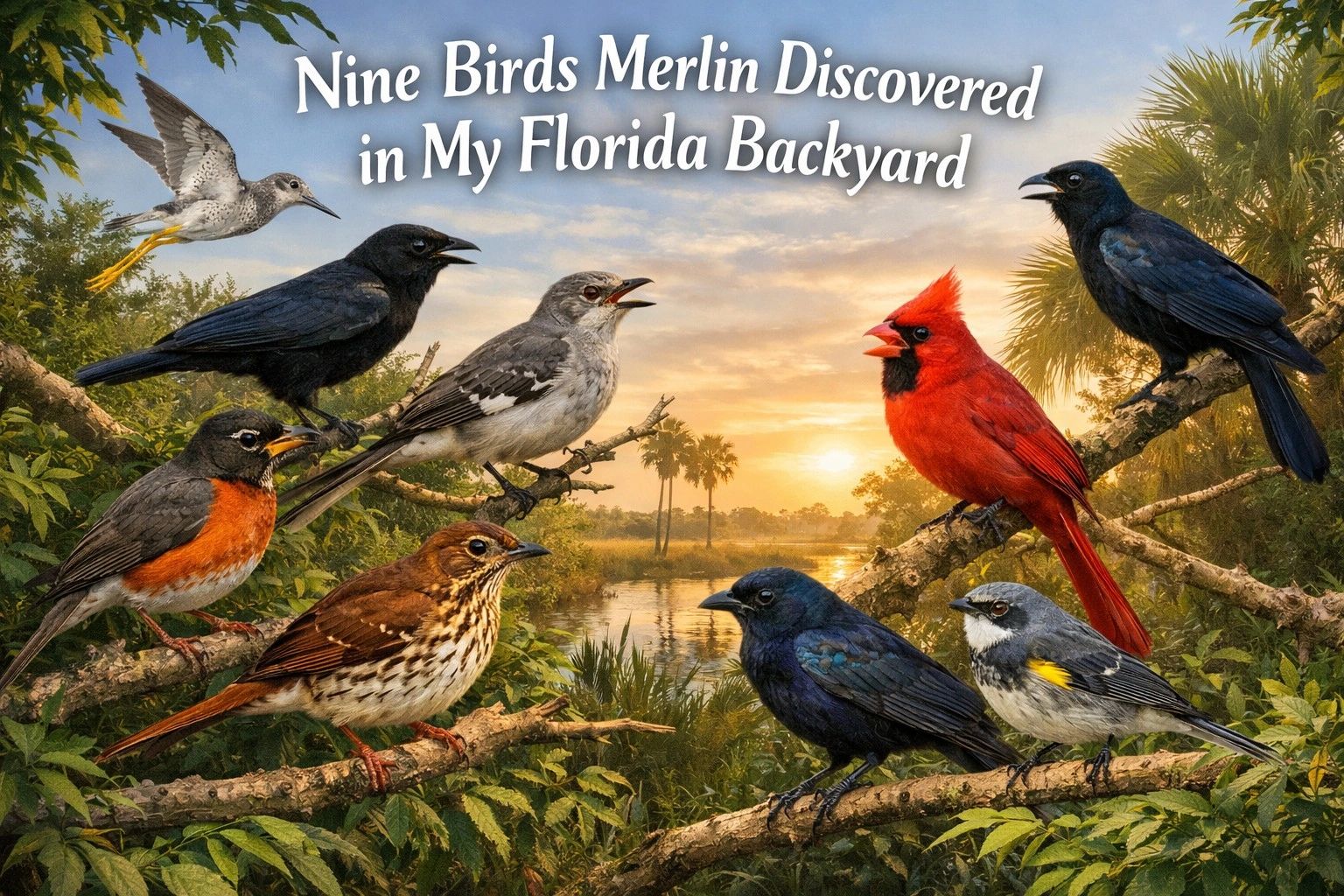
Nine Birds Merlin Discovered in My Florida Backyard
Early one quiet morning in my Florida backyard, while enjoying a fresh cup of coffee, the air buzzed with birdsong. Some sounds were familiar, while others were entirely new. The trees and shrubs surrounding the yard wer...
By Rebecca "Madam Chronicler" Ryan
Early one quiet morning in my Florida backyard, while enjoying a fresh cup of coffee, the air buzzed with birdsong. Some sounds were familiar, while others were entirely new. The trees and shrubs surrounding the yard were full of hidden singers, many of which remained out of sight.
Driven by curiosity to identify the singers, I launched the Merlin Bird ID app, created by the Cornell Lab of Ornithology, and initiated its Sound ID function. The app analyzes local bird calls to determine the species.
Within seconds, Merlin began to reveal the birds sharing the morning with me. Even though I couldn’t see them all, their songs told the story.
Over the next few minutes, Merlin identified nine different bird species nearby.
American Robin
One of the first songs Merlin recognized was a series of cheerful whistles emanating from a nearby tree.
The app identified the singer as an American Robin, a bird known for its bright orange-red chest and clear, musical song. Robins often sing phrases that many people describe as “cheerily, cheer up, cheer up.”
While American robins are commonly linked to northern states and the springtime, they can also be found in Florida during certain periods of the year. They often forage on lawns, searching for earthworms and insects.
Robins are excellent listeners. When hunting, they may tilt their heads slightly to the side, appearing to listen carefully for movement beneath the soil before pulling a worm.
Northern Mockingbird
Following the robin’s cheerful melody, a more intricate performance emerged.
The Northern Mockingbird was nearby, delivering a rapid series of repeated phrases, which Merlin quickly recognized.
Mockingbirds are renowned for their remarkable ability to mimic other birds. A single mockingbird can copy dozens of different sounds, repeating each phrase several times before moving on to the next.
These birds are common in Florida neighborhoods, parks, and open areas. Their bold personalities and impressive vocal skills earned them the title of Florida’s state bird.
Some mockingbirds sing even late into the night, especially during breeding season.
Boat-Tailed Grackle
A distinct, metallic sound soon joined the morning chorus.
Merlin identified the call as a Boat-Tailed Grackle, a large blackbird often found near coastal areas and wetlands.
Male boat-tailed grackles are glossy black with long, keel-shaped tails, while females are typically brown. Their calls are often described as sounding like a rusty gate or squeaky hinge.
These birds are commonly found along Florida’s coastlines, in lagoons and marshes. They are opportunistic feeders, often seen searching for food in parking lots, docks, and shoreline vegetation.
Greater Yellowlegs
From a distance, a sharp, whistling call emerged.
Merlin identified the sound as a Greater Yellowlegs, a tall shorebird known for its long yellow legs and slender body.
Greater yellowlegs are migratory birds that travel between breeding grounds in northern North America and wintering areas further south, including Florida.
They can often be found in marshes, shallow lagoons, and tidal flats, where they wade through the water to search for small fish, insects, and crustaceans.
Their distinctive, loud whistles act as alarm calls, warning of potential danger.
Fish Crow
Soon, another familiar bird made itself known.
The app detected a Fish Crow, a species commonly found near rivers, coastlines, and estuaries. At first glance, fish crows look almost identical to American crows.
However, their call is distinctive. Instead of the typical “caw,” fish crows make a short, nasal sound often described as “uh-uh.”
These adaptable birds often gather near water, feeding on fish, shellfish, insects, and scraps of food.
Common Grackle
A few moments later, Merlin identified another blackbird in the area: the Common Grackle.
Common grackles are large, glossy birds with long tails and striking yellow eyes. Their plumage can appear iridescent with shades of purple and blue when sunlight hits their feathers.
Their calls consist of a mix of clicks, whistles, and squeaks, occasionally sounding almost mechanical.
Common grackles are highly social birds, often seen in enormous flocks numbering in the thousands.
Brown Thrasher
Hidden within dense shrubs, another singer joined the growing list.
Merlin identified the bird as a Brown Thrasher, a secretive species known for its rich brown coloring and streaked chest.
Brown thrashers are remarkable vocalists, capable of singing hundreds of different song variations, often repeating each phrase twice before moving on.
Because they favor dense vegetation, they are typically heard more often than seen.
Yellow-Rumped Warbler
Among the many voices in the morning chorus was the soft trill of a small songbird.
Merlin identified the sound as a Yellow-Rumped Warbler, a migratory bird often seen in Florida during the winter.
These small birds are easily recognized by their bright yellow patches on their rumps, sides, and crowns.
Unlike many other warblers, yellow-rumped warblers can digest waxy berries, which helps them survive when insects are scarce during colder months.
Northern Cardinal
One of the clearest songs of the morning came from a bright red bird perched nearby.
Merlin identified the singer as a Northern Cardinal, a very recognizable bird in North America.
Male cardinals are renowned for their brilliant red feathers and distinctive crests. Their songs consist of strong, clear whistles that many people interpret as phrases such as “cheer-cheer-cheer” or “birdie-birdie-birdie.”
Interestingly, both male and female cardinals sing, a characteristic that is unusual among many bird species.
Cardinals are common in Florida neighborhoods, forests, and parks, often visiting backyard bird feeders.
Listening to the Backyard
What began as a simple moment of curiosity quickly turned into a fascinating glimpse into the hidden wildlife surrounding my backyard.
Even without seeing most of the birds, their songs revealed their presence. With the help of Merlin’s Sound ID feature, nine different species were identified within just a few minutes.
Experiences like this show that even an ordinary backyard can host a surprising diversity of wildlife. Sometimes all it takes is stopping to listen.
Bibliography
Cornell Lab of Ornithology. Merlin Bird ID App. Cornell University.
Cornell Lab of Ornithology. All About Birds.
National Audubon Society. Guide to North American Birds.
Sibley, David Allen. The Sibley Guide to Birds. Alfred A. Knopf.
Florida Fish and Wildlife Conservation Commission. Florida Bird Species Information.
Originally published at the live site .