
Places ·
St. Augustine – Surrounded by Water, Pirates, and Shipwrecks
When people talk about St. Augustine, Florida, they often call it “the oldest city in the United States.” Founded by the Spanish in 1565, St. Augustine is more than just a quaint coastal town with cobblestone streets and...
By Rebecca "Madam Chronicler" Ryan
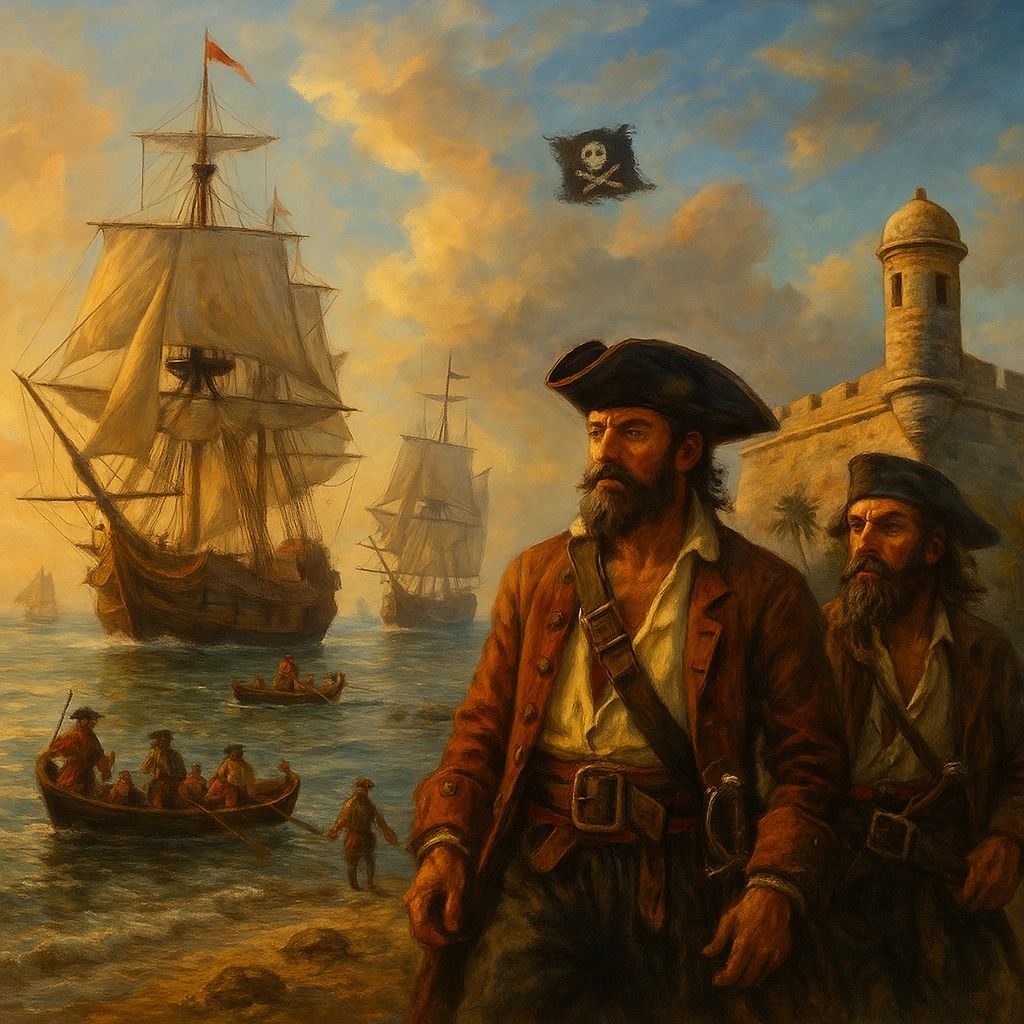
When people talk about St. Augustine, Florida, they often call it “the oldest city in the United States.” Founded by the Spanish in 1565, St. Augustine is more than just a quaint coastal town with cobblestone streets and historic buildings. Its entire identity has always been tied to the water. From the very beginning, St. Augustine was surrounded by rivers, marshes, and the mighty Atlantic Ocean. This watery world shaped its economy, its defenses, and its culture.
But water also brought danger. Pirates prowled the seas, storms scattered ships into the shallows, and rival empires sent war fleets to attack the settlement. Today, the story of St. Augustine is a tale of survival and adventure, with pirates, shipwrecks, treasure hunters, and explorers all playing a role in its history.
Let’s dive into the fascinating story of how water, pirates, and shipwrecks defined St. Augustine, the “Ancient City” of Florida.
A City Born of the Sea
St. Augustine was founded on September 8, 1565, by Spanish admiral Pedro Menéndez de Avilés. Spain wanted a permanent base in Florida to protect its treasure fleets sailing back to Europe from the Caribbean. Those fleets carried gold, silver, and precious goods from the Americas, and pirates—as well as rival nations like France and England—wanted a piece of that wealth.
The spot Menéndez chose had everything Spain needed: a safe harbor, access to the sea, and natural waterways like the Matanzas River and Salt Run that could serve as both defense and transportation routes. The Atlantic coastline, however, was tricky. Shifting sandbars, shallow inlets, and powerful storms often trapped or sank ships. For sailors, the waters around St. Augustine were both a lifeline and a threat.
Archaeological digs in the city and nearby shipwrecks show just how tied to the water St. Augustine really was. Items like navigational instruments, cannons, and even ballast stones reveal that this was a place where the sea dictated daily life (McEwan, 1993).
Pirates in St. Augustine’s Waters
From the 16th through the 18th centuries, the waters off Florida were teeming with pirates and privateers. Pirates were outlaws who attacked ships for treasure, while privateers were pirates with a license—essentially permission from a government to raid enemy ships during wartime.
Sir Francis Drake’s Raid (1586)
One of the most famous pirate attacks on St. Augustine happened in 1586 when English privateer Sir Francis Drake arrived with 23 ships. Drake had already plundered Spanish settlements in the Caribbean and saw St. Augustine as an easy target.
Spanish accounts describe how Drake’s men stormed the settlement, burning houses, stealing supplies, and setting fire to the church. The Spanish defenders fled into the marshes, leaving the town in ruins (Kelsey, 1998). This raid proved that Spain needed stronger defenses if St. Augustine was to survive.
Captain Robert Searle (1668)
Eighty years later, another English pirate named Robert Searle struck. Sailing out of Jamaica, Searle and his crew raided St. Augustine in 1668, looting homes and kidnapping residents. Searle’s attack was so brutal that it spurred Spain to build the famous Castillo de San Marcos, the massive stone fortress that still stands today (Deagan & Thomas, 2009).
The Golden Age of Piracy
During the late 1600s and early 1700s—the so-called “Golden Age of Piracy”—famous pirates like Blackbeard and Henry Jennings roamed the Florida coast. While there’s no direct record of Blackbeard raiding St. Augustine, legends claim he prowled the waters nearby. Pirate lore became woven into the city’s identity, and even today, visitors can find pirate museums and reenactments that celebrate this swashbuckling past.
Shipwrecks Around St. Augustine
The coast near St. Augustine has been called a “graveyard of ships.” Storms, shifting sands, and battles all contributed to a long history of shipwrecks.
Treasure Fleets and Hurricanes
One of the most famous events tied to shipwrecks near Florida was the disaster of the Spanish treasure fleets. In 1715 and again in 1733, hurricanes smashed Spanish convoys carrying gold and silver from the Americas. Many ships sank off Florida’s east coast, including some near St. Augustine.
These wrecks became targets for both pirates and treasure hunters. Salvagers in the 18th century used diving bells and primitive gear to recover coins, silver bars, and jewels. Even today, modern treasure hunters continue to search the waters near St. Augustine for these lost riches (Smith, 1995).
Archaeological Shipwreck Discoveries
Marine archaeologists have located dozens of wrecks near St. Augustine. For example, the Storm Wreck, discovered in 2009, dates to the late 1700s and contained cannons, navigational tools, and personal items from sailors (Meide, 2013). Another, known as the Anniversary Wreck, was found in 2015 and is believed to be part of a Spanish convoy.
Each wreck is like a time capsule, revealing details about trade, warfare, and everyday life at sea. These finds show just how dangerous the waters were and how St. Augustine stood at the crossroads of empire, piracy, and shipwrecks.
The Castillo de San Marcos – Fortress Against the Sea
After centuries of pirate raids and shipwrecks, Spain realized it needed a permanent, powerful defense for St. Augustine. In 1672, they began building the Castillo de San Marcos, a massive stone fort made of coquina (a type of limestone made of shell fragments).
The fort’s design used bastions and thick walls that could withstand cannon fire. Most importantly, it gave Spain control over the harbor. From its walls, soldiers could watch for pirate sails on the horizon or enemy fleets trying to blockade the city.
The Castillo proved its worth during sieges by the British in 1702 and 1740. Despite bombardments, the fort held strong, saving the city from destruction. Without it, St. Augustine might not have survived as the oldest European city in America (Manucy, 1947).
Myths, Legends, and Pirate Treasure
St. Augustine isn’t just about history—it’s also about legend. For centuries, locals have whispered stories about hidden pirate treasure buried in the marshes and beaches around the city.
Some tales say Captain Kidd or Blackbeard buried gold on Anastasia Island, while others claim ghostly ships sail the waters near the Matanzas Inlet. Though most of these stories are folklore, they add color to St. Augustine’s maritime identity.
Tour guides often share stories of haunted shipwrecks, cursed treasure, and ghostly pirates wandering the streets at night. While these tales may not be supported by archaeology, they show how deeply piracy and shipwrecks remain part of local culture.
St. Augustine Today – Living With Its Maritime Past
Walking around St. Augustine today, you can still feel its connection to the water. The Matanzas River flows past the Castillo, shrimp boats dock in the harbor, and sailboats drift across the Atlantic horizon.
Tourists can visit the Pirate & Treasure Museum, explore the Castillo de San Marcos, or even take ghost tours that recount pirate legends. Divers and archaeologists continue to explore shipwrecks off the coast, and local museums preserve artifacts pulled from the sea.
The city thrives on this identity. Its history of water, pirates, and shipwrecks isn’t just something in textbooks—it’s alive in festivals, reenactments, and community pride.
Why St. Augustine’s Maritime History Still Matters
St. Augustine’s story is more than just local history. It shows how water shaped the entire development of the Americas. The Spanish empire depended on treasure fleets, and pirates were a global force that disrupted trade and reshaped geopolitics. Shipwrecks became archaeological windows into the past, letting us study everyday life at sea.
For historians, archaeologists, and adventurers alike, St. Augustine remains one of the most fascinating places in North America. It is a city where the ocean shaped every choice, where pirates left their mark, and where shipwrecks still whisper secrets from beneath the waves.
Conclusion
St. Augustine is not just the oldest city in the United States—it is a city defined by water. From its founding in 1565 to the pirate raids that scarred its shores, from treasure fleets that sank in hurricanes to modern divers uncovering wrecks, the story of St. Augustine is one of resilience and adventure.
Surrounded by water, shaped by pirates, and haunted by shipwrecks, this coastal city stands as a living reminder of how the sea has always been both a gift and a danger. And as long as the waves keep rolling onto the beaches of St. Augustine, its maritime legacy will never fade.
Bibliography
Deagan, K., & Thomas, D. (2009). From Santa Elena to St. Augustine: Archaeology of the First Spanish Colony in the United States. University Press of Florida.
Kelsey, H. (1998). Sir Francis Drake: The Queen’s Pirate. Yale University Press.
Manucy, A. (1947). Castillo de San Marcos: A History of Its Construction, 1672–1702. National Park Service.
McEwan, B. G. (1993). Spanish Missions of La Florida. University Press of Florida.
Meide, C. (2013). “The Storm Wreck: An American Revolutionary War Shipwreck off St. Augustine, Florida.” The International Journal of Nautical Archaeology, 42(2), 295–304.
Smith, R. C. (1995). Treasure Shipwrecks of the Florida Coast. Pineapple Press.
Originally published at the live site .