
Maritime ·
The Amazing Bodies of Sharks: Nature’s Perfect Predators
Sharks are some of the most fascinating creatures on Earth! Their bodies are built for survival, speed, and power. In fact, sharks have been swimming in our oceans for more than 400 million years—way before dinosaurs wal...
By Rebecca "Madam Chronicler" Ryan
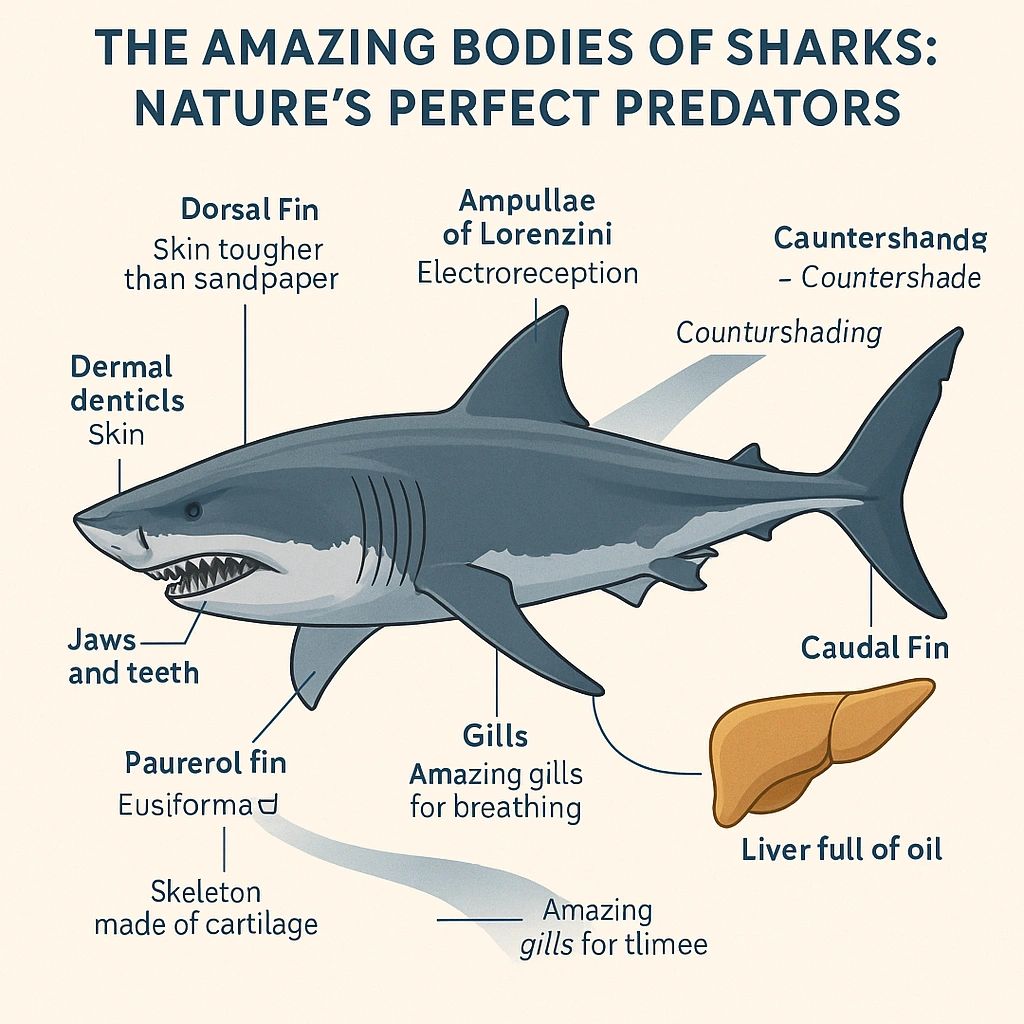
Sharks are some of the most fascinating creatures on Earth! Their bodies are built for survival, speed, and power. In fact, sharks have been swimming in our oceans for more than 400 million years—way before dinosaurs walked the planet. They come in all shapes and sizes, but every shark shares special features that help them thrive in their underwater world.
Today, let’s dive deep into the amazing bodies of sharks and discover what makes them such perfect predators!
1. The Shape That Rules the Seas
One of the first things you’ll notice about a shark is its streamlined shape. Their bodies are shaped like torpedoes. This is called a fusiform shape. It allows them to glide through the water easily, reducing drag and letting them swim fast with little effort.
Some sharks, like the shortfin mako shark (Isurus oxyrinchus), can swim as fast as 45 miles per hour (Compagno, 2001)! Their sleek bodies help them chase down prey like tuna and swordfish.
But not all sharks are built for speed. Some, like the whale shark (Rhincodon typus), have wide, flattened heads and slower swimming styles. They’re filter feeders, slowly moving through the water to scoop up plankton.
2. Powerful Fins: Built for Balance and Speed
Sharks have several types of fins, and each plays a special role.
Dorsal Fins:
These are the famous fins you see sticking out of the water in shark movies! The dorsal fin helps with stability, preventing the shark from tipping over. Some sharks, like the great white (Carcharodon carcharias), have large dorsal fins that also aid in fast swimming.
Pectoral Fins:
Located on the sides of the shark, these fins work like airplane wings. They lift the shark as it swims, allowing it to glide through the water.
Caudal Fin (Tail Fin):
This is the powerhouse of the shark. The tail fin propels the shark forward, with its shape affecting the shark’s speed and swimming style. Fast sharks have crescent-shaped tails, while slower ones have more rounded tails.
3. Skin Tougher Than Sandpaper
A shark’s skin isn’t smooth like it looks. It’s actually rough and feels like sandpaper! This is because of tiny, tooth-like scales called dermal denticles. These denticles reduce drag and help sharks swim faster by creating tiny whirlpools that push water more efficiently along their bodies (Reif, 1978).
Interestingly, these denticles also help sharks sneak up on prey. By reducing noise and turbulence, sharks can approach without being detected.
4. Jaws of Steel
One of the most famous parts of a shark’s body is its jaw. Sharks have some of the strongest bites in the animal kingdom. Their jaws are not fused to their skulls, which allows them to extend their mouths forward and take huge bites.
Most sharks have several rows of teeth. When one tooth falls out, another moves forward to replace it. This means they are never without teeth! Some sharks, like the bull shark (Carcharhinus leucas), can have as many as 350 teeth at one time.
Different sharks have different kinds of teeth based on their diet:
- Sharp, pointed teeth for grabbing fish (like the mako shark).
- Flat, crushing teeth for eating crabs and shellfish (like the nurse shark).
- Serrated teeth for tearing into large prey (like the great white shark).
5. Super Senses
Sharks have some of the best senses in the ocean.
Smell:
Sharks are often called “swimming noses.” They can detect tiny amounts of blood in the water from miles away (Tester, 1963).
Sight:
Many sharks can see well in dim light. Some even have a special reflective layer in their eyes, called the tapetum lucidum, which helps them see in the dark.
Hearing:
Sharks can hear low-frequency sounds from long distances. They are drawn to the sounds of struggling fish.
Electroreception:
One of the coolest things about sharks is their Ampullae of Lorenzini. These are small, jelly-filled pores around their snouts that detect electric fields. Every living thing gives off a small electric charge, and sharks can sense it! This helps them find hidden prey, even under sand or inside caves (Kalmijn, 1971).
6. A Nose Like No Other
The shark’s nose is all about detecting smells, not for breathing. Their nostrils, called nares, help them follow scent trails in the water. Some sharks can even tell which nostril received a scent first, allowing them to track scents like a bloodhound.
7. Amazing Gills for Breathing
Unlike people, sharks don’t have lungs. Instead, they breathe through gills located on the sides of their heads. As water passes over their gills, oxygen is absorbed into their bodies.
Some sharks, like the great white, must keep swimming to breathe. This is called obligate ram ventilation. Other sharks, like the nurse shark, can pump water over their gills while resting on the ocean floor.
8. Livers Full of Oil
Sharks don’t have swim bladders like many fish. Instead, they rely on their large, oily livers to stay buoyant. The liver can make up about 25% of their body weight and is packed with a special oil called squalene that helps them float (Baldridge, 1970).
This oil is also a source of energy. If food becomes scarce, sharks can use the oil for fuel.
9. A Skeleton Made of Cartilage
Unlike bony fish, sharks don’t have bones! Their skeletons are made of cartilage, the same flexible material found in human noses and ears.
Cartilage is strong but much lighter than bone, which makes sharks more flexible and helps them swim quickly and gracefully.
10. Body Sizes That Stun
Sharks come in many different sizes.
Smallest Shark:
The dwarf lanternshark (Etmopterus perryi) is only about 8 inches long—small enough to fit in your hand! It lives deep in the ocean and can even glow in the dark.
Largest Shark:
The whale shark (Rhincodon typus) can grow up to 40 feet long! Despite its size, it’s a gentle giant that eats tiny plankton.
Strongest Bite:
The great white shark holds the record for the strongest bite force among sharks, capable of more than 4,000 pounds per square inch (Wroe et al., 2008).
11. Shark Reproduction: A Unique Strategy
Shark reproduction is just as fascinating as their bodies. Depending on the species, sharks can give birth in different ways.
Oviparous (Egg-laying):
Some sharks, like the horn shark, lay eggs in protective cases called “mermaid’s purses.” The eggs hatch later, and baby sharks emerge.
Viviparous (Live Birth with Placenta):
Other sharks, like the hammerhead, give birth to live pups that develop inside the mother and are nourished through a placenta—just like humans!
Ovoviviparous (Eggs Hatch Inside):
Most sharks fall into this category. The eggs hatch inside the mother, and the pups are born alive, ready to swim right away.
Some shark species even practice intrauterine cannibalism, where the strongest pups eat their siblings before birth, like the sand tiger shark (Carcharias taurus) (Gilmore, Dodrill, & Linley, 1983).
12. Body Camouflage and Colors
Sharks often have colors that help them blend into their surroundings.
Countershading:
Many sharks are darker on top and lighter underneath. This is called countershading. It makes them hard to spot from both above and below. From above, they blend into the dark ocean depths, and from below, they blend with the bright surface.
Some sharks even have special markings. The thresher shark has a long, whip-like tail used to stun prey. Others, like the tiger shark, have stripes that fade as they age.
13. Healing Powers
Sharks are known for their ability to heal quickly. Their wounds rarely get infected, and they can recover from injuries that would be fatal to other animals. Scientists are studying shark skin and immune systems to learn more about their healing abilities (Rasmussen, Crow, & Becker, 2020).
14. Built to Survive
With all these incredible body features, it’s no wonder sharks have survived for hundreds of millions of years. They’ve outlasted dinosaurs, ice ages, and countless environmental changes.
Sadly, many sharks are now at risk because of overfishing, pollution, and habitat loss. Understanding their bodies and how they survive can help people protect them.
Conclusion: Nature’s Marvelous Design
Sharks are some of the most incredible creatures on the planet. Every part of their body has a purpose, from their rough skin to their powerful jaws and super senses. These adaptations make them perfectly suited for life in the ocean, whether they’re speedy hunters or slow-moving giants.
Next time you hear about sharks, remember—they’re not just “scary predators.” They are living fossils, amazing athletes, and vital parts of the ocean’s ecosystems.
By learning about their incredible bodies, we can appreciate them for what they truly are: nature’s perfect predators!
Bibliography (APA Format)
Baldridge, H. D. (1970). Shark repellent studies: Repellency of several chemical fractions from shark liver oil. Naval Research Reviews, 23(9), 15-18.
Compagno, L. J. V. (2001). Sharks of the World: An Annotated and Illustrated Catalogue of Shark Species Known to Date. FAO Species Catalogue for Fishery Purposes, No. 1, Volume 2.
Gilmore, R. G., Dodrill, J. W., & Linley, P. A. (1983). Reproductive biology of the sand tiger shark, Carcharias taurus (Rafinesque). Fishery Bulletin, 81(2), 201-225.
Kalmijn, A. J. (1971). The electric sense of sharks and rays. Journal of Experimental Biology, 55(2), 371-383.
Rasmussen, L. E. L., Crow, G. L., & Becker, J. J. (2020). Investigations of wound healing in sharks. Marine Biology Research, 16(6), 517–525.
Reif, W. E. (1978). Wound healing in sharks: Morphology, ultrastructure, and histochemistry. Journal of Morphology, 157(2), 115-137.
Tester, A. L. (1963). The role of olfaction in shark feeding behavior. Pacific Science, 17(2), 145-170.
Wroe, S., McHenry, C., & Thomason, J. (2008). Bite club: Comparative bite force in big biting mammals and the prediction of predatory behavior in fossil taxa. Proceedings of the Royal Society B: Biological Sciences, 275(1631), 1559-1565.
Originally published at the live site .