
Rivers ·
The Birds Along the Mississippi River: Nature’s Feathered Highway
The Mississippi River is more than just one of America’s greatest waterways. It is also one of the most important bird highways in the world. Stretching over 2,300 miles from Minnesota to the Gulf of Mexico, the river wi...
By Rebecca "Madam Chronicler" Ryan
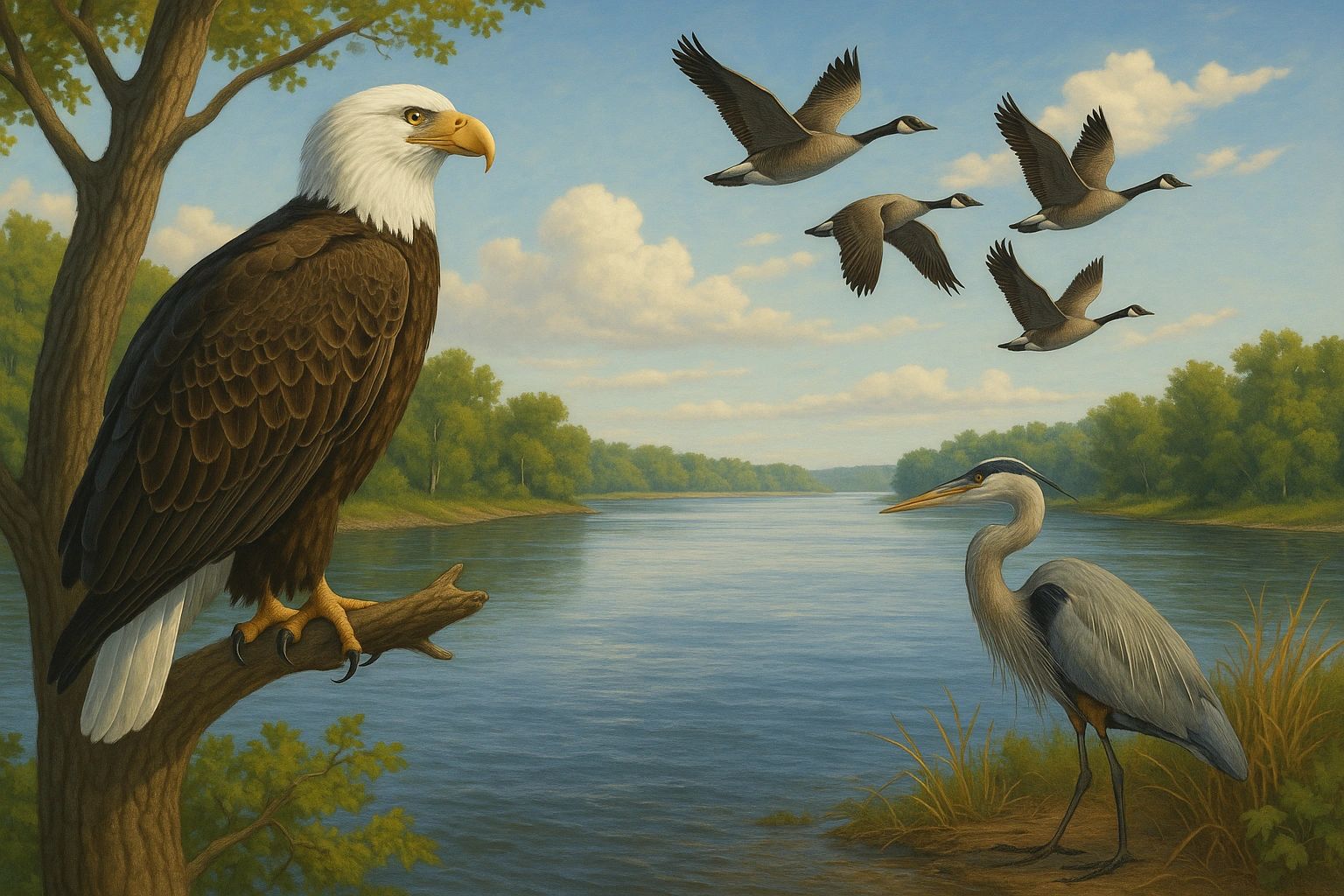
The Mississippi River is more than just one of America’s greatest waterways. It is also one of the most important bird highways in the world. Stretching over 2,300 miles from Minnesota to the Gulf of Mexico, the river winds through forests, wetlands, prairies, and deltas. These habitats make it a paradise for birds of all kinds—from tiny warblers to mighty eagles. If you’ve ever stood along the riverbanks, you’ve probably heard the songs, seen the flocks, or watched the swoop of wings overhead.
In this blog, we’ll dive deep into the fascinating world of the birds of the Mississippi River. You’ll discover why this river is so important to migratory species, meet some of the most famous feathered residents, and explore the challenges they face today. By the end, you’ll understand why the Mississippi River isn’t just a waterway—it’s a lifeline for millions of birds.
The Mississippi Flyway: A Superhighway in the Sky
The Mississippi River lies at the heart of the Mississippi Flyway, one of the four major bird migration routes in North America. Each spring and fall, more than 325 species of birds use this flyway to travel between their breeding and wintering grounds . Some fly as far north as Canada’s boreal forests and as far south as the Amazon rainforest.
Why do so many birds follow the Mississippi? The answer lies in its geography and resources. The river offers a natural guide, pointing birds south in the fall and north in the spring. Along the way, it provides wetlands, forests, and backwaters full of food and shelter. This makes it easier for birds to rest and refuel during their long journeys.
Some scientists even call the Mississippi River one of the most important bird migration corridors on the planet . Without it, many bird species would struggle to complete their incredible journeys.
Resident Birds of the River
Not all birds are just passing through. Many species call the Mississippi River home year-round. These include:
Bald Eagles
Few birds inspire awe like the Bald Eagle (Haliaeetus leucocephalus). Once endangered due to hunting and pesticide use, Bald Eagles have made a strong comeback thanks to conservation efforts . Today, they are a common sight along the river, especially near dams and locks where fish are plentiful. In winter, huge gatherings of eagles can be seen, especially in places like the Upper Mississippi National Wildlife and Fish Refuge.
Great Blue Herons
Tall and graceful, Great Blue Herons (Ardea herodias) stalk the shallows of the river, spearing fish with lightning-fast strikes. They can often be seen standing motionless for long periods, waiting for the perfect catch. Herons nest in colonies called rookeries, often in tall trees near backwaters.
Wood Ducks
The colorful Wood Duck (Aix sponsa) is one of the river’s most beautiful residents. With their iridescent feathers and striking patterns, they are a favorite among birdwatchers. Wood Ducks prefer wooded wetlands, where they nest in tree cavities or man-made nest boxes.
Migratory Visitors: The Seasonal Guests
The real magic of the Mississippi River is revealed during migration seasons. Millions of birds pass through, turning the skies into moving tapestries of wings.
Warblers
In spring, birders eagerly await the arrival of warblers—small, brightly colored songbirds that migrate from Central and South America. Species like the Yellow Warbler, Black-and-White Warbler, and American Redstart fill river forests with their songs.
Warblers are insect eaters, and they rely on the flush of spring insects to fuel their journey north. Without healthy riparian forests, their migration would be nearly impossible .
Sandhill Cranes
Every fall and spring, flocks of Sandhill Cranes (Antigone canadensis) stop along the Mississippi to rest and feed. Their loud, trumpeting calls echo across wetlands. With wingspans reaching up to 7 feet, these ancient birds have been migrating for millions of years .
Ducks and Geese
Waterfowl are perhaps the most famous migrants of the Mississippi Flyway. Species like Mallards, Canvasbacks, Snow Geese, and Canada Geese travel in vast numbers. Some wetlands host hundreds of thousands of ducks during peak migration. For hunters and conservationists alike, these migrations are symbols of the river’s abundance.
Rare and Special Birds of the River
Some birds of the Mississippi River are less common but no less fascinating.
Prothonotary Warbler
Known as the “Golden Swamp Warbler,” the Prothonotary Warbler (Protonotaria citrea) nests in tree cavities near flooded forests. Its bright yellow plumage glows in the dim light of bottomland hardwood forests. Sadly, habitat loss has caused population declines .
Whooping Crane
One of North America’s rarest birds, the Whooping Crane (Grus americana), once teetered on the edge of extinction. Thanks to conservation efforts, a small population has been reintroduced to parts of the Mississippi Flyway. With only a few hundred individuals alive, spotting one is a once-in-a-lifetime experience .
Peregrine Falcon
The Peregrine Falcon (Falco peregrinus) is the fastest bird in the world, capable of diving at speeds over 200 mph. Once nearly wiped out by pesticides, Peregrines now nest on Mississippi River bridges and bluffs, where they prey on pigeons, ducks, and other birds .
The Role of Habitats Along the River
The Mississippi River’s bird diversity depends on its variety of habitats. Each habitat supports different species:
- Floodplain Forests: Home to warblers, woodpeckers, and owls.
- Backwaters and Sloughs: Feeding grounds for herons, egrets, and ducks.
- Sandbars and Islands: Nesting sites for terns and plovers.
- Wetlands and Marshes: Critical for waterfowl, cranes, and shorebirds.
Scientists emphasize that without these habitats, many bird populations would collapse . The Mississippi is not just a river—it’s an ecosystem that sustains life for countless feathered travelers.
Threats Facing Birds of the Mississippi River
Despite its importance, the Mississippi River ecosystem faces many challenges. These include:
Habitat Loss
Development, agriculture, and river engineering have reduced wetlands and forests along the river. For birds, this means fewer resting and feeding sites .
Pollution
Runoff from farms carries pesticides and fertilizers into the river. These chemicals can poison birds directly or reduce insect populations they rely on for food.
Climate Change
Warming temperatures are altering migration patterns. Some birds are arriving earlier in spring, which may not match the timing of insect hatches .
Collisions
Birds migrating along the river face hazards like tall buildings, power lines, and wind turbines. Millions die each year from collisions .
Conservation Success Stories
Thankfully, there is hope. Many organizations are working to protect the birds of the Mississippi River.
National Wildlife Refuges
The Upper Mississippi River National Wildlife and Fish Refuge, stretching 261 miles through four states, is a haven for birds. It protects critical habitats for more than 300 species .
The Migratory Bird Treaty Act
This landmark law, passed in 1918, protects migratory birds from hunting and habitat destruction. It has been a cornerstone of bird conservation in North America.
Citizen Science
Every year, thousands of birdwatchers participate in events like the Christmas Bird Count and Great Backyard Bird Count. Data collected by ordinary people helps scientists track bird populations .
Why Birds of the Mississippi Matter
Birds are more than just beautiful. They play vital roles in ecosystems:
- Pollinators and Seed Dispersers: Many birds help plants reproduce.
- Pest Control: Insect-eating birds protect crops and forests.
- Indicators of Health: Because they are sensitive to environmental change, birds act as “canaries in the coal mine.”
Beyond science, birds bring joy and inspiration. They connect people to nature and remind us of the beauty of the world around us.
How You Can Help
You don’t need to be a scientist to make a difference. Here are some simple ways to support the birds of the Mississippi River:
- Plant Native Trees and Flowers: These provide food and shelter for birds.
- Support Conservation Groups: Donations and volunteering go a long way.
- Keep Cats Indoors: Domestic cats kill billions of birds each year .
- Use Bird-Friendly Glass: Prevent collisions by making windows visible to birds.
- Reduce Pesticide Use: Healthier insects mean healthier birds.
Conclusion: A River of Wings
The Mississippi River is not just a waterway—it’s a ribbon of life connecting two continents. From Bald Eagles soaring overhead to tiny warblers flitting through the trees, the river’s birds are a reminder of nature’s beauty and resilience.
But they also remind us of our responsibility. Protecting the Mississippi River means protecting one of the world’s greatest bird highways. Whether you’re a scientist, a birdwatcher, or just someone who enjoys a walk by the water, you are part of this story.
So next time you hear the call of a crane, see the flash of a warbler, or spot an eagle’s nest high in a tree, take a moment to marvel. Along the Mississippi River, the skies are alive, and the wings of birds carry stories as old as time.
Bibliography
- Bellrose, F. C. (1980). Ducks, geese & swans of North America. Harrisburg, PA: Stackpole Books.
- Both, C., Bouwhuis, S., Lessells, C. M., & Visser, M. E. (2006). Climate change and population declines in a long-distance migratory bird. Nature, 441(7089), 81–83. https://doi.org/10.1038/nature04539
- Butler, M. J., Harrell, W., & Harrell, S. (2020). Whooping Crane population dynamics. Journal of Wildlife Management, 84(2), 345–354. https://doi.org/10.1002/jwmg.21788
- Faaborg, J., Holmes, R. T., Anders, A. D., Bildstein, K. L., Dugger, K. M., Gauthreaux, S. A., … Warnock, N. (2010). Recent advances in understanding migration systems of New World land birds. Ecological Monographs, 80(1), 3–48. https://doi.org/10.1890/09-0395.1
- Johnson, W. C. (2008). Riparian vegetation and hydrological processes. Hydrological Processes, 22(22), 4303–4321. https://doi.org/10.1002/hyp.7094
- Knudsen, E., Linden, A., Both, C., Jonzen, N., Pulido, F., Saino, N., … Stenseth, N. C. (2014). Challenging claims in the study of migratory birds and climate change. Biological Reviews, 89(2), 912–938. https://doi.org/10.1111/brv.12074
- Krapu, G. L., Brandt, D. A., Kinzel, P. J., & Pearse, A. T. (2014). Spring migration ecology in the mid-continent population of Sandhill Cranes with an emphasis on use of the Central Platte River Valley, Nebraska. Wildlife Monographs, 189(1), 1–41. https://doi.org/10.1002/wmon.1017
- Loss, S. R., Will, T., & Marra, P. P. (2013). The impact of free-ranging domestic cats on wildlife in the United States. Nature Communications, 4, 1396. https://doi.org/10.1038/ncomms2380
- Loss, S. R., Will, T., Loss, S. S., & Marra, P. P. (2014). Bird–building collisions in the United States: Estimates of annual mortality and species vulnerability. The Condor, 116(1), 8–23. https://doi.org/10.1650/CONDOR-13-090.1
- Mattsson, B. J., & Cooper, R. J. (2006). Louisiana Waterthrush (Seiurus motacilla), a stream specialist, and its habitat in the southern Appalachians. The Auk, 123(2), 507–519. https://doi.org/10.1642/0004-8038(2006)123[507:LWASAS]2.0.CO;2
- Millsap, B. A., Grubb, T. G., Murphy, R. K., Swem, T., & Watson, J. W. (2019). Conservation significance of alternative nests of Bald Eagles. Journal of Raptor Research, 53(2), 113–126. https://doi.org/10.3356/0892-1016-53.2.113
- National Audubon Society. (2019). The Mississippi Flyway. Audubon. Retrieved from https://www.audubon.org/
- Ratcliffe, D. (1993). The peregrine falcon. London: T & AD Poyser.
- Sullivan, B. L., Aycrigg, J. L., Barry, J. H., Bonney, R. E., Bruns, N., Cooper, C. B., … Kelling, S. (2014). The eBird enterprise: An integrated approach to development and application of citizen science. Biological Conservation, 169, 31–40. https://doi.org/10.1016/j.biocon.2013.11.003
- U.S. Fish & Wildlife Service (USFWS). (2022). Upper Mississippi River National Wildlife and Fish Refuge: Habitat and wildlife. Retrieved from https://www.fws.gov/
Originally published at the live site .