
Stories ·
The Brown Thrasher: The Hidden Singer With a Thousand Songs
After the shifting calls of the Common Grackle faded into the background, the morning seemed to settle for a moment.
By Rebecca "Madam Chronicler" Ryan
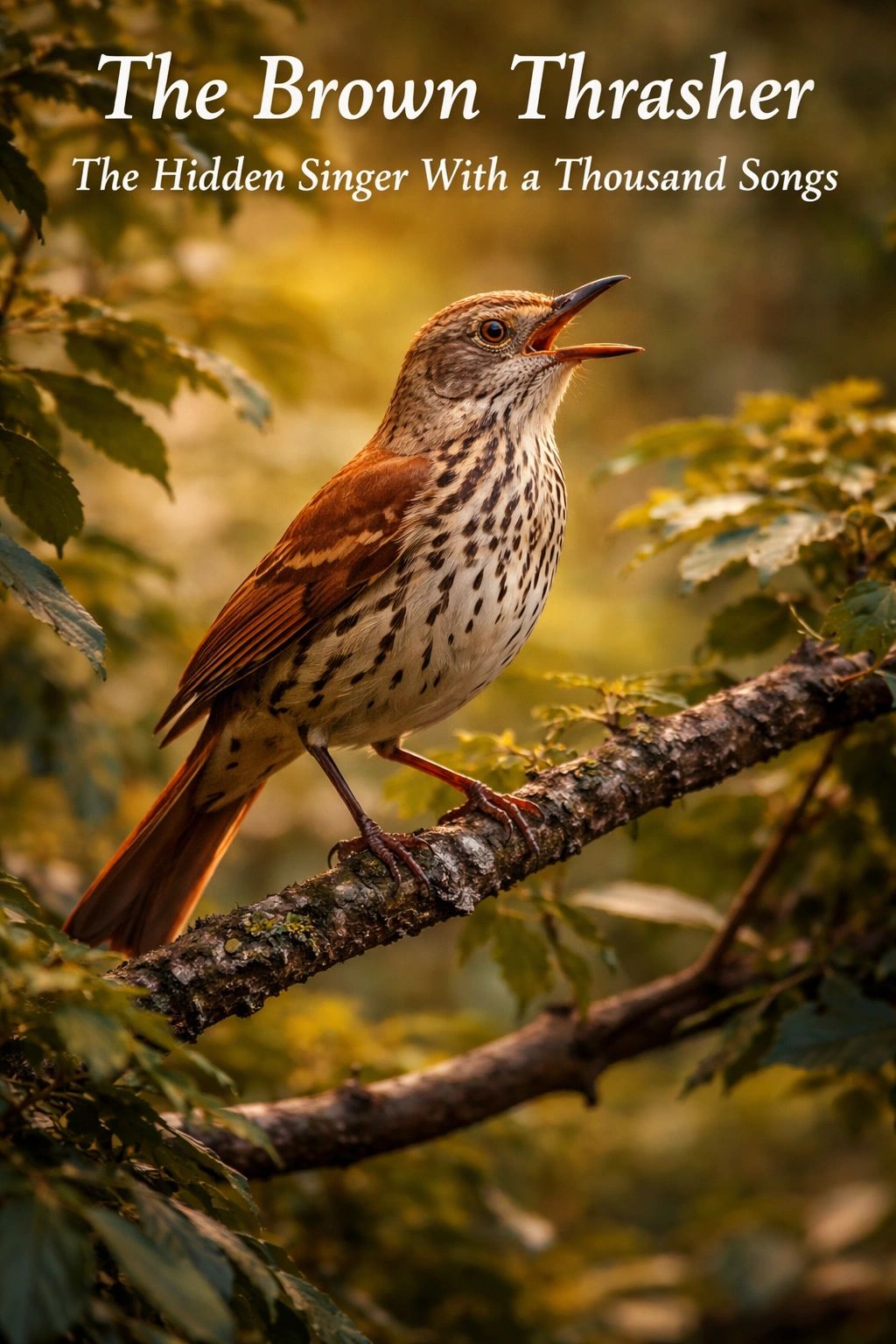
After the shifting calls of the Common Grackle faded into the background, the morning seemed to settle for a moment.
The louder, more obvious voices had already made themselves known. The cardinal had cut through the air with clarity. The mockingbird had filled the space with layered sound. Even the grackles had left their sharp, metallic imprint on the soundscape.
Then something quieter began.
It wasn’t loud.
It wasn’t immediate.
It came from deeper within the brush, from a place that wasn’t easy to see.
A series of short phrases, each repeated twice, moved steadily through the air. The sound didn’t carry the same boldness as the other birds. It felt more contained, more deliberate, as though it belonged to something hidden.
I checked the Merlin Bird ID app.
Brown Thrasher.
A Voice From the Underbrush
Unlike the other birds that morning, the Brown Thrasher didn’t announce itself from an open perch or the top of a tree.
Its voice came from within.
From thick shrubs, tangled branches, and the kind of dense growth where movement is difficult to track.
Listening closely, the pattern of its song became clear. Each phrase was repeated once, then replaced with something new. Then that phrase repeated, and another followed.
There was structure to it, but not in the same way as the mockingbird.
It felt more methodical.
More grounded.
And what stood out most was how much variation there was.
A Singer With Endless Variety
The Brown Thrasher is known for having one of the largest song repertoires of any North American bird.
Some estimates suggest it can produce over a thousand different song variations.
Standing there, listening to it, that idea became easier to understand.
The song never settled into a single pattern. It moved constantly, shifting from one phrase to the next, each one distinct but connected through repetition.
It didn’t feel random.
It felt intentional.
Each sound delivered, repeated, and then replaced, like a sequence unfolding in real time.
Seeing the Bird That Stays Hidden
Spotting the Brown Thrasher proved more difficult than identifying its voice.
Unlike the cardinal or grackle, it didn’t perch out in the open. It stayed low, moving through the undergrowth where branches and leaves created natural cover.
When I finally caught a glimpse of it, it was brief.
A flash of warm brown.
A long tail slipping through the brush.
Then stillness again.
The Brown Thrasher is built for this kind of environment. Its coloration blends perfectly with dry leaves, bark, and shadow. Its movements are quick but controlled, allowing it to disappear almost as soon as it becomes visible.
A Bird Designed for the Ground
While many birds spend much of their time in trees, the Brown Thrasher is often found closer to the ground.
It moves through leaf litter and low vegetation, searching for food with a focused, deliberate approach.
Its long, slightly curved bill is well suited for digging and probing. It flips leaves aside, uncovering insects, seeds, and other small food sources hidden beneath the surface.
Watching this behavior, there is a sense of persistence.
It doesn’t rush.
It works through the environment, piece by piece, uncovering what is hidden.
The Meaning Behind the Name
The name “thrasher” comes from the bird’s feeding behavior.
As it searches for food, it often appears to “thrash” through leaves and debris, moving material aside in quick, forceful motions.
But there is nothing chaotic about it.
The movement is controlled.
Purposeful.
Each action is part of a process, a way of interacting with the environment that reflects both instinct and adaptation.
A Life of Caution
The Brown Thrasher is not a bird that seeks attention.
It is cautious by nature, staying within cover and avoiding open spaces when possible.
This behavior makes it less visible than many of the other birds identified that morning. It is present, but not always seen.
Its song becomes its primary way of being noticed.
It reveals itself through sound rather than sight.
Territory and Communication
Like many songbirds, the Brown Thrasher uses its voice to establish territory and communicate with others.
But its approach is different.
The repetition of phrases creates clarity, making each part of the song stand out. The variety keeps the sequence dynamic, preventing it from becoming predictable.
Listening to it, there is a sense of intelligence in the structure.
It is not just making noise.
It is organizing sound.
A Bird of Edges and Boundaries
The Brown Thrasher is often found in transitional spaces.
Edges of forests.
Borders of fields.
Areas where dense vegetation meets open ground.
These environments provide both cover and access to food, creating the conditions the bird needs to thrive.
In Florida, this can include overgrown yards, wooded areas, and natural spaces where shrubs and low trees dominate.
Returning to That Morning
As the Merlin app continued to identify birds, the Brown Thrasher felt different from the others.
It wasn’t the loudest.
It wasn’t the easiest to see.
But it held attention in a quieter way.
Its song required listening.
Its presence required patience.
It was not a bird that revealed itself all at once.
The Value of What Stays Hidden
There is something meaningful about species that are not immediately visible.
They remind us that not everything in nature is designed to stand out.
Some things exist just beneath the surface, requiring effort to notice and understand.
The Brown Thrasher is one of those species.
It doesn’t demand attention.
It rewards it.
A Different Kind of Complexity
While the mockingbird is often celebrated for its mimicry, the Brown Thrasher’s complexity comes from within.
Its song is not built from imitation.
It is built from variation.
From repetition and change.
From a structure that feels both ordered and fluid at the same time.
Listening to it, there is a sense that the bird is exploring sound, testing boundaries, creating something that evolves moment by moment.
More Than Just Another Songbird
At a glance, the Brown Thrasher might seem like just another small bird moving through the brush.
But spending time listening to it changes that perception.
It becomes something more.
A hidden presence.
A constant voice.
A reminder that complexity often exists where we least expect it.
Conclusion: The Singer You Don’t Always See
That morning, the Brown Thrasher was not the most visible bird.
But it was one of the most memorable.
Its song carried from the underbrush, steady and varied, revealing a presence that might otherwise have gone unnoticed.
It reminded me that not all wildlife announces itself boldly.
Some of it stays hidden.
Some of it requires listening.
And sometimes, the most intricate stories are the ones unfolding just out of sight.
Bibliography
Cornell Lab of Ornithology. All About Birds: Brown Thrasher.
Cornell Lab of Ornithology. Merlin Bird ID App. Cornell University.
National Audubon Society. Brown Thrasher.
Sibley, David Allen. The Sibley Guide to Birds. Alfred A. Knopf.
Florida Fish and Wildlife Conservation Commission. Florida Bird Species Information.
Originally published at the live site .