
Maritime ·
The Downy Woodpecker: The Sound That Comes From the Tree
Some birds are easy to find.
By Rebecca "Madam Chronicler" Ryan
Some birds are easy to find.
They move constantly.
They call out.
They make themselves known.
But some birds are noticed in a different way.
Not by what you see.
But by what you hear.
The downy woodpecker is one of those birds.
A Sound That Feels Like It Belongs to the Tree
The first time I noticed it, I didn’t see anything at all.
I heard it.
A quick, steady tapping sound—light, almost hollow—coming from somewhere nearby. It wasn’t loud, but it was distinct enough to stand out against everything else.
It didn’t feel like a call.
It felt like part of the tree itself.
A rhythm that blended into the environment in a way that made it easy to overlook if you weren’t paying attention.
I stopped.
Listened again.
The tapping came in short bursts, then paused, then started again from a slightly different direction.
So I opened the Merlin Bird ID app and let it listen.
Within seconds, it gave me the answer.
Downy Woodpecker.
And just like that, the sound had a source.
Looking at the Trunk Instead of the Branches
After identifying it, I did what I had done with most birds.
I looked into the trees.
But not at the branches this time.
At the trunks.
And that’s where I saw it.
A Bird That Moves Vertically
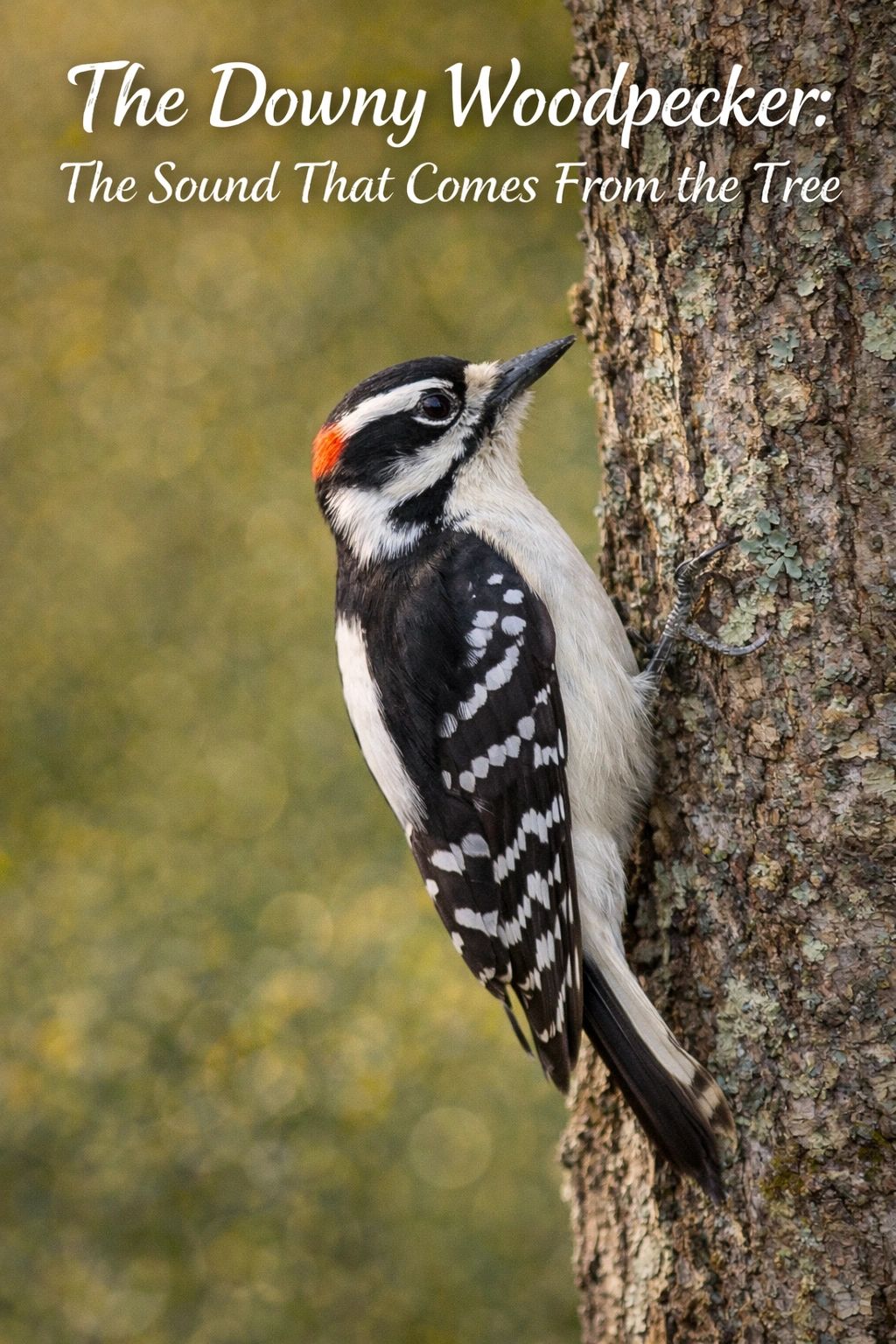
The downy woodpecker wasn’t perched the way most birds are.
It was clinging.
Its body pressed against the tree, its feet gripping the bark, its tail braced against the surface for support. It moved upward in short, deliberate steps, pausing occasionally before shifting again.
It didn’t hop.
It climbed.
And that alone made it stand out.
A Pattern That Feels Clean and Sharp
At first glance, the downy woodpecker looks simple.
Black and white.
Clean lines.
Clear contrast.
But the more you look, the more detail appears.
A white underside.
Black wings marked with small white spots.
A bold white stripe running down its back.
And, on some, a small red patch at the back of the head—subtle but unmistakable.
According to the Smithsonian Handbooks: Birds of North America (Eastern Region), the downy woodpecker is the smallest woodpecker in North America, and its compact size makes it easy to miss if you’re not paying attention.
But once you see it, the pattern is easy to remember.
Movement That Feels Measured
Watching the downy woodpecker move, there’s a rhythm to it.
Climb.
Pause.
Tap.
Then move again.
It doesn’t rush.
It doesn’t wander aimlessly.
Every movement feels intentional, as if it knows exactly where it’s going and what it’s looking for.
The Purpose Behind the Tapping
The tapping sound that first caught my attention wasn’t random.
It had purpose.
According to Smithsonian descriptions, downy woodpeckers peck at trees to find insects hidden beneath the bark. Their bills are designed to chip away at the surface, exposing small spaces where food might be hidden.
It’s not just noise.
It’s searching.
And once you understand that, the sound feels different.
More focused.
More deliberate.
A Bird That Stays Close
Unlike some birds that keep their distance, the downy woodpecker often stays within reach.
It moves along trees, fence posts, even feeders if they’re available, staying in areas that are easy to observe.
It doesn’t disappear into the distance.
It remains part of the immediate space.
And that makes it easier to follow over time.
A Familiar Presence in the Yard
The more I noticed it, the more often it appeared.
Not always in the same place.
But always nearby.
Moving between trees.
Returning to familiar spots.
Becoming part of the rhythm of the yard in a way that felt consistent.
A Sound That Becomes Recognizable
Once I knew what I was listening for, the tapping stood out more clearly.
It wasn’t just background noise anymore.
It was a signal.
A way to locate the bird before seeing it.
And that made it easier to notice again and again.
The Moment Merlin Made It Clear
Like the other birds in this series, everything began with that moment of recognition.
Before Merlin, the sound blended in.
After Merlin, it stood out.
The bird didn’t change.
My awareness did.
A Bird That Changes How You See Trees
What the downy woodpecker changes most is perspective.
It shifts your attention from leaves and branches to the surface of the tree itself.
The bark.
The texture.
The places where something might be hidden.
And suddenly, the tree doesn’t feel static anymore.
It feels active.
Alive with movement just beneath the surface.
A Quiet Kind of Presence
The downy woodpecker doesn’t dominate the space.
It doesn’t call constantly.
It doesn’t move in large, dramatic patterns.
But it adds something steady.
Something consistent.
A quiet presence that becomes more noticeable the longer you pay attention.
Conclusion: The Sound That Leads You to It
The downy woodpecker is not the loudest bird.
It is not the most colorful.
It is not the fastest.
But it is one of the easiest to recognize—once you know what to listen for.
It doesn’t announce itself with a call.
It reveals itself through rhythm.
Through that steady tapping that blends into the tree until you stop and notice it.
And once you do—once you connect that sound to the small bird moving along the bark—you realize something simple.
Sometimes, the easiest way to find something…
Is to listen for it first.
Bibliography
Cornell Lab of Ornithology. All About Birds: Downy Woodpecker.
Smithsonian Institution. Smithsonian Handbooks: Birds of North America (Eastern Region).
National Audubon Society. Downy Woodpecker.
Sibley, David Allen. The Sibley Guide to Birds.
Florida Fish and Wildlife Conservation Commission. Florida Bird Species Information.
Originally published at the live site .