
Maritime ·
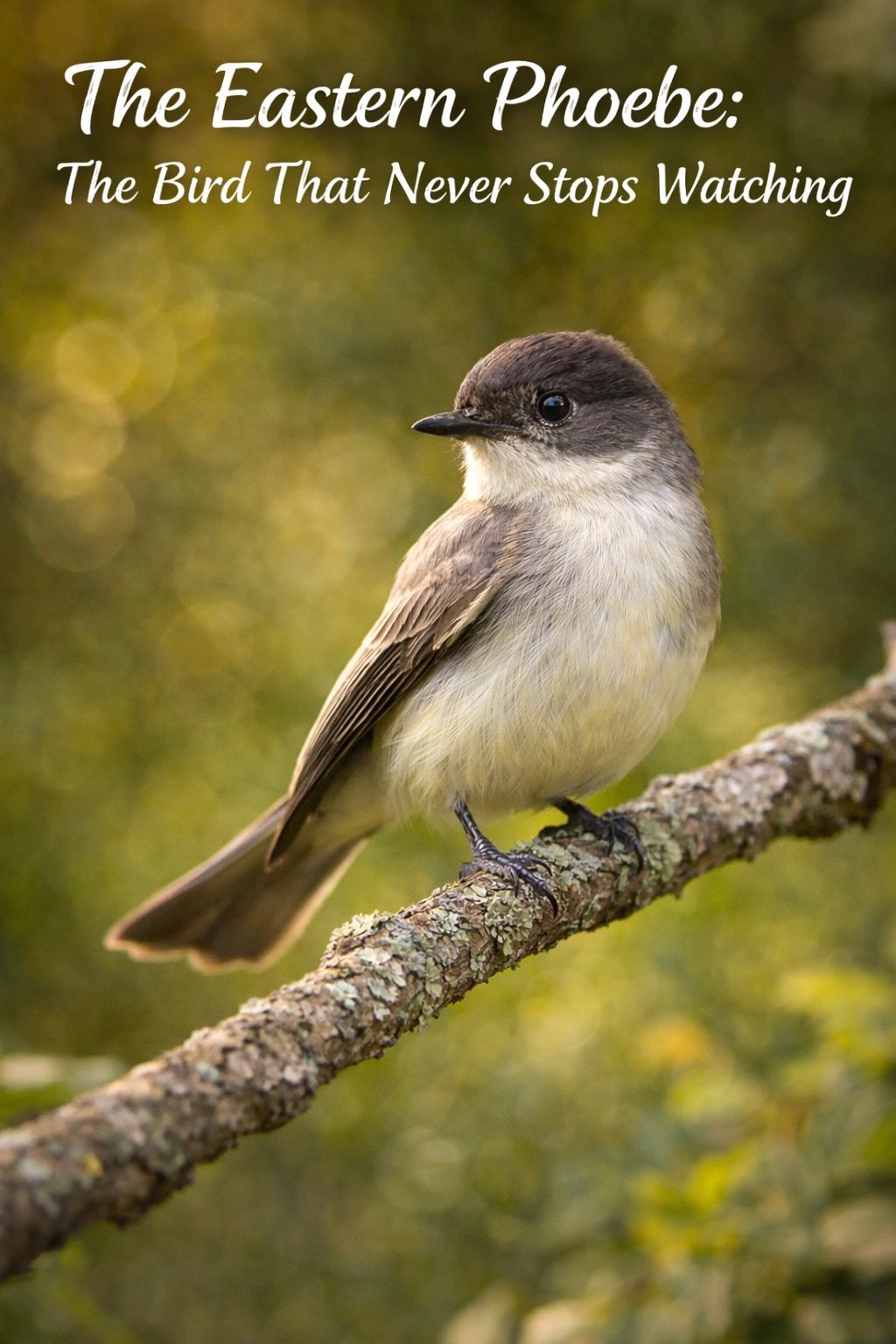
The Eastern Phoebe: The Bird That Never Stops Watching
Some birds move constantly.
By Rebecca "Madam Chronicler" Ryan
Some birds move constantly.
Some fill the air with sound.
Some disappear before you can fully notice them.
But every once in a while, there’s a bird that does something different.
It stays.
And it watches.
The eastern phoebe is one of those birds.
A Sound That Feels Simple
The first time I noticed it, it wasn’t complicated.
It wasn’t layered or musical or difficult to place.
It was simple.
Two notes.
Clear.
Repeated.
“Fee-bee… fee-bee…”
It didn’t carry the urgency of a killdeer or the softness of a mourning dove. It didn’t echo or blend into the background.
It stood on its own.
I paused, listening, letting it repeat a few more times, trying to match it to something familiar—but there was nothing quite like it.
So I opened the Merlin Bird ID app and let it listen.
Within seconds, it gave me the answer.
Eastern Phoebe.
And just like that, the sound and the name matched perfectly.
Looking for Stillness Instead of Movement
After identifying it, I did what I had done with most birds.
I started looking for movement.
But this time, that didn’t help.
Because the eastern phoebe wasn’t moving much at all.
It was perched.
Still.
On a low branch, just above eye level.
And for a moment, it blended in so completely that I almost missed it entirely.
A Bird That Waits Instead of Wanders
Unlike the chickadee or titmouse, which move constantly, the eastern phoebe holds its position.
It doesn’t hop from branch to branch.
It doesn’t dart through leaves.
It stays.
Watching.
Its posture is upright but relaxed, its dark head and soft gray body giving it a simple, understated appearance. There’s no bold pattern, no bright color to draw attention.
And yet, it stands out—because of what it does next.
The Tail That Never Stops
Even while the bird stays still, one part of it doesn’t.
Its tail.
It dips downward.
Then returns.
Then dips again.
Over and over in a steady rhythm that continues whether the bird moves or not.
At first, it feels like a small detail.
But the longer you watch, the more noticeable it becomes.
It’s constant.
Almost like a quiet signal that the bird is alert, aware, and ready.
A Sudden Burst of Motion
Then, without warning, the stillness breaks.
The phoebe launches forward.
Quick.
Direct.
It catches something in the air—a small insect—and just as quickly returns to the same perch.
The same exact spot.
And just like that, the stillness resumes.
The tail dips again.
And the waiting continues.
Hunting From Observation
This is how the eastern phoebe lives.
Not by searching constantly.
But by watching.
According to the Smithsonian Handbooks: Birds of North America (Eastern Region), the eastern phoebe is a flycatcher, meaning it captures insects in midair rather than foraging on the ground or in trees.
It doesn’t wander widely.
It selects a vantage point.
And it waits.
Everything about it is built around timing.
A Bird That Returns to the Same Place
What stood out most was how consistent it was.
After each flight, it returned to the same perch.
The same branch.
The same position.
It didn’t search for a new spot.
It trusted the one it had chosen.
And that consistency made it easier to follow.
A Voice That Matches Its Simplicity
The call of the eastern phoebe reflects its behavior.
Simple.
Clear.
Repeated.
“Fee-bee… fee-bee…”
Field guides describe it as one of the earliest and most recognizable calls of spring in many areas, but even outside of that context, it stands out because of its clarity.
It doesn’t try to be complex.
It doesn’t need to be.
A Bird That Lives Close to Structures
Unlike many birds that stay strictly in natural spaces, the eastern phoebe often nests near human structures.
Under eaves.
On ledges.
Bridges.
Porches.
It builds its nest using mud and plant material, creating a sturdy cup in places that offer shelter and stability.
This brings it closer to people.
Closer than you might expect.
The Moment Merlin Made It Clear
Like the other birds in this series, everything began with that moment of recognition.
Before Merlin, the sound was just a repetition.
After Merlin, it had identity.
And once it had identity, it became easier to notice—not just once, but every time it returned.
A Different Kind of Presence
The eastern phoebe doesn’t fill the space.
It doesn’t dominate the soundscape.
It doesn’t move constantly.
Instead, it holds a position within it.
A fixed point.
A place where movement begins and ends.
And that makes it feel different.
A Bird That Teaches Patience
Watching the phoebe changes how you experience the moment.
It slows everything down.
It shifts your focus from movement to stillness.
From searching to waiting.
It reminds you that not everything happens all at once.
Some things happen in bursts.
Between pauses.
Conclusion: The Bird That Watches First
The eastern phoebe is not the loudest bird.
It is not the most colorful.
It is not the most active.
But it is one of the most focused.
It watches.
Waits.
Then moves with purpose.
And once you recognize it—once you connect that simple, repeating call with the bird perched quietly nearby—you realize something simple.
Not every bird needs to move constantly to be noticed.
Some just need to be still long enough for you to see them.
Bibliography
Cornell Lab of Ornithology. All About Birds: Eastern Phoebe.
Smithsonian Institution. Smithsonian Handbooks: Birds of North America (Eastern Region).
National Audubon Society. Eastern Phoebe.
Sibley, David Allen. The Sibley Guide to Birds.
Florida Fish and Wildlife Conservation Commission. Florida Bird Species Information.
Originally published at the live site .