
Maritime ·
The Most Misunderstood Sharks in the Ocean
For decades, sharks have carried one of the worst reputations in the animal kingdom. Movies, sensational headlines, and dramatic television specials have often portrayed them as ruthless killing machines lurking beneath ...
By Rebecca "Madam Chronicler" Ryan
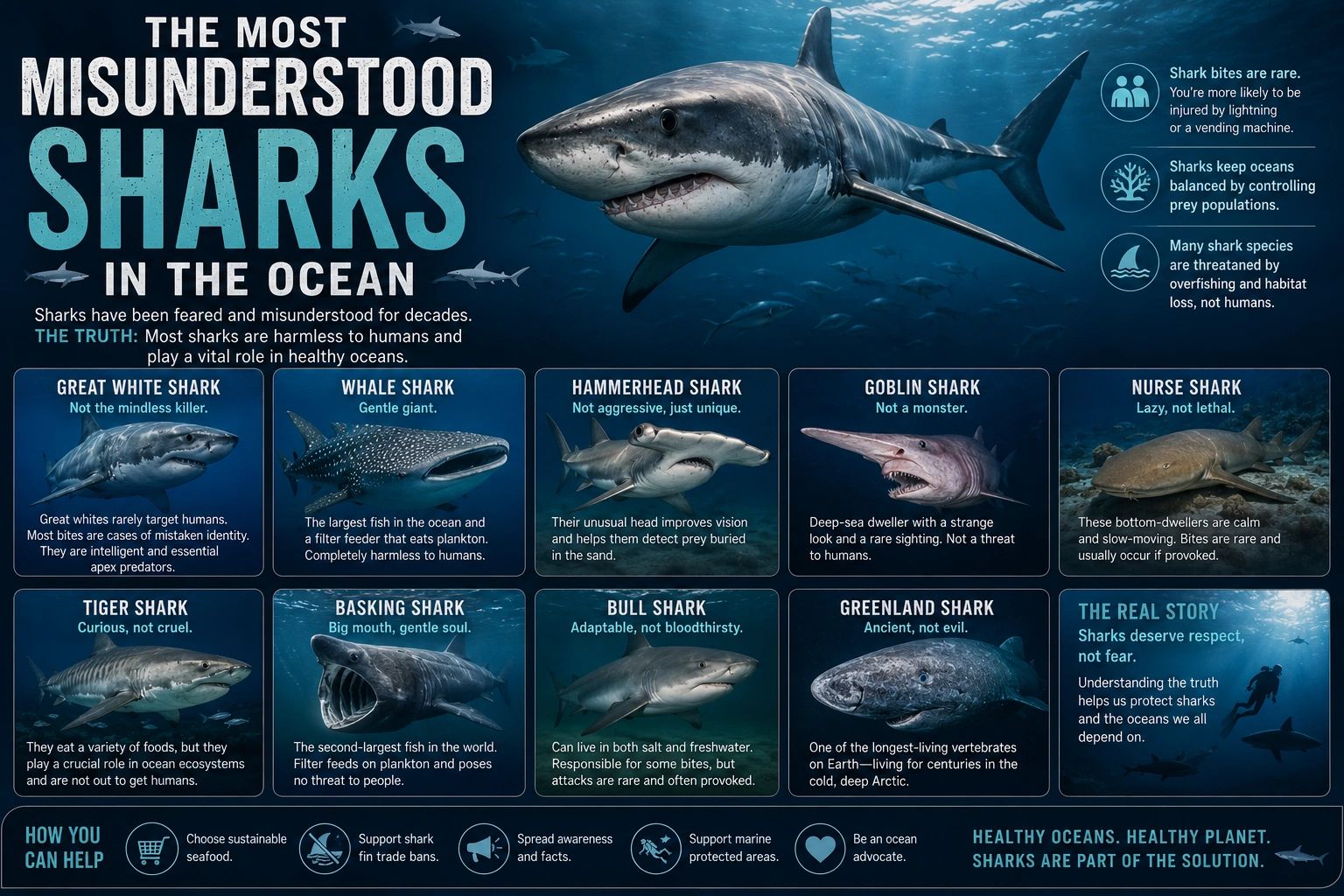
For decades, sharks have carried one of the worst reputations in the animal kingdom. Movies, sensational headlines, and dramatic television specials have often portrayed them as ruthless killing machines lurking beneath the waves. Yet the truth about sharks is far more complicated—and far more fascinating.
Most shark species are harmless to humans. Many are shy, elusive, and rarely seen. Some feed only on plankton. Others spend their lives crawling along the seafloor like underwater scavengers. Even many large predatory sharks play essential ecological roles that help maintain healthy marine ecosystems.
But despite scientific advances and growing conservation awareness, many shark species remain deeply misunderstood.
Some are feared because of exaggerated myths. Others are overlooked entirely because they lack the fame of great white sharks or tiger sharks. A few possess bizarre appearances that make them seem almost prehistoric or alien.
In reality, these misunderstood sharks represent some of the most extraordinary evolutionary success stories in the ocean.
Understanding them matters because public perception directly affects conservation. Sharks face increasing threats from overfishing, habitat destruction, climate change, and the global shark fin trade. Misunderstanding often leads to fear, and fear rarely inspires protection.
The more scientists study sharks, the clearer it becomes that these animals are not monsters.
They are survivors.
Great White Sharks: The Victims of Hollywood
No shark suffers more from public misunderstanding than the great white shark.
Ever since Jaws terrified audiences in 1975, great whites have been viewed as aggressive predators obsessed with attacking humans. Images of giant dorsal fins slicing through the water became symbols of fear worldwide.
But real great whites behave very differently from their fictional portrayals.
Great Whites Rarely Target Humans
According to the Florida Museum’s International Shark Attack File (ISAF), unprovoked shark bites remain extremely rare considering the millions of people who enter the ocean every year.
Most encounters involving great whites are believed to be cases of mistaken identity. Surfers and swimmers viewed from below can resemble seals or sea lions, which are primary prey for many adult great whites.
In many cases, sharks release humans after an initial bite because people are not preferred prey.
Scientists emphasize that sharks do not hunt humans as food.
Highly Intelligent Predators
Research has revealed that great whites are intelligent, curious animals with complex behaviors.
They migrate thousands of miles across oceans, return to specific feeding grounds, and display social interactions researchers are still trying to understand.
Satellite tracking studies have shown great whites traveling between California and Hawaii, South Africa and Australia, and along entire coastlines with astonishing navigational accuracy.
Rather than mindless killers, great whites are highly evolved apex predators playing critical ecological roles.
Whale Sharks: Gentle Giants Misjudged by Size
At over 40 feet long, whale sharks are the largest fish on Earth.
And despite their enormous size, they are completely harmless to humans.
Yet many people still fear whale sharks simply because they are sharks.
Filter Feeders, Not Hunters
Whale sharks feed primarily on plankton, fish eggs, and tiny organisms by filtering massive amounts of water through their mouths.
They possess thousands of tiny teeth, but those teeth play almost no role in feeding.
Divers frequently swim safely beside whale sharks in regions such as Mexico, the Philippines, and the Maldives.
These sharks are calm, slow-moving animals more interested in microscopic prey than large mammals.
Threatened Despite Their Gentle Nature
Unfortunately, whale sharks face serious conservation challenges.
Boat strikes, fishing pressure, habitat degradation, and tourism impacts threaten populations in many regions.
The International Union for Conservation of Nature (IUCN) lists whale sharks as endangered.
Ironically, one of the ocean’s gentlest giants is also one of its most vulnerable.
Hammerhead Sharks: Strange but Brilliant
Hammerhead sharks often frighten people because of their bizarre appearance.
Their wide hammer-shaped heads look unnatural, even intimidating. But the cephalofoil—the scientific name for their unusual head structure—is actually one of evolution’s most remarkable adaptations.
Built for Precision Hunting
Hammerheads use their broad heads to improve vision, maneuverability, electroreception, and prey detection.
Their widely spaced sensory organs allow them to detect electrical signals from prey buried beneath the sand. Great hammerheads frequently hunt stingrays using this specialized sensory system.
Far from being deformed or aggressive, hammerheads are highly specialized predators.
Massive Schools
Scalloped hammerheads are famous for forming enormous schools containing hundreds of individuals near underwater seamounts and islands.
Scientists are still studying why these schools form, but theories include mating behavior, predator protection, and social interaction.
Despite their intimidating appearance, hammerheads are generally not considered highly dangerous to humans.
Goblin Sharks: The “Alien” of the Deep Sea
Few sharks look stranger than the goblin shark.
With its elongated snout, protruding jaws, and pale pink skin, the goblin shark often appears in viral images described as “nightmare fuel” or “prehistoric monsters.”
But goblin sharks are among the least threatening sharks in existence.
Deep-Sea Specialists
Goblin sharks inhabit deep ocean environments rarely visited by humans. Most live hundreds or even thousands of feet below the surface.
Because food is scarce in deep water, goblin sharks evolved specialized hunting adaptations.
Their jaws can extend outward rapidly to snatch prey, giving them one of the most unusual feeding mechanisms among sharks.
Extremely Rare Encounters
Humans almost never encounter goblin sharks in the wild.
Most specimens are discovered accidentally through deep-sea fishing operations.
Their frightening appearance stems from deep-sea evolution, not aggression.
In reality, goblin sharks are fragile, slow-moving animals adapted to one of Earth’s harshest environments.
Nurse Sharks: Lazy Giants of the Reef
Nurse sharks are frequently misunderstood because of their size and appearance.
These bottom-dwelling sharks can grow over 10 feet long and possess powerful jaws capable of crushing shellfish and crustaceans.
But nurse sharks are generally among the calmest sharks in tropical waters.
Resting Sharks, Not Constant Hunters
Unlike fast-swimming pelagic sharks, nurse sharks often spend long periods resting motionless on the seafloor.
They are nocturnal hunters that feed primarily at night.
During the day, divers commonly observe groups of nurse sharks resting peacefully beneath reefs and ledges.
Defensive, Not Aggressive
Most nurse shark incidents involving humans occur because people harass, grab, or accidentally step on them.
When provoked, nurse sharks can bite defensively and hold on with powerful jaws.
But unprovoked attacks are extremely uncommon.
Their reputation as “dangerous” sharks is largely exaggerated.
Tiger Sharks: The Ocean’s Misjudged Opportunists
Tiger sharks are often labeled as indiscriminate “garbage cans of the sea” because they consume a wide variety of prey items.
This reputation has contributed to fear and misunderstanding.
Important Ecosystem Regulators
Tiger sharks are apex predators that help regulate marine ecosystems by controlling prey populations.
Research shows tiger sharks influence the behavior of turtles, dugongs, and other marine animals, indirectly affecting seagrass ecosystems and biodiversity.
Without large predators like tiger sharks, marine ecosystems can become imbalanced.
Curious, Not Evil
Tiger sharks are naturally curious animals.
Like many predators, they investigate unfamiliar objects using their mouths. This curiosity sometimes contributes to shark bite incidents, but it does not mean tiger sharks are malicious or bloodthirsty.
Scientists emphasize that tiger sharks behave according to instinct and ecological function—not aggression driven by hatred or intent.
Basking Sharks: Massive Sharks That Eat Plankton
The basking shark is the second-largest fish in the world after the whale shark.
Growing over 30 feet long, basking sharks often alarm boaters and swimmers because of their enormous mouths and size.
But basking sharks are harmless filter feeders.
Gentle Surface Feeders
Basking sharks swim slowly near the surface while filtering plankton from seawater.
Their huge mouths remain open while feeding, creating dramatic appearances that sometimes trigger fear.
Historically, fishermen exaggerated stories about basking sharks, contributing to myths about “sea monsters.”
In reality, basking sharks are peaceful giants that pose no threat to humans.
Threatened by Human Activity
Basking sharks were heavily hunted for liver oil, fins, and meat throughout history.
Today, they remain vulnerable due to slow reproduction rates and accidental entanglement in fishing gear.
Bull Sharks: Feared but Misunderstood
Bull sharks are often considered one of the most dangerous shark species because they inhabit shallow coastal waters and can tolerate freshwater environments.
They are frequently blamed for attacks near beaches and river systems.
But bull sharks are still widely misunderstood.
Built for Harsh Environments
Bull sharks evolved extraordinary physiological adaptations that allow them to move between saltwater and freshwater.
They have been documented in rivers thousands of miles inland.
This ability makes them one of the most adaptable sharks on Earth.
Important Coastal Predators
Bull sharks play critical roles in coastal ecosystems by regulating prey populations and maintaining ecological balance.
Like other sharks, they are opportunistic predators following instinct—not malicious attackers.
Many shark incidents occur because humans increasingly share coastal habitats with sharks.
Greenland Sharks: Ancient Survivors
Greenland sharks are among the strangest vertebrates on Earth.
Living in Arctic waters, these slow-moving sharks can survive for centuries.
Some scientists estimate Greenland sharks may live over 400 years, making them the longest-living vertebrates known to science.
Slow and Mysterious
Greenland sharks inhabit deep, icy waters where little sunlight penetrates.
They grow slowly, reproduce slowly, and remain poorly understood due to the difficulty of studying Arctic marine environments.
Their sluggish movement and ghostly appearance often make them seem eerie or unnatural.
But Greenland sharks represent one of evolution’s greatest endurance stories.
They survived changing climates, shifting oceans, and centuries of environmental upheaval.
Why Sharks Are So Misunderstood
Several factors contribute to widespread misunderstanding of sharks.
Media Sensationalism
Shark attacks generate enormous media attention despite being statistically rare.
Headlines emphasizing fear, danger, and horror shape public perception far more strongly than stories about conservation or ecology.
Fear of the Unknown
Humans naturally fear predators, especially in environments where visibility is limited.
The ocean itself creates psychological uncertainty. Sharks become symbols of unseen danger beneath the surface.
Lack of Exposure
Most people never encounter sharks in the wild.
Without direct experience, movies and news coverage often become the primary sources of information.
Unfortunately, entertainment media has historically prioritized drama over accuracy.
Sharks Need Protection, Not Fear
Despite their fearsome reputations, sharks are among the ocean’s most threatened animals.
Overfishing, bycatch, habitat destruction, pollution, and shark finning have devastated populations worldwide.
Many shark species reproduce slowly, making recovery difficult once populations decline.
Conservation organizations now emphasize that protecting sharks benefits entire marine ecosystems.
Healthy shark populations support healthy oceans.
Changing Public Perception
Scientists and conservationists increasingly focus on education as a key conservation strategy.
The more people understand sharks, the more likely they are to support protections such as:
- Marine protected areas
- Sustainable fisheries management
- Shark fin trade restrictions
- Bycatch reduction efforts
- Habitat conservation
Fear rarely inspires conservation.
Understanding does.
The Truth About Sharks
The most misunderstood sharks in the ocean are not villains, monsters, or mindless killers.
They are ancient predators shaped by millions of years of evolution.
Some are gentle filter feeders. Others are deep-sea specialists. Some are highly social, while others roam oceans alone. Together, they represent one of the most diverse and ecologically important groups of animals in marine ecosystems.
Sharks deserve respect, but not irrational fear.
The more scientists study them, the more sharks reveal themselves to be intelligent, specialized, and vital to ocean health.
Misunderstanding sharks has already caused enormous damage to their populations worldwide.
Changing that perception may be one of the most important steps toward protecting the future of the ocean itself.
Because sharks are not simply creatures of fear.
They are survivors of Earth’s ancient oceans—and they still have much to teach us.
Bibliography and Primary Sources
Primary Sources
- NOAA Fisheries. Shark Conservation and Species Profiles. https://www.fisheries.noaa.gov/
- Florida Museum of Natural History. International Shark Attack File (ISAF). https://www.floridamuseum.ufl.edu/shark-attacks/
- IUCN Red List of Threatened Species. Shark Assessments. https://www.iucnredlist.org/
- National Geographic Society. Shark Biology and Conservation. https://www.nationalgeographic.com/animals/fish
- Smithsonian Ocean Portal. Shark Species and Adaptations. https://ocean.si.edu/
- Save Our Seas Foundation. Shark Research and Conservation. https://saveourseas.com/
- Compagno, Leonard J.V. Sharks of the World. Food and Agriculture Organization of the United Nations (FAO).
- University of Miami Shark Research & Conservation Program. https://sharkresearch.earth.miami.edu/
- Pew Charitable Trusts. Global Shark Conservation Efforts. https://www.pewtrusts.org/
- Marine Biological Association of the United Kingdom. Shark Ecology and Ocean Predators. https://www.mba.ac.uk/
Originally published at the live site .