
Maritime ·
The Northern Flicker: The Woodpecker That Walks the Ground
Some birds stay in the trees.
By Rebecca "Madam Chronicler" Ryan
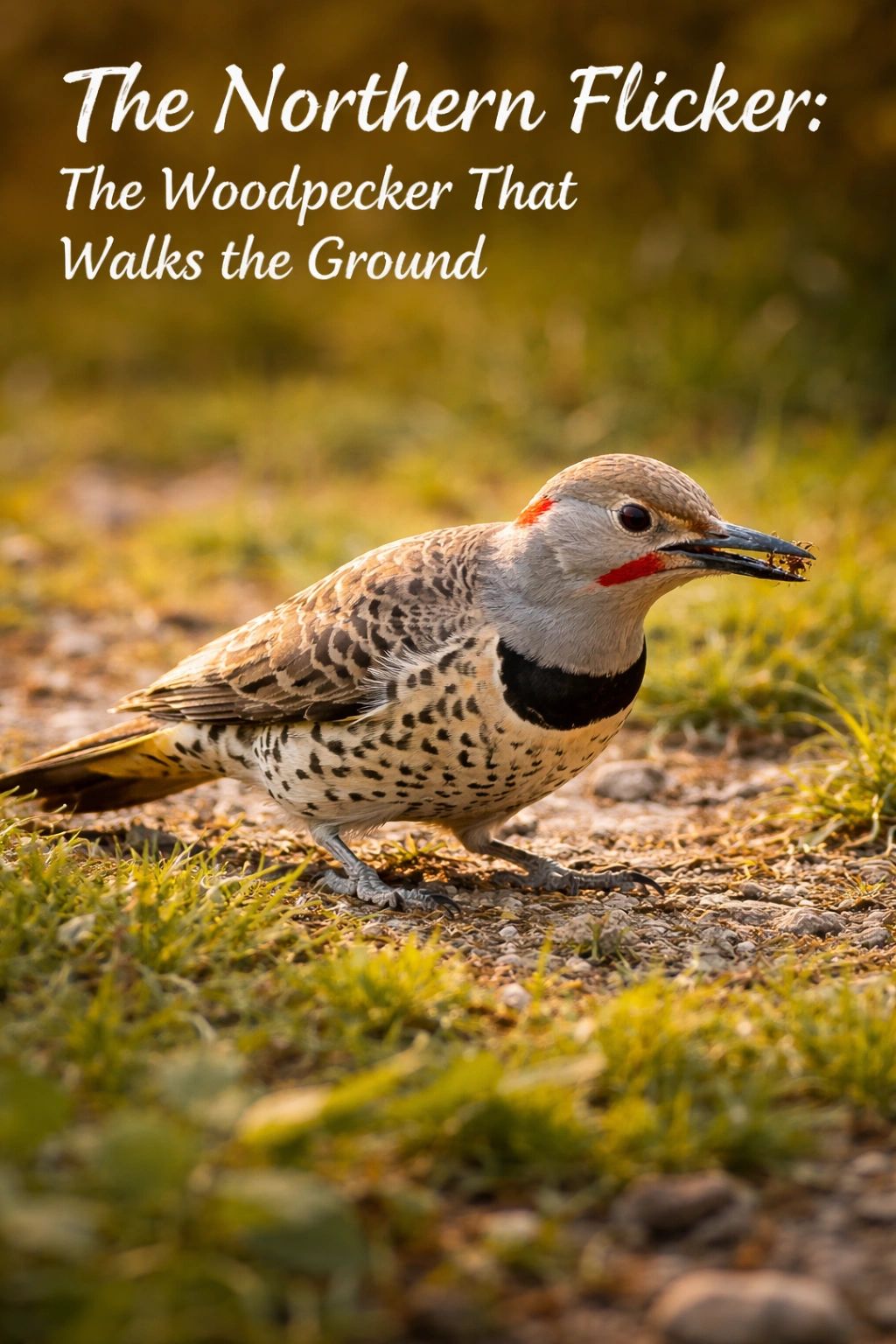
Some birds stay in the trees.
Some stay in the sky.
Some stay near the water.
But every once in a while, you notice something that doesn’t quite follow the pattern.
The northern flicker is one of those birds.
A Sound That Feels Familiar—but Different
The first time I noticed it, it wasn’t because I saw it.
It was because of the sound.
Not sharp like a killdeer.
Not musical like a wren.
Not soft like a dove.
This sound was rhythmic, almost hollow—like tapping, but not quite the steady drumming I had come to associate with woodpeckers.
It came in bursts.
Then stopped.
Then started again somewhere else.
I paused, listening, trying to place it. It felt familiar, like something I should recognize, but it didn’t quite match anything I had already learned.
So I opened the Merlin Bird ID app and let it listen.
Within seconds, it gave me the answer.
Northern Flicker.
And for a moment, that didn’t make sense either.
Because I knew what a woodpecker was supposed to do.
And this didn’t sound like that.
Looking Up—Then Looking Down
At first, I did what I always did when I heard a woodpecker.
I looked up.
Into the trees.
Along trunks and branches where I expected to see that familiar pattern—clinging to bark, tapping steadily, moving upward in short bursts.
But there was nothing there.
The sound came again.
Closer this time.
And that’s when I realized I had been looking in the wrong place.
It wasn’t in the tree.
It was on the ground.
A Woodpecker Where You Don’t Expect One
Seeing a woodpecker on the ground feels wrong at first.
It doesn’t match the image most people have in their heads.
But there it was.
Standing in the open, moving across the grass in short steps, stopping occasionally, then moving again. It didn’t cling to bark. It didn’t climb.
It walked.
And that’s what made it stand out immediately.
A Pattern That Reveals Itself Slowly
At first glance, the northern flicker doesn’t feel as bold as some birds.
Its coloring blends in—browns, grays, and soft patterns that don’t immediately draw attention. But the longer you look, the more detail emerges.
Black spots scattered across its chest.
A distinct crescent marking across its upper chest.
A subtle but structured pattern across its back.
Then, when it moves or spreads its wings, something unexpected appears.
A flash of color.
Bright.
Almost hidden until the exact moment it reveals itself.
According to the Smithsonian Handbooks: Birds of North America (Eastern Region), northern flickers have vivid yellow or red coloration under their wings and tail, depending on the region.
And when you see it, even briefly, it changes how you remember the bird.
Movement That Feels Intentional
Watching the flicker move across the ground, there is a rhythm to it.
It doesn’t rush.
It doesn’t hop the way smaller birds do.
It walks.
Stops.
Tilts its head slightly, as if listening or inspecting something just beneath the surface.
Then it probes the ground with its bill.
Again and again.
Not randomly.
But with purpose.
Feeding Where Others Don’t
This is where the northern flicker truly separates itself.
Unlike most woodpeckers that feed on insects inside trees, the flicker spends much of its time searching for food on the ground.
Specifically—ants.
According to Smithsonian descriptions, ants make up a large part of its diet, and the flicker uses its slightly curved bill to dig into soil and access them.
It doesn’t rely on bark.
It relies on the ground.
And that changes everything about how it behaves.
A Bird That Bridges Two Worlds
The northern flicker feels like it exists between categories.
It is a woodpecker.
But it doesn’t stay in trees.
It forages on the ground.
But it still flies and perches when needed.
It blends in when still.
But flashes color when it moves.
It doesn’t fully belong to one pattern.
And that’s what makes it interesting.
The Moment It Takes Flight
When the flicker finally takes off, the transformation is immediate.
What was once a subtle, earth-toned bird suddenly becomes something more striking. Its wings open, revealing that hidden color beneath, bright and unexpected against the sky.
The flight itself is different too.
Not smooth like a hawk.
Not fluttering like a small songbird.
It moves in a slightly undulating pattern—rising and falling as it travels forward.
And just like that, it’s gone.
A Sound That Connects It All
The call of the northern flicker is just as distinctive as its behavior.
A loud, repeated “wick-a-wick-a-wick” or a sharp call that carries across space.
Field guides describe it as a clear, ringing call, and once you hear it, it becomes easy to recognize.
Like many of the birds in this series, it’s the sound that comes first.
The identification follows.
Then the understanding.
The Role of Merlin in the Moment
Before Merlin, the sound didn’t quite make sense.
After Merlin, everything aligned.
The tapping.
The movement.
The location.
It all connected.
And once it did, the bird became something I could recognize—not just once, but again and again.
A Different Way of Seeing the Ground
What the northern flicker changes most is perspective.
It makes you look down.
At spaces you might otherwise ignore.
Grass.
Open patches.
Areas that don’t immediately seem active.
And suddenly, those spaces feel just as alive as the trees above.
A Bird That Breaks the Pattern
The flicker doesn’t follow the rules you expect.
It doesn’t stay where it’s supposed to.
It doesn’t behave the way you assume it will.
And because of that, it becomes memorable.
Not because it’s the loudest or brightest.
But because it’s different.
Conclusion: The Bird That Redefines the Ground
The northern flicker is not the typical woodpecker.
It doesn’t stay in the trees.
It doesn’t follow the pattern.
It walks the ground, searching where others don’t, revealing itself slowly through movement and detail.
And once you recognize it—once you connect that sound to the bird moving across the grass—you realize something simple.
Not everything belongs where you expect it to be.
Sometimes, the most interesting things are found in the places you weren’t looking.
Bibliography
Cornell Lab of Ornithology. All About Birds: Northern Flicker.
Smithsonian Institution. Smithsonian Handbooks: Birds of North America (Eastern Region).
National Audubon Society. Northern Flicker.
Sibley, David Allen. The Sibley Guide to Birds.
Florida Fish and Wildlife Conservation Commission. Florida Bird Species Information.
Originally published at the live site .