
Maritime ·
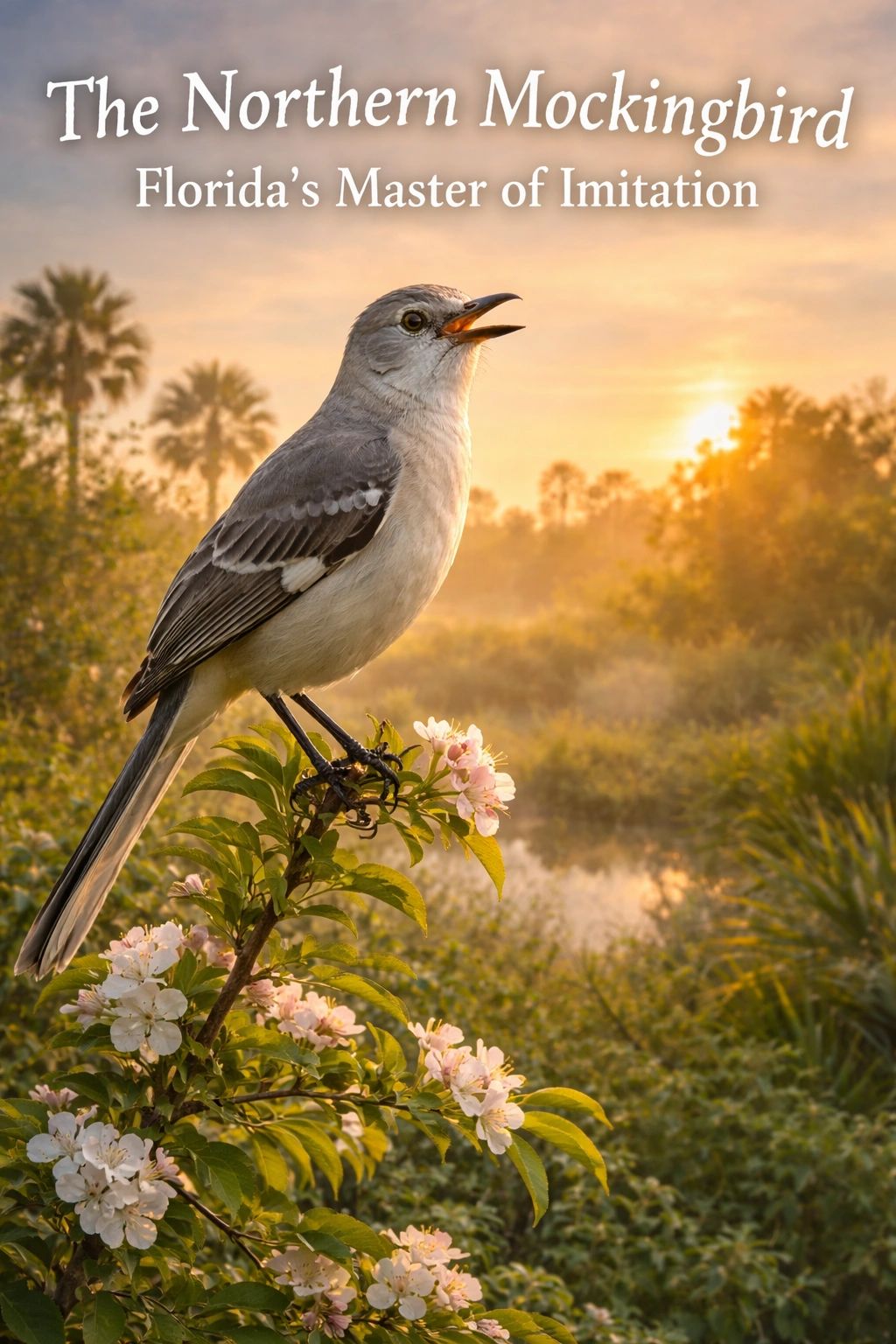
The Northern Mockingbird: Florida’s Master of Imitation
Not long after the American robin’s steady song drifted through the trees that morning, another sound took over the air.
By Rebecca "Madam Chronicler" Ryan
Not long after the American robin’s steady song drifted through the trees that morning, another sound took over the air.
At first, it didn’t seem like a single bird at all.
The song shifted constantly. One moment it was a series of sharp whistles, then it turned into something softer and more musical, followed by a completely different sound altogether. It felt as though multiple birds were calling at once, overlapping and competing for space in the morning chorus.
Curious, I glanced down at the Merlin Bird ID app as it listened.
The answer appeared almost instantly.
Northern Mockingbird.
A Performer Hidden in Plain Sight
The Northern Mockingbird is one of the most common birds in Florida, yet its voice can still feel surprising. Unlike many birds that stick to a single type of song, the mockingbird builds its performance from a constantly changing sequence of sounds.
Standing there, listening, it became clear that this bird wasn’t just singing. It was performing.
Mockingbirds are known for repeating each phrase several times before moving on to the next. This creates a rhythm that feels deliberate, almost rehearsed. The repetition allows the listener to catch each sound clearly before it changes again.
What makes the mockingbird truly remarkable, however, is not just how it sings, but what it sings.
The Art of Mimicry
As the recording continued, the variety of sounds became more obvious.
Some of the calls resembled other birds that had already been identified that morning. Others sounded unfamiliar, almost mechanical in their tone. It raised an interesting question: how many of these sounds actually belonged to the mockingbird itself?
The answer is that many of them didn’t.
Northern mockingbirds are famous for their ability to mimic other species. Over time, they build a repertoire of sounds that can include not only other birds, but also frogs, insects, and even human-made noises.
Car alarms, cell phone alerts, and squeaking hinges have all been documented as part of a mockingbird’s performance.
This ability is not random. It serves a purpose.
By mimicking a wide range of sounds, mockingbirds create the impression that multiple birds are occupying the same territory. This can discourage rivals and make the area seem more competitive than it actually is.
At the same time, a larger repertoire may signal strength and intelligence, making the bird more attractive to potential mates.
Seeing the Mockingbird
Although the mockingbird’s voice is complex, its appearance is more understated.
Perched on a branch or rooftop, it may not stand out immediately. Its body is mostly gray, with a lighter underside and subtle white markings on its wings. When it flies, those white patches become more visible, flashing briefly as it moves.
Its long tail adds to its balanced, streamlined look, often flicking slightly as it shifts position.
There is a quiet confidence in its posture. The mockingbird often chooses exposed perches, placing itself where it can be both seen and heard. It does not hide as much as some other birds, relying instead on its bold presence and vocal ability.
A Bird That Sings Without Rest
One of the most striking things about mockingbirds is how often they sing.
Even after the initial recording session ended, the sound continued. The bird seemed almost tireless, moving from one sequence of calls to another without pause.
In some cases, mockingbirds will sing for extended periods, especially during the breeding season. Unmated males are particularly persistent, sometimes continuing their songs well into the night.
This behavior can catch people off guard. Hearing a bird singing after dark is unexpected, and the mockingbird’s varied repertoire can make it seem even more unusual.
But for the bird, this effort is part of a strategy. The longer and more varied the performance, the greater the chance of attracting a mate and securing territory.
Territory and Bold Behavior
The Northern Mockingbird is not just a skilled singer. It is also fiercely territorial.
During breeding season, mockingbirds actively defend their space. They may chase away other birds, animals, and even humans who come too close to their nests.
This boldness is part of what makes them so successful. They are not easily intimidated, and their willingness to confront much larger intruders gives them an advantage.
Watching a mockingbird patrol its territory, there is a sense of constant awareness. It remains alert, ready to respond to anything that might pose a threat.
Life in Florida’s Neighborhoods
One of the reasons mockingbirds are so familiar is their ability to thrive in a wide range of environments.
In Florida, they can be found in neighborhoods, parks, open fields, and coastal areas. They adapt easily to human presence, often choosing nesting sites close to homes and buildings.
This proximity allows people to observe them regularly, even if they don’t always realize it.
The mockingbird’s song often becomes part of the background, blending into the daily soundscape. It is heard but not always noticed, recognized but not always appreciated for its complexity.
Feeding and Daily Behavior
When not singing, mockingbirds spend much of their time searching for food.
They feed on a mix of insects, fruits, and berries, adjusting their diet based on what is available. This flexibility allows them to remain active throughout the year.
Their movements are quick and purposeful. They may run across the ground, pause briefly, and then dart forward again. At times, they perform short flights to catch insects in midair, demonstrating agility that matches their vocal skill.
A Bird With Cultural Significance
The Northern Mockingbird holds a special place in the cultural identity of several states, including Florida, where it has been designated the official state bird.
Its association with music and creativity has made it a symbol of expression and individuality. The idea of a bird that can mimic so many sounds resonates with the concept of adaptation and learning.
Writers and poets have often drawn inspiration from the mockingbird, seeing in its song a reflection of the natural world’s complexity.
Returning to That Morning
As the Merlin app continued to identify birds throughout the backyard, the mockingbird’s presence remained unmistakable.
It was not just one voice among many. It was a dominant force in the soundscape, shaping the way the entire environment felt.
What began as a moment of curiosity turned into something more immersive. The mockingbird’s song created layers, weaving together sounds that might otherwise seem separate.
It made the morning feel fuller, more dynamic, more alive.
The Value of Listening Closely
The experience of hearing the mockingbird through Merlin’s Sound ID feature highlighted something important.
Without paying close attention, it would be easy to miss what was happening.
The song might be dismissed as noise, its variations overlooked, its complexity ignored. But by listening carefully, it became clear that the mockingbird was doing something far more intricate.
It was telling a story through sound.
Each phrase, each repetition, each shift in tone contributed to a larger pattern that revealed both its behavior and its place in the environment.
More Than Just a Common Bird
Like the American robin, the Northern Mockingbird is often considered ordinary simply because it is so common.
But that familiarity can be misleading.
Behind its everyday presence is a bird capable of remarkable vocal ability, complex behavior, and a level of adaptability that allows it to thrive in changing environments.
It is not just a background singer in the natural world. It is one of its most skilled performers.
Conclusion: A Voice That Defines the Landscape
That morning in the backyard, the mockingbird was impossible to ignore.
Its voice carried across the space, shifting and evolving in ways that kept it constantly engaging. It turned a simple listening session into something more dynamic, revealing layers of sound that might otherwise have gone unnoticed.
In many ways, the Northern Mockingbird defines the soundscape of Florida neighborhoods. Its presence is woven into the daily experience of those who live there, even if it is not always recognized.
Taking the time to listen changes that.
It transforms a familiar sound into something meaningful, something worth understanding.
And once you recognize the mockingbird’s voice, it becomes impossible to hear the world around you in quite the same way again.
Bibliography
Cornell Lab of Ornithology. All About Birds: Northern Mockingbird.
Cornell Lab of Ornithology. Merlin Bird ID App. Cornell University.
National Audubon Society. Northern Mockingbird.
Sibley, David Allen. The Sibley Guide to Birds. Alfred A. Knopf.
Florida Fish and Wildlife Conservation Commission. Florida Bird Species Information.
Originally published at the live site .