
Maritime ·
The Osprey: The Fisherman of the Florida Sky
Some encounters with wildlife happen in a single moment.
By Rebecca "Madam Chronicler" Ryan
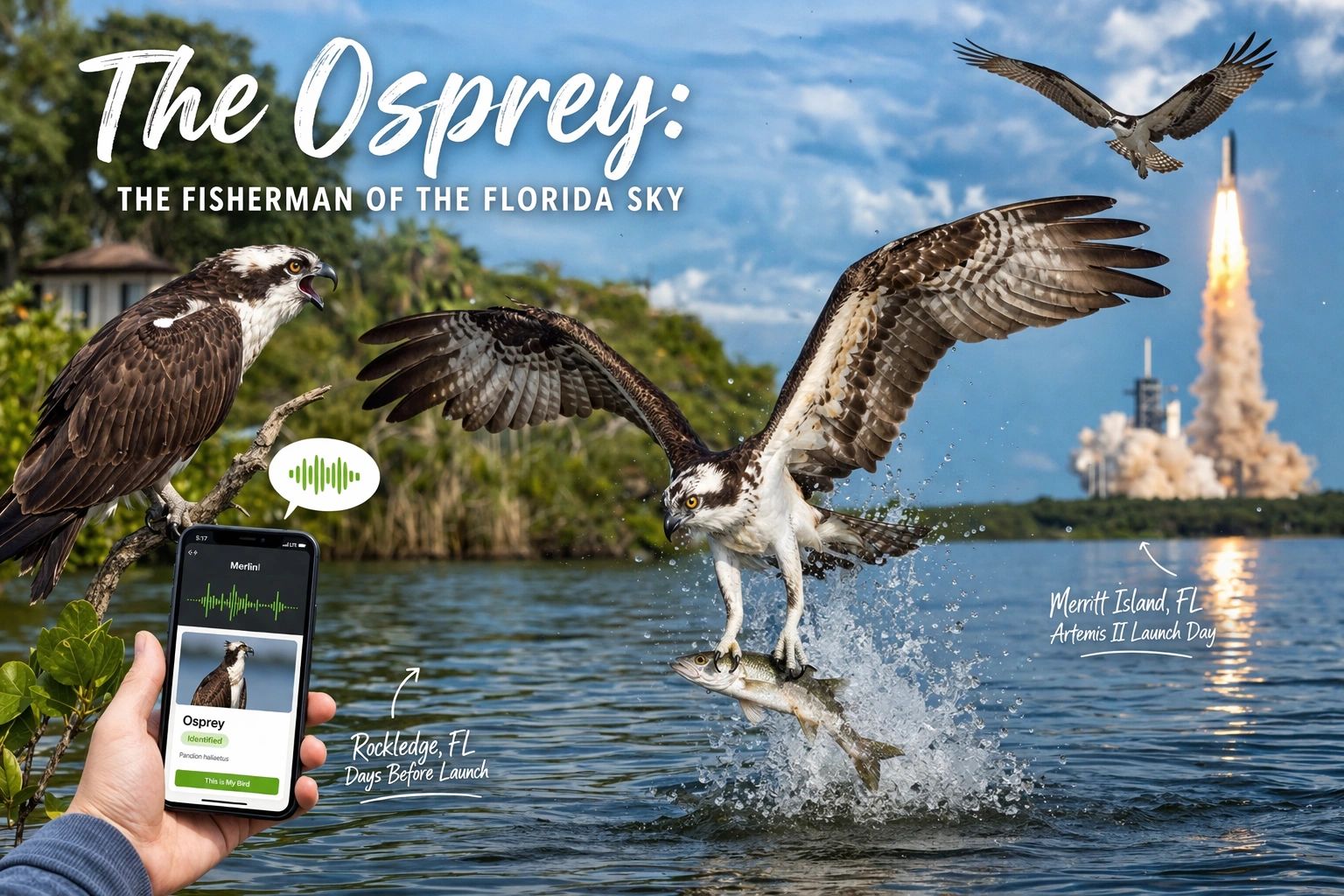
Some encounters with wildlife happen in a single moment.
You see something, recognize it, and move on.
Others unfold slowly, building over time and connecting places in ways you don’t expect.
The Osprey was one of those.
A Sound Before the Sight
A few days before the Artemis II launch, the first sign of the Osprey wasn’t something I saw.
It was something I heard.
Behind my house in Rockledge, there’s a lake that usually carries a steady, familiar quiet. Wind moves across the water, smaller birds come and go, and everything blends into a rhythm that feels consistent.
But that day, something cut through it.
A sharp, high-pitched call.
It was brief, almost abrupt, but it carried clearly across the water. It didn’t sound like the other birds I had been hearing.
So I opened the Merlin Bird ID app and let it listen.
Within seconds, it confirmed it.
Osprey.
In that moment, the sound changed. It wasn’t just part of the background anymore—it had a name, a presence, a place in the environment.
And once I knew what it was, I started looking for it.
Looking Up
It didn’t take long to find it.
High above the lake, a large bird moved in wide, steady circles. Its wings were long and slightly bent, forming a shallow “M” shape that stood out against the sky. The tips of its feathers spread outward, catching the light as it turned.
It barely flapped.
It didn’t need to.
There was something controlled about the way it moved. Nothing felt wasted or random. It wasn’t just flying—it was searching.
A Hunter in Motion
The osprey’s behavior is often described as patient and methodical, and seeing it in person made that clear.
It wasn’t reacting to the environment.
It was studying it.
From above, it scanned the surface of the water, tracking subtle movement beneath it. Fish don’t make obvious signals, but the osprey sees what most of us can’t.
Its head tilted slightly.
Adjusted.
Locked in.
Everything about the moment felt focused.
The Dive
There is always a moment just before it happens.
A pause.
A shift.
Then motion.
The Osprey dropped.
Fast and direct, it cut through the air with sudden speed. Just before reaching the water, its talons extended forward.
Then impact.
The surface broke open.
Water surged outward.
And for a brief moment, the bird disappeared completely.
Rising From the Water
When it emerged, it did so with force.
Its wings beat hard against the resistance of the water, lifting itself back into the air. And in its grip—
A fish.
Held tightly and positioned headfirst.
That detail might seem small, but it reveals just how specialized the osprey is. By aligning the fish forward, it reduces drag and makes flight more efficient.
Nothing about the osprey is accidental.
Built for Fishing
The osprey is not just another bird of prey.
It is a specialist.
Nearly its entire diet consists of fish, and its body reflects that purpose. Its talons are curved and textured to grip slippery prey. One of its outer toes can rotate, allowing it to grasp fish more securely.
Even its feathers are adapted to handle repeated contact with water.
Everything about it leads back to one function.
To hunt.
To catch.
To survive.
Days Later at Merritt Island
By the time my husband and I made our way to Merritt Island for the Artemis II launch, the Osprey was already familiar.
The call.
The shape.
The movement.
So when I saw one circling over the lagoon that afternoon, it didn’t feel like a new discovery.
It felt like recognition.
The Same Bird, A Larger World
Above the lagoon, it moved exactly the same way it had over the lake in Rockledge.
Wide wings.
Slow circles.
Constant focus on the water below.
The setting was different—more open, more expansive—but the behavior was identical.
And that made something clear.
This wasn’t a bird tied to one place.
It was tied to water.
Sky vs Sky
There was something impossible to ignore about the contrast.
People had gathered to watch a rocket rise into the sky—precision-built, powerful, designed to leave Earth behind.
At the same time, the osprey was using that same sky in a completely different way.
Not to leave.
But to live.
To hunt.
To return.
A Connection Across Places
What stood out most wasn’t just seeing the Osprey once.
It was recognizing it again.
From the lake behind my house in Rockledge to the open waters of Merritt Island, the bird moved through the same system.
It didn’t belong to one location.
It belonged to the environment itself.
Hearing Changes Everything
Before Merlin identified that first call, the Osprey might have gone unnoticed.
Just another shape overhead.
Just another sound in the distance.
But once it had a name, everything changed.
The environment became more detailed.
More layered.
More alive.
More Than Just a Bird of Prey
It would be easy to group the Osprey with other raptors and leave it at that.
But watching it closely reveals something more.
It is not just a predator.
It is a connection point.
Between air and water.
Between places.
Between what we notice and what we overlook.
Conclusion: The Hunter That Was Already There
The Osprey wasn’t part of the launch.
It didn’t arrive with the crowd.
It didn’t leave with the rocket.
It was already there.
Days before.
Circling over the lake.
Calling across the water.
And when I saw it again at Merritt Island, it wasn’t something new.
It was something familiar.
A reminder that even in moments defined by looking toward space, there is always something happening closer to home.
All you have to do is listen.
Bibliography
Cornell Lab of Ornithology. All About Birds: Osprey.
Smithsonian Institution. Smithsonian Handbooks: Birds of North America (Eastern Region).
National Audubon Society. Osprey.
Sibley, David Allen. The Sibley Guide to Birds.
Florida Fish and Wildlife Conservation Commission. Florida Bird Species Information.
Originally published at the live site .