
Maritime ·
Tracking Giants: How OCEARCH Is Saving Sharks and Our Oceans
Have you ever dreamed of following a great white shark across the ocean? Thanks to an organization called OCEARCH, you can do just that—and help save the very predators that make our oceans so wild and wonderful. OCEARCH...
By Rebecca "Madam Chronicler" Ryan
Have you ever dreamed of following a great white shark across the ocean? Thanks to an organization called OCEARCH, you can do just that—and help save the very predators that make our oceans so wild and wonderful. OCEARCH is a global nonprofit that’s changing the game for marine research, education, and conservation. Their mission? To give scientists open access to ocean data so we can better protect sharks and the entire marine ecosystem.
Let’s dive in and explore how OCEARCH is helping to track, tag, and protect some of the most powerful animals on Earth—and why that matters for us all.
What Is OCEARCH?
Founded in 2007 by explorer and TV personality Chris Fischer, OCEARCH began as a dream to bring science out of the lab and into the open ocean. The organization is best known for its shark tracking platform, which lets anyone follow tagged sharks, like the famous great white “Mary Lee,” as they move along coastlines.
But OCEARCH isn’t just about cool apps. It’s a floating science lab, educational program, and conservation group all in one. Their goal is to accelerate ocean research by giving scientists a high-tech platform at sea to conduct studies safely and efficiently—all while making that data public and free to use.
According to Fischer, “You can’t protect what you don’t understand.” And he’s right. OCEARCH is helping us understand the lives of ocean giants, one tag at a time.
Why Sharks?
Sharks are apex predators—top of the food chain. That means they help keep the ocean healthy by balancing fish populations. But they’re also in big trouble.
More than one-third of shark and ray species are now threatened with extinction, according to the International Union for Conservation of Nature (IUCN) Red List (Dulvy et al., 2021). The main threats? Overfishing, habitat loss, pollution, and climate change.
Sharks grow slowly, live long lives, and have few babies. This makes them especially vulnerable to human activity. If we lose sharks, the ripple effects could throw entire ecosystems out of balance.
That’s where OCEARCH comes in. By tracking sharks and studying their health, behavior, and movements, researchers can learn what these animals need to survive—and how we can help.
The OCEARCH Research Platform: A Lab on the Sea
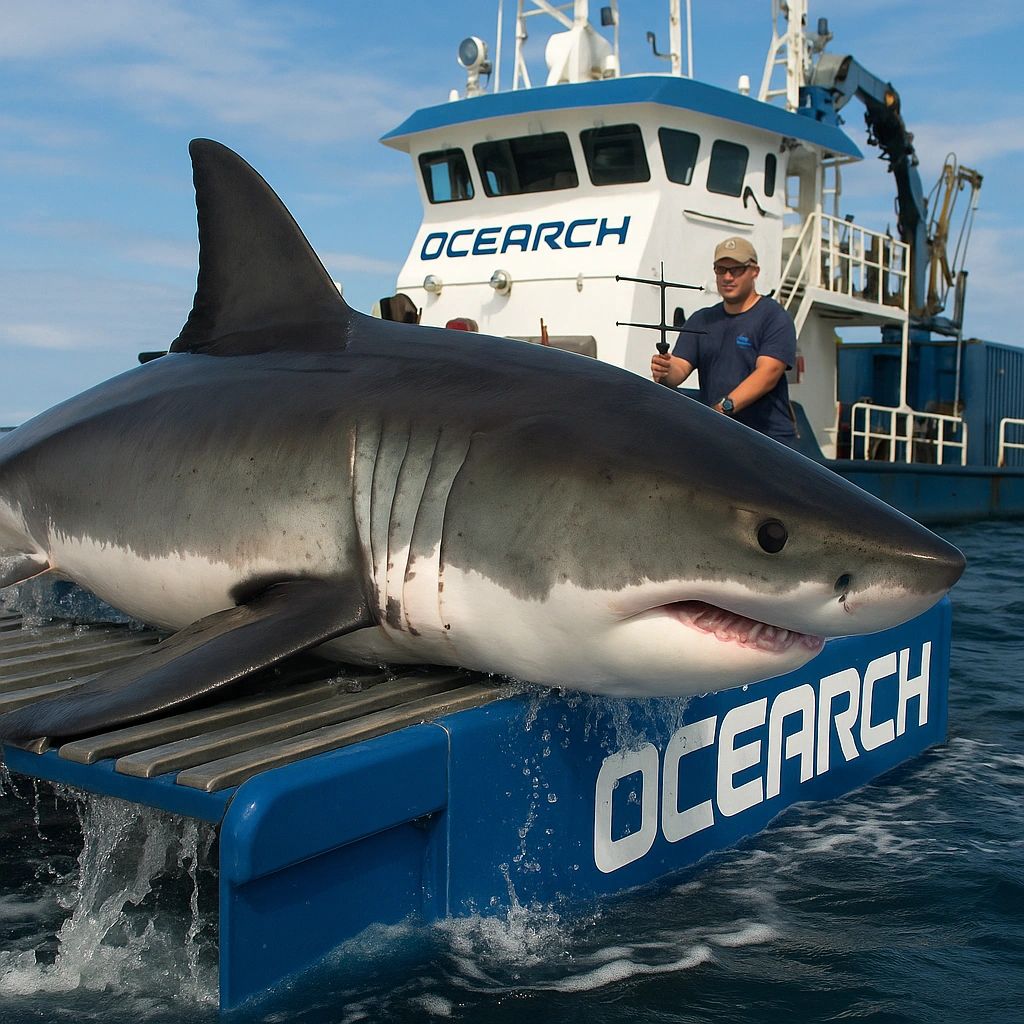
Most shark research used to happen in small boats or on land, using very basic tools. But OCEARCH changed all that with its 75-foot research vessel, also named OCEARCH. This ship is packed with state-of-the-art equipment and serves as a mobile lab at sea.
One of the coolest features is the hydraulic lift platform, which allows the team to safely bring sharks onto the deck for tagging and sample collection. Once the shark is on the platform, scientists have about 15 minutes to gather all the data they need before releasing the animal back into the ocean.
In that short time, scientists collect:
- Blood samples
- Muscle biopsies
- Parasite samples
- Ultrasound scans
- Fin clips for genetics
- Data from satellite and acoustic tags
These samples help researchers study everything from shark diet and stress levels to reproduction and population genetics.
Tagging Sharks: How It Works
OCEARCH uses two main types of tags:
- Satellite tags – These transmit the shark’s location whenever the dorsal fin breaks the surface of the water. It’s how you can track sharks in real time on OCEARCH’s website and mobile app.
- Acoustic tags – These send a sound signal that can be picked up by underwater receivers when the shark swims nearby. These tags are super useful for understanding how sharks move in and out of coastal areas.
Together, these tags help create a full picture of a shark’s life: where it hunts, breeds, migrates, and rests.
The data collected is then shared with over 200 scientists and institutions around the world who are working on ocean conservation.
Famous Sharks You Can Track
OCEARCH has tracked more than 400 sharks so far, along with other marine animals like sea turtles and alligators. Some sharks have become celebrities!
1. Mary Lee
Mary Lee was a 16-foot, 3,456-pound great white shark tagged in 2012 off Cape Cod. She traveled thousands of miles along the U.S. East Coast and even had her own Twitter account before her tag went silent in 2017.
2. Nukumi
Nukumi (pronounced noo-goo-mee) is the largest great white shark ever tagged by OCEARCH. She measured 17 feet, 2 inches and weighed more than 3,500 pounds. She was named after a legendary Indigenous grandmother figure who passed wisdom down through generations.
3. Breton
Breton is another famous great white who was tagged off Nova Scotia in 2020. Since then, he’s traveled up and down the East Coast, giving scientists valuable data on shark migration routes.
You can follow these sharks and many more on the OCEARCH Global Shark Tracker, which is fun, educational, and updated in real time.
Not Just Sharks: A Whole Ecosystem
While sharks are the stars, OCEARCH is also interested in the whole marine food web. During each expedition, scientists also study:
- Fish (like tuna and cobia)
- Sea turtles
- Plankton and jellyfish
- Water quality and microplastics
- Ocean temperature and salinity
Why study all of this? Because sharks are part of a bigger story. To protect them, we need to protect their environment too.
For example, researchers have discovered that some sharks change their migration paths based on water temperature—possibly due to climate change. OCEARCH helps track these changes in real time.
Education That Inspires
OCEARCH doesn’t just collect data—it also inspires the next generation of ocean lovers through its STEM Education Program.
Their free online curriculum includes lessons in:
- Science
- Math
- Technology
- Geography
- Conservation
The materials are designed for K-12 students and align with national standards. Teachers across the country use OCEARCH resources to bring real-world science into their classrooms.
Plus, the live shark tracker is a hit with kids and adults alike. It makes science exciting and personal—especially when you’re following a shark that just pinged near your local beach!
Working Together: The Power of Collaboration
OCEARCH doesn’t work alone. Their ship is often packed with scientists from places like:
- NOAA (National Oceanic and Atmospheric Administration)
- University of Miami
- Harvard University
- Nova Southeastern University
- Florida Fish and Wildlife Conservation Commission
By bringing researchers together on one platform, OCEARCH helps speed up discoveries that might otherwise take years. Each expedition can support 15–20 research projects at once.
This team approach is making a big difference in how we understand and protect sharks.
How OCEARCH Helps Save Sharks
All this research leads to better policies and protections for sharks and marine life. For example:
- Protected areas – Knowing where sharks breed and feed helps governments create marine protected zones.
- Fishing regulations – Tagging data can help reduce bycatch (accidental shark deaths in fishing gear).
- Climate action – Studying how sharks respond to warming oceans gives clues about ecosystem health.
- Public support – When people track a shark they care about, they’re more likely to support ocean conservation.
According to a study published in Frontiers in Marine Science, OCEARCH data has been critical in creating spatial models to predict shark migration routes and improve conservation efforts (Hammerschlag et al., 2021).
What’s Next for OCEARCH?
OCEARCH continues to expand its work globally, with expeditions to:
- The Atlantic Coast (from Canada to the Carolinas)
- The Gulf of Mexico
- The Pacific Ocean
- And even future plans for international waters
Their long-term goal? To complete the North Atlantic White Shark Puzzle—a full picture of the great white shark’s life cycle in the North Atlantic. This would be the first complete set of data for any ocean apex predator in the world.
That’s a huge milestone, not just for sharks but for all of ocean science.
How You Can Get Involved
Want to help OCEARCH protect the ocean? Here are some easy ways to dive in:
- Visit OCEARCH.org to track sharks in real time.
- Follow OCEARCH on social media to get updates on new pings and expeditions.
- Download the OCEARCH app to bring the tracker on the go.
- Use OCEARCH’s education resources if you’re a student, parent, or teacher.
- Donate or buy merch to help fund future research.
Every little bit helps bring us closer to understanding and protecting life beneath the waves.
Final Thoughts: Why OCEARCH Matters
Sharks may seem scary to some, but they are essential to a healthy ocean. OCEARCH is showing the world that science, education, and conservation can work together to protect these amazing creatures.
By giving scientists the tools they need, by making research fun and easy to follow, and by involving people of all ages in ocean discovery, OCEARCH is helping to save sharks—and our oceans—for generations to come.
So next time you wonder what’s swimming beneath the surface, check out the Global Shark Tracker. You might just spot a great white making waves off your favorite beach.
And thanks to OCEARCH, you’ll know a little more about the world that shark calls home.
Bibliography
Dulvy, N. K., Pacoureau, N., Rigby, C. L., Pollom, R. A., Jabado, R. W., Ebert, D. A., … & Simpfendorfer, C. A. (2021). Overfishing drives over one-third of all sharks and rays toward a global extinction crisis. Current Biology, 31(21), 4773-4787. https://doi.org/10.1016/j.cub.2021.08.062
Hammerschlag, N., Gallagher, A. J., Wester, J., Luo, J., & Ault, J. S. (2021). Don’t fear the fin: Quantifying human safety relative to shark presence in coastal waters. Frontiers in Marine Science, 8, 616319. https://doi.org/10.3389/fmars.2021.616319
OCEARCH. (n.d.). About OCEARCH. Retrieved from https://www.ocearch.org
OCEARCH. (n.d.). Shark Tracker. Retrieved from https://www.ocearch.org/tracker
OCEARCH. (n.d.). Education Resources. Retrieved from https://www.ocearch.org/education
Originally published at the live site .