
Stories ·
Tracking Giants: The Incredible Work of OCEARCH
Imagine being able to follow a great white shark named “Freya” as she swims thousands of miles up and down the Atlantic Ocean. Or picture yourself watching the path of a massive tiger shark crossing the Gulf of Mexico in...
By Rebecca "Madam Chronicler" Ryan
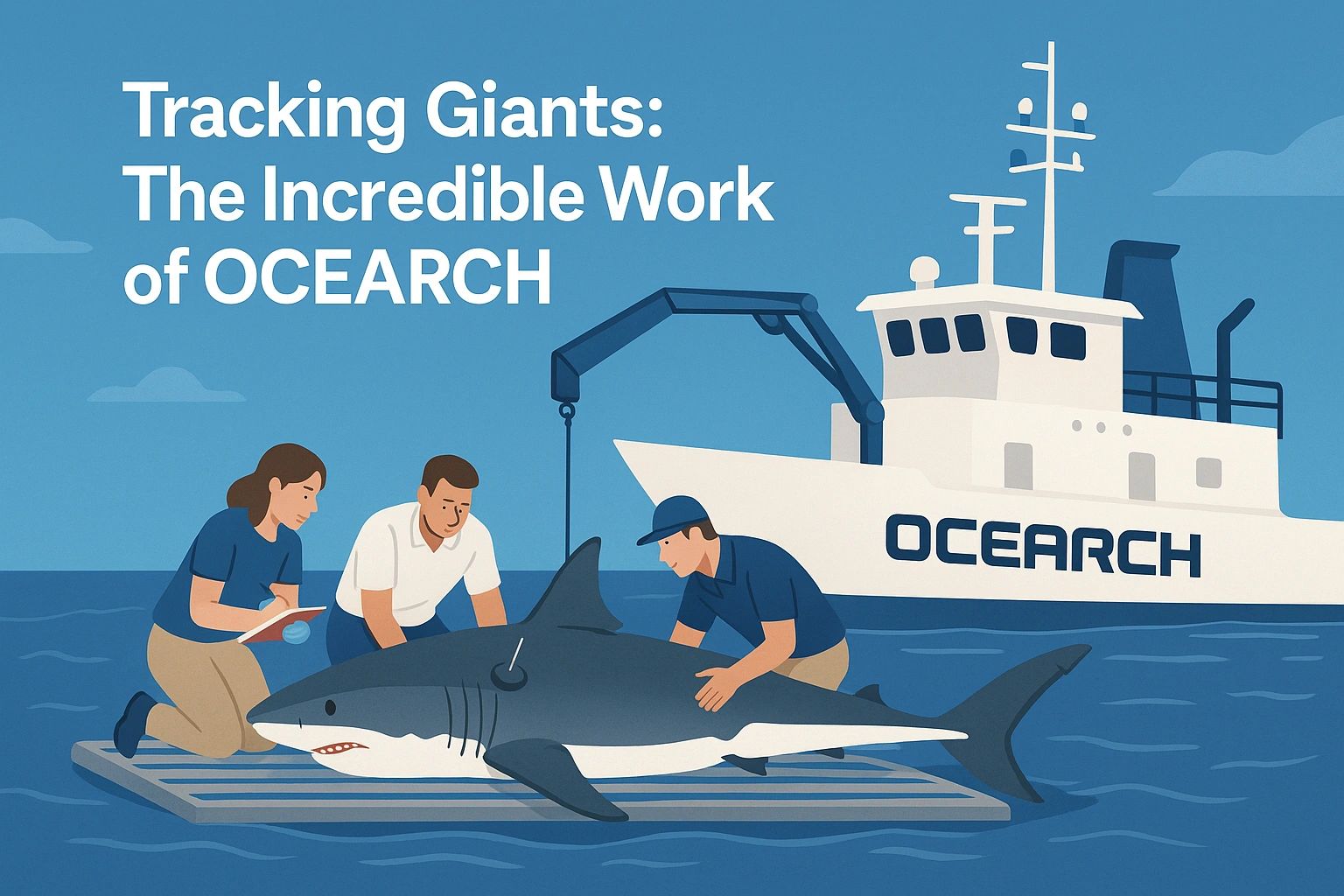
Imagine being able to follow a great white shark named “Freya” as she swims thousands of miles up and down the Atlantic Ocean. Or picture yourself watching the path of a massive tiger shark crossing the Gulf of Mexico in real time. Thanks to OCEARCH, that’s not just something from a movie—it’s science in action. And it’s changing the way we understand sharks and the ocean itself.
OCEARCH is a nonprofit organization that’s making big waves in ocean research. They’re best known for tagging and tracking large marine animals, especially sharks. But their mission goes much deeper. OCEARCH is helping scientists unlock secrets about the oceans, teaching the public why marine life matters, and even helping to protect our planet’s most mysterious creatures.
In this post, we’ll dive into everything OCEARCH is doing—from their amazing ship-based research expeditions to their global shark tracking app. We’ll also explore how their work is saving sharks, educating communities, and making a difference worldwide.
What Is OCEARCH?
OCEARCH was founded in 2007 by Chris Fischer, a former TV host who wanted to do more than just talk about the ocean—he wanted to help save it. The name OCEARCH comes from combining “ocean” and “research.” That’s exactly what they do.
At the heart of OCEARCH is its one-of-a-kind ship, the M/V OCEARCH. It acts like a floating science lab and mobile shark-tagging station. Scientists from around the world join the crew on expeditions to catch, study, tag, and release sharks and other marine animals. The data collected helps answer some big questions:
- Where do sharks go throughout the year?
- How do they reproduce?
- What are their roles in the ecosystem?
- How are humans affecting their lives?
OCEARCH is all about collaboration. More than 200 scientists from over 100 institutions have joined OCEARCH expeditions to collect samples, tag animals, and share their findings. This open-source approach means anyone—scientists, students, and even curious kids—can learn from the data.
Why Sharks?
Sharks have been around for more than 400 million years, but today many species are in serious trouble. Overfishing, habitat loss, and pollution have taken a major toll. Some shark populations have dropped by more than 70% in just a few decades (Pacoureau et al., 2021).
That’s a problem not just for sharks, but for the ocean as a whole. Sharks are apex predators, which means they sit at the top of the food chain. When shark numbers go down, the entire balance of ocean life can shift.
OCEARCH focuses on sharks because understanding their habits is key to protecting them—and the oceans they help control. By tagging and tracking these animals, researchers can figure out where they migrate, where they breed, and what areas need the most protection.
How Tagging Works
OCEARCH uses a special lift on their ship to gently raise large sharks out of the water for about 15 minutes. During this time, scientists collect up to 12 different samples, including blood, mucus, and even parasites. They also attach a satellite tag to the shark’s dorsal fin. This tag sends a signal every time the shark’s fin breaks the surface of the water.
That signal helps create a digital map of the shark’s movements. You can see these movements for yourself using the free OCEARCH Global Shark Tracker app. It’s a fun and educational way to follow your favorite sharks—like “Breton,” a great white who’s traveled more than 25,000 miles.
The process is carefully designed to protect the shark. The team works fast, keeps the shark wet, and makes sure the animal is released safely and in good health.
What We’ve Learned So Far
Since 2007, OCEARCH has tagged over 430 animals, including great white sharks, tiger sharks, makos, hammerheads, whales, and even alligators. Each animal tells a different story.
Here are just a few cool discoveries:
- Sharks travel farther than we thought: Some great whites tagged off the East Coast of the U.S. have swum all the way to the Gulf of Mexico and back (Curtis et al., 2018).
- They use the same “highways” every year: Certain shark species follow regular migratory routes that pass through key feeding and breeding grounds.
- Sharks are giving birth off U.S. coastlines: For years, no one knew where great white sharks gave birth. Thanks to OCEARCH data, researchers now believe that the waters off Long Island and the Carolinas may be pupping grounds for these predators (Skomal et al., 2021).
- Some sharks dive really deep: Tiger sharks tagged in the Atlantic have been recorded diving over 1,000 feet down in search of prey.
These discoveries help governments create better laws and marine protected areas. They also give scientists more insight into how climate change and human activity are affecting the ocean.
OCEARCH’s Education Mission
One of the coolest parts of OCEARCH’s work is how they bring science to life for students and teachers. They offer a whole STEM curriculum based on real shark tracking data. The lessons include subjects like math, biology, geography, and environmental science—and they’re designed to be fun and interactive.
Over 20 million students have used OCEARCH learning materials (OCEARCH, 2024). Teachers can access free worksheets, classroom challenges, and even virtual expeditions.
By turning students into “citizen scientists,” OCEARCH is helping raise the next generation of marine biologists and conservation leaders. They make it easy for anyone to get involved in protecting the ocean, no matter where they live.
Why Open Access Science Matters
Most scientific research is kept behind paywalls, hidden in journals that only experts read. But OCEARCH believes knowledge should be shared. That’s why they publish their data for free on their website and apps.
This open-source model speeds up discovery and helps more people get involved. It also encourages teamwork between universities, nonprofits, and even fishermen. In fact, many OCEARCH crew members used to be commercial anglers who now use their skills to help sharks instead of catch them.
By tearing down barriers, OCEARCH is changing the culture of marine science—and it’s working.
OCEARCH and Conservation
So, does tagging sharks actually help save them? The answer is yes. The data OCEARCH collects is used by governments and conservation groups to create better rules and protect important habitats.
For example:
- The U.S. National Marine Fisheries Service has used OCEARCH data to adjust fishing seasons and protect shark nursery areas.
- Marine protected areas (MPAs) in the Atlantic are now being shaped using shark movement data from OCEARCH expeditions.
- Shark ecotourism—like diving tours—is booming in places like the Bahamas, thanks to a better understanding of where sharks live and migrate.
Sharks face a lot of threats, from overfishing to pollution to climate change. But with more data, we can make smarter choices and help shark populations recover.
Famous Sharks of OCEARCH
Part of what makes OCEARCH so exciting is the chance to “meet” individual sharks and follow their stories. Each shark gets a name and a tracking profile. Some become internet celebrities with thousands of followers.
Here are a few of the most famous:
- Mary Lee: A 3,500-pound great white tagged off Cape Cod. She became one of OCEARCH’s most popular sharks ever and traveled more than 40,000 miles.
- Lydia: The first great white shark known to cross the Atlantic. Her journey helped prove that sharks migrate between continents.
- Miss Costa: A fan favorite known for her frequent returns to the Southeast U.S. coast.
- Breton: A huge male great white that has traveled thousands of miles and revealed new insights about adult shark migration.
- Maple: A young great white who spent lots of time near Nova Scotia, showing that the North Atlantic is a hot spot for sharks.
These sharks aren’t just data points—they’re ambassadors. They help people feel connected to wildlife in a personal way.
Looking Ahead: The Future of OCEARCH
OCEARCH isn’t slowing down. The team continues to explore new waters, tag new species, and expand their global impact. Some of their upcoming goals include:
- Tagging more hammerhead and mako sharks, which are critically endangered.
- Studying how climate change is shifting shark migration patterns.
- Expanding their research to the Pacific and Indian Oceans.
- Building stronger ties between science and policy to protect marine ecosystems.
They’re also working to better understand how healthy oceans support human life. After all, oceans give us oxygen, regulate climate, and provide food for billions of people. If we don’t protect marine life, we risk harming ourselves too.
How You Can Help
You don’t have to be a scientist to join the OCEARCH mission. Here are a few easy ways to make a difference:
- Download the OCEARCH Tracker App: Follow your favorite sharks and share their journeys with friends.
- Use OCEARCH classroom materials: Teachers and parents can bring shark science into the classroom.
- Support marine conservation: Choose seafood from sustainable sources, reduce plastic waste, and speak up for ocean protection.
- Follow OCEARCH on social media: Stay updated on new discoveries and upcoming expeditions.
Every small action helps. And together, we can make sure these ancient animals are still around for the next generation.
Final Thoughts
OCEARCH is more than just a research group—it’s a movement. They’ve made shark science exciting, accessible, and important. By tagging and tracking ocean giants, they’re helping us protect the sea, understand the planet, and connect people with nature.
In a world where sharks are often feared or misunderstood, OCEARCH shows us the truth: sharks are powerful, essential, and worth saving. So next time you see a fin in the water, don’t think “Jaws.” Think science. Think OCEARCH.
Bibliography
Curtis, T. H., McCandless, C. T., Carlson, J. K., Skomal, G. B., Kohler, N. E., Sulikowski, J. A., … & Musick, J. A. (2018). Seasonal distribution and historic trends in abundance of white sharks, Carcharodon carcharias, in the western North Atlantic Ocean. Fisheries Research, 188, 157–167. https://doi.org/10.1016/j.fishres.2016.12.019
OCEARCH. (2024). About Us. Retrieved from https://www.ocearch.org/
Pacoureau, N., Rigby, C. L., Kyne, P. M., Sherley, R. B., Winker, H., Carlson, J. K., … & Dulvy, N. K. (2021). Half a century of global decline in oceanic sharks and rays. Nature, 589(7843), 567–571. https://doi.org/10.1038/s41586-020-03173-9
Skomal, G. B., Braun, C. D., Chisholm, J. H., & Thorrold, S. R. (2021). Movements of young-of-the-year white sharks in the western North Atlantic Ocean. Scientific Reports, 11(1), 18190. https://doi.org/10.1038/s41598-021-97664-7
Originally published at the live site .