
Maritime ·
Which Shark Inspired Jaws? Tracing the True Story Behind Cinema's
When Jaws debuted in 1975, it sent shockwaves through pop culture, redefining the summer blockbuster and igniting a wave of fear about sharks that has lasted for generations. But few realize that the great white terror o...
By Rebecca "Madam Chronicler" Ryan
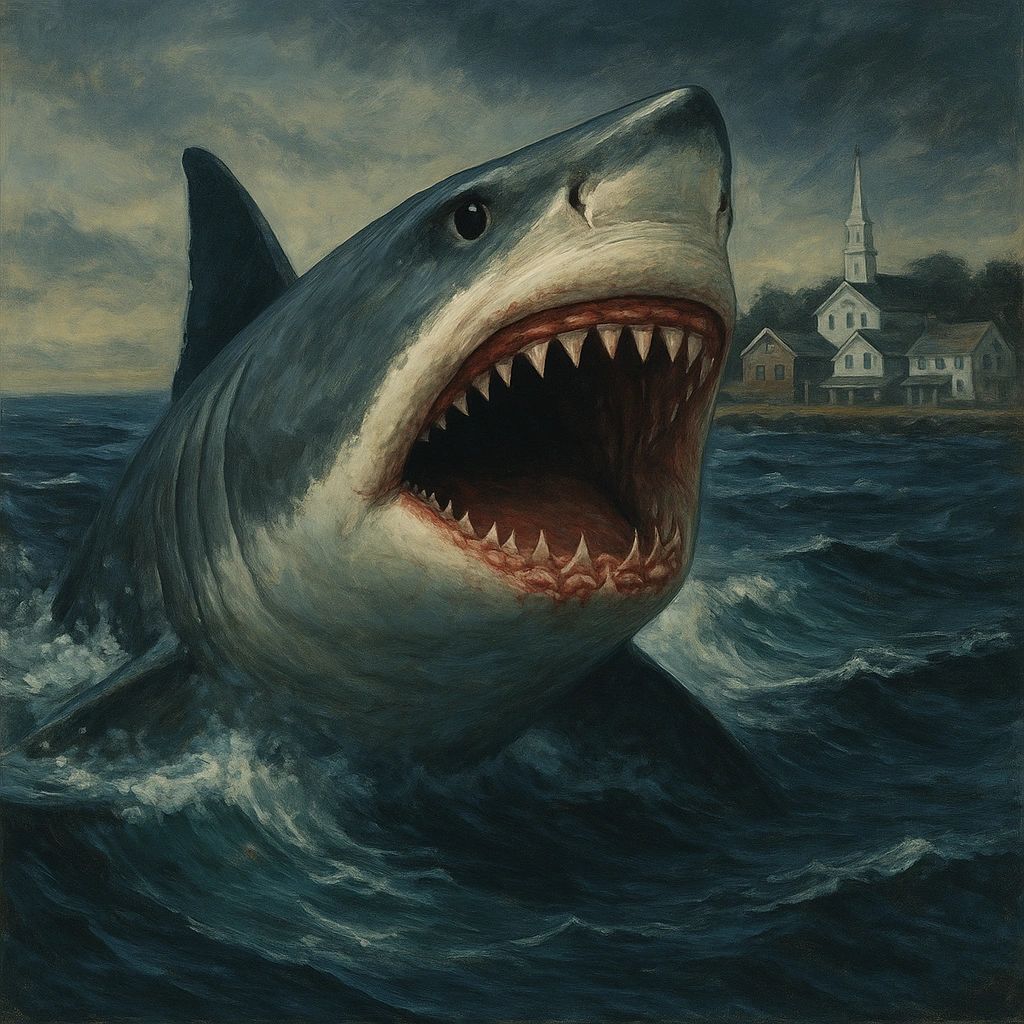
When Jaws debuted in 1975, it sent shockwaves through pop culture, redefining the summer blockbuster and igniting a wave of fear about sharks that has lasted for generations. But few realize that the great white terror of Amity Island was actually inspired by a real-life event—a series of shark attacks that took place in New Jersey in 1916.
This blog dives deep into the question: Which shark inspiredJaws?** We’ll explore the true story behind the film, the science of the great white shark (Carcharodon carcharias), and how fiction, fear, and fact came together to create the most infamous fish in film history.
The 1916 Jersey Shore Shark Attacks: The Spark Behind the Story
The shark that inspired Jaws wasn’t just a Hollywood invention—it was based, in part, on a series of shark attacks that shocked the U.S. East Coast in July 1916. At the time, Americans were enjoying a hot summer and a newfound enthusiasm for beachgoing. New Jersey’s coastline was packed with tourists.
Then the unthinkable happened.
Between July 1 and July 12, five people were attacked by a shark, and four of them died. What made the attacks even more terrifying was their geography:
- Two attacks occurred in the surf near Beach Haven and Spring Lake—typical oceanfront settings.
- Three more happened miles inland in a tidal river called Matawan Creek, where sharks were never expected to be.
The Matawan Creek incident, especially, stunned the public and confounded scientists. One of the victims was a young boy, and another was a man trying to recover his body.
At the time, there was widespread uncertainty about whether sharks were even capable of attacking humans. The idea that a single predator could swim miles upstream and kill people was unprecedented—and controversial.
The U.S. press exploded with sensational headlines. Panic gripped the region. The federal government sent scientists and sailors to investigate. Local fishermen hunted sharks with dynamite. It was one of the earliest documented “shark panics” in American history (Capuzzo, 2001).
Peter Benchley’s Inspiration: Blending Fact and Fiction
Fast forward to the early 1970s. Journalist and writer Peter Benchley was fascinated by sharks, particularly the great white. He had read reports of large sharks being caught off Long Island and was deeply inspired by the 1916 New Jersey attacks.
In interviews, Benchley admitted that he drew direct inspiration from the 1916 events when crafting the storyline of his 1974 novel Jaws (Benchley, 2002). The fictional setting of Amity Island—a quaint New England beach town rocked by shark attacks—closely mirrors the panic and politics of New Jersey 60 years earlier.
Benchley also borrowed from marine science and eyewitness reports of rogue sharks—individual sharks that, for unknown reasons, may repeatedly enter populated waters and attack humans.
Thus, the fictional monster in Jaws is not any specific shark, but a composite:
- The geography and panic of the 1916 attacks
- The size and mystique of the great white shark
- The rogue predator theory circulating in early 20th-century marine science
Spielberg’s film adaptation took the story global, but the beating heart of Jaws—a single, massive shark terrorizing a seaside town—was pulled straight from American history.
Was the 1916 Shark a Great White?
Here’s where the mystery deepens. While Jaws clearly presents a great white shark as its villain, experts continue to debate the actual species responsible for the 1916 attacks.
The Case for the Great White
Many marine biologists believe a juvenile great white shark was responsible. Great whites are known to frequent the Atlantic coast and can enter brackish water briefly. They are opportunistic feeders, capable of ambushing prey in shallow areas. In 1916, great whites were already feared due to their size and teeth (Burgess & Callahan, 1996).
The Case for the Bull Shark
Other experts argue that a bull shark (Carcharhinus leucas) fits the evidence better:
- Bull sharks can tolerate freshwater for long periods and are often found in rivers.
- They are aggressive and have been documented attacking humans in both saltwater and freshwater habitats (Compagno et al., 2005).
- Matawan Creek, where three of the attacks occurred, was more hospitable to a bull shark than a great white.
Since the technology to tag or track sharks didn’t exist in 1916, we may never know for certain. But it’s likely that the “Jersey man-eater” was either a great white or a bull shark—and either way, it left an indelible mark on the American imagination.
The Great White Shark: Biology of a Legend
Whether or not the 1916 shark was a great white, that’s the species Peter Benchley chose for his novel—and Spielberg immortalized in film. Why? Because great whites are visually and behaviorally compelling.
Size and Strength
Great whites are among the largest predatory fish on Earth, reaching lengths of 20 feet and weights over 5,000 pounds. They have powerful jaws, lined with serrated teeth that can exert 4,000 psi of bite force—enough to bite through bone (Wroe et al., 2008).
Sensory Powerhouse
These sharks have exceptional senses:
- Electroreception via ampullae of Lorenzini
- Smell—can detect blood in water from miles away
- Vision suited for both daylight and low-light conditions
- Hearing attuned to low-frequency vibrations
Migration and Intelligence
Recent satellite tagging has revealed that great whites are long-distance travelers. Some have been tracked migrating from California to Hawaii or from South Africa to Australia (Bonfil et al., 2005). They’re also intelligent, capable of learning and altering hunting tactics (Huveneers et al., 2015).
These traits made the great white the perfect villain in Jaws: huge, stealthy, powerful, and mysterious.
The Rogue Shark Theory: Science or Speculation?
A central theme of Jaws is the concept of a rogue shark—a single predator that develops a “taste” for human flesh and repeatedly attacks.
Is that biologically plausible?
The answer is: not really.
Sharks don’t hunt humans on purpose. Most bites are likely cases of mistaken identity (e.g., surfers on boards resembling seals). Sharks tend to bite once, realize the human isn’t prey, and swim away (McPhee, 2014).
The rogue shark theory gained traction in the early 1900s, but modern marine science has largely discredited it. Sharks lack the complex social learning or behavioral psychology associated with mammalian “rogue” behavior. There’s no evidence that any shark becomes a serial killer by choice.
Still, the theory served the dramatic needs of Jaws—a single enemy that could be hunted, defeated, and overcome. And in fiction, that makes for a better story than a random bite.
HowJawsChanged Everything
The shark that inspired Jaws didn’t just shape a novel or a movie. It helped change how the world thought about the ocean.
In Film
Jaws became the first “summer blockbuster,” launching a new era of big-budget thrillers. It spawned sequels, parodies, theme park rides, and an entire subgenre of creature features. But no shark movie before or since has matched its suspense or impact.
In Science
Ironically, while Jaws promoted shark fear, it also sparked scientific interest in shark behavior. After the film, funding for shark research increased, and public awareness about shark biology grew (Neff & Hueter, 2013).
In Conservation
As public attitudes matured, the same fear Jaws unleashed became a tool for education and conservation. Peter Benchley himself became a passionate shark advocate. Today, many scientists and filmmakers use the shark’s iconic status to promote protection efforts.
The Legacy of the “Jaws” Shark
So, which shark inspired Jaws?
- It was likely a real shark, possibly a great white, that struck New Jersey in 1916.
- It was the idea of a rogue predator—implausible, yet dramatic.
- It was the great white shark—elevated from mystery to monster to symbol.
Today, we know that sharks are not villains. They are ancient, complex, and essential to ocean health. The “Jaws” shark may have frightened a generation, but it also brought sharks into the spotlight in a way no textbook ever could.
Conclusion: From Fact to Fiction to Awareness
Half a century after its release, Jaws continues to influence how we see sharks. It was inspired by a real mystery—a series of unexplained attacks off the Jersey coast—but it took artistic liberties to turn fear into legend.
The true shark that inspired Jaws may never be known with certainty. But its legacy is undeniable. It taught us how much stories shape science, how fiction can spark fascination, and how understanding must follow fear.
So the next time you hear that ominous da-dum da-dum, remember: the shark from Jaws may have been born from a nightmare, but today, it calls us to deeper knowledge, better stewardship, and awe for the wild blue world beneath our feet.
References
Benchley, P. (2002). Shark Trouble: True Stories About Sharks and the Sea. Random House.
Bonfil, R., Meyer, M., Scholl, M. C., Johnson, R., O’Brien, S., Oosthuizen, H., … & Paterson, M. (2005). Transoceanic migration, spatial dynamics, and population linkages of white sharks. Science, 310(5745), 100–103. https://doi.org/10.1126/science.1114898
Burgess, G. H., & Callahan, M. (1996). Worldwide pattern of shark attacks on humans. In Great White Sharks: The Biology of Carcharodon carcharias (pp. 457–469). Academic Press.
Capuzzo, M. (2001). Close to Shore: The Terrifying Shark Attacks of 1916. Broadway Books.
Compagno, L. J. V., Dando, M., & Fowler, S. (2005). Sharks of the World. Princeton University Press.
Huveneers, C., Rogers, P. J., Semmens, J. M., Beckmann, C., Kock, A. A., Page, B., & Goldsworthy, S. D. (2015). Effects of a shark repellent on the behaviour of white sharks (Carcharodon carcharias). Scientific Reports, 5, 11584. https://doi.org/10.1038/srep11584
McPhee, D. (2014). Unprovoked shark bites: Are they becoming more prevalent? Coastal Management, 42(5), 478–492. https://doi.org/10.1080/08920753.2014.942046
Neff, C., & Hueter, R. (2013). Science, policy, and the public discourse of shark “attack”: A proposal for reclassifying human–shark interactions. Journal of Environmental Studies and Sciences, 3(1), 65–73. https://doi.org/10.1007/s13412-013-0107-2
Wroe, S., McHenry, C., & Thomason, J. (2008). Bite club: Comparative bite force in big biting mammals and the prediction of predatory behaviour in fossil taxa. Proceedings of the Royal Society B: Biological Sciences, 272(1563), 619–625. https://doi.org/10.1098/rspb.2004.3049
Originally published at the live site .