
Maritime ·
Why Herons and Egrets Nest Together in Coastal Ecosystems
Along coastlines and estuaries, spring transforms quiet trees into crowded neighborhoods. Branches fill with long legs, sharp bills, and restless movement. White feathers flash beside gray and blue ones. Calls echo acros...
By Rebecca "Madam Chronicler" Ryan
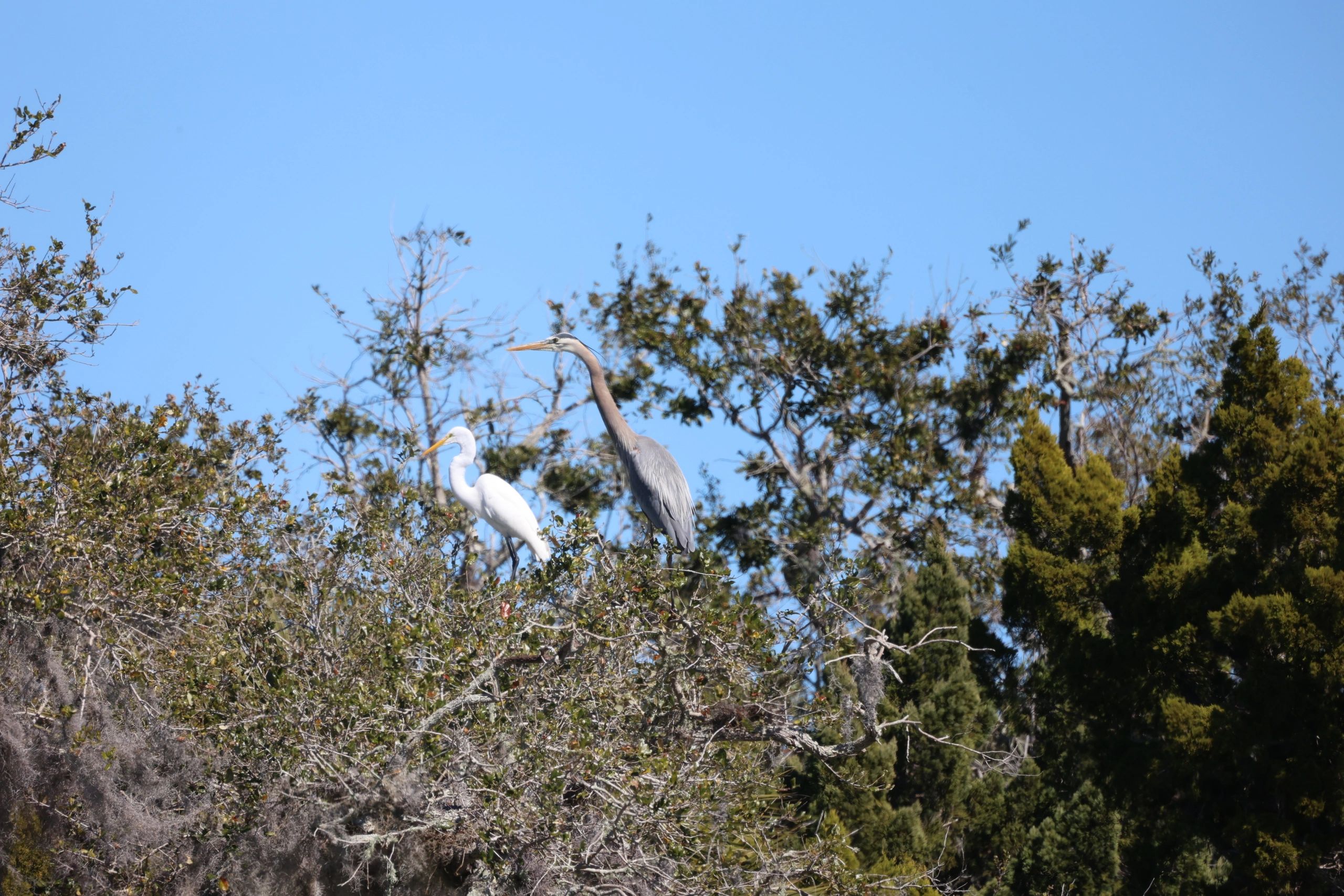
Along coastlines and estuaries, spring transforms quiet trees into crowded neighborhoods. Branches fill with long legs, sharp bills, and restless movement. White feathers flash beside gray and blue ones. Calls echo across marshes and mangrove islands. This is nesting season for herons and egrets, and it’s almost never a solitary affair.
Instead of nesting alone, these birds gather in large, shared breeding colonies known as rookeries. Great blue herons, great egrets, snowy egrets, tricolored herons, and other wading birds often raise their young side by side, sometimes packing hundreds or even thousands of nests into a single stand of trees. This seemingly chaotic behavior is actually the result of a long evolutionary process shaped by survival, cooperation, and the rhythms of coastal ecosystems.
Herons and egrets nest together, increasing their chances of successfully raising young. These mixed colonies provide safety, improve food access, and reflect the overall health of the wetlands they depend on.
Colonial Nesting in Wading Birds
A rookery is a place where birds nest close together during the breeding season. For herons and egrets, these sites are usually located over water, often in mangroves, flooded forests, coastal hammocks, or isolated islands. Nesting over water limits access for land predators and provides a clear escape route if danger approaches..
Colonial nesting is common among wading birds worldwide. Decades of research show that birds nesting in groups often produce more surviving chicks than those nesting alone. While crowding increases noise and competition, the benefits of group nesting generally outweigh the costs, especially in environments with high threats and limited safe nesting sites.
Evolutionary Advantages of Nesting Together
Colonial nesting didn’t happen by chance. It evolved because it boosted reproductive success. Birds who tolerated their neighbors and returned to established colonies were more likely to pass on their genes. Over time, this behavior became common among herons and egrets.
Ecologists studying colonial birds have found that nesting in groups improves early predator detection, increases collective defense, and enhances access to information about food resources. These advantages are particularly important in coastal ecosystems, where conditions can change rapidly due to tides, storms, and shifting water levels.
Protection Through Numbers
One of the strongest reasons herons and egrets nest together is protection from predators. Eggs and chicks are vulnerable to a wide range of threats, including raccoons, snakes, birds of prey, and nest-raiding birds such as crows and gulls.
Within a colony, predators face an increased risk of early detection. When one bird reacts, others quickly follow suit. Adults may mob predators, issue loud alarm calls, or take flight in unison. These collective responses make it challenging for predators to approach undetected or stay in the colony for long.
Studies comparing solitary nests to colonial nests demonstrate significantly lower predation rates in colonies. In simpler terms, predators are less successful when numerous adults are watching and responding simultaneously (Burger, 1981).
The Power of Mixed-Species Defense
Mixed-species colonies offer an extra layer of protection. Various species respond to threats differently; some are more aggressive, others more vocal, and still others quicker to flee. These combined responses create a complex and effective defense system.
Studies show that mixed-species colonies face fewer successful predator attacks compared to single-species colonies. The varied behaviors within mixed colonies make it more difficult for predators to adapt to or exploit predictable patterns (Wittenberger & Hunt, 1985).
Limited Safe Nesting Habitat
Safe nesting sites in coastal ecosystems are scarce. Trees need to be high enough to avoid flooding, isolated enough to deter predators, and close enough to feeding grounds to support frequent trips back to the nest.
Mangrove islands and flooded forests provide suitable habitats, but they are limited. Once herons and egrets find a good nesting site, they often return year after year. Nesting together allows multiple species to share safe locations instead of competing for them.
In this context, tolerating neighbors becomes a survival strategy, as the risk of nesting alone in a less secure location often outweighs the challenges of sharing space.
Food Availability Shapes Colonies
Nesting is one of the most energy-demanding periods in a bird’s life. Adults must feed themselves while also catching enough food to raise rapidly growing chicks. As a result, colonies thrive only when food is abundant and readily accessible.
Coastal wetlands offer food in seasonal pulses. As water levels drop after flooding, fish and invertebrates concentrate in shallow pools. Herons and egrets time their nesting to these conditions, ensuring an easy food supply for their chicks.
Long-term studies in the Florida Everglades demonstrate that wading bird nesting success is strongly linked to water timing and prey concentration. Colonies often fail when water levels drop too early or too late (Frederick & Ogden, 2001).
Sharing Information About Feeding Grounds
Nesting together enhances information access. Birds returning from successful feeding trips are frequently followed by others, intentionally or not. Consequently, colony members learn where prey is concentrated and how environmental conditions shift across the landscape.
This process, known as local enhancement, allows individuals to benefit from the experience of others. Although different species may hunt in various ways or locations, shared information enables the entire colony to respond more effectively to changing environmental conditions (Buckley, 1997).
Avoiding Competition Through Specialization
Although herons and egrets often eat similar prey, direct competition is reduced through subtle differences in behavior and habitat use. Each species has evolved its own feeding style, preferred water depth, and prey size.
Great blue herons often hunt in deeper water and target larger fish. Snowy egrets are more active feeders in shallow flats, while tricolored herons specialize in narrow channels and edges. These differences allow many species to feed in the same wetland without depleting the same resources (Kushlan, 1976).
Vertical Organization Within Colonies
Competition is also reduced within the nesting colony itself. Larger species tend to build nests higher in trees, where branches are stronger and can support heavier bodies. Smaller species usually nest lower, where branches are thinner but more numerous.
This vertical separation reduces aggressive encounters and minimizes damage to nests. It also reflects differences in body size, flight ability, and vulnerability to predators. Such organization has been documented in mixed colonies across many regions and is considered a hallmark of stable rookery structure (Parsons & Master, 2000).
Synchronizing With Coastal Cycles
Coastal ecosystems are shaped by tides, rainfall, and seasonal storms. Nesting together allows herons and egrets to synchronize their breeding with these natural cycles. When conditions are favorable, colonies grow rapidly; however, when conditions are poor, the birds may skip breeding altogether.
This sensitivity makes wading bird colonies powerful indicators of ecosystem health. Successful nesting suggests that water flow, prey availability, and habitat structure are functioning as they should. Colony failure, however, often signals deeper environmental problems (Ogden, 2005).
Rookeries as Nutrient Hubs
Large nesting colonies contribute to more than just raising chicks; they also reshape the surrounding environment. As birds forage in wetlands and roost in trees, they transport nutrients from water to land. Over time, droppings accumulate beneath nesting sites, enriching the soil.
Research indicates that these nutrient inputs promote plant growth and modify vegetation structure. Rookery sites frequently support distinct plant and insect communities, directly connecting bird behavior to broader ecosystem processes (Mizutani et al., 1992).
When Colonies Decline
Because nesting is so demanding, colonies often fail before other signs of ecosystem collapse become apparent. Scientists monitor nest numbers, breeding timing, and chick survival to detect early warning signs.
Wading bird colony declines are linked to wetland drainage, altered water flow, pollution, and habitat loss. Often, these bird declines appear years before wetlands visibly degrade, making them valuable indicators for conservation planning (Frederick et al., 2009).
Lessons From the Everglades
The Florida Everglades provide a clear example of how colonial nesting reflects ecosystem health. In the early 20th century, water diversion projects disrupted natural flooding patterns, causing fish to no longer concentrate in shallow areas at the right times, leading to the collapse of wading bird colonies.
By the 1970s, populations had plummeted by over 90%. Restoration efforts shifted to restoring natural water flow. As prey returned, mixed-species colonies slowly reappeared, confirming the strong connection between hydrology, food availability, and colonial nesting (Ogden, 2005).
Why These Colonies Matter Today
As coastal ecosystems face development, climate change, and rising sea levels, safe nesting sites are disappearing. Protecting mixed-species rookeries protects multiple bird species and the wetlands they sustain.
Conservation strategies that prioritize nesting colonies often lead to broader ecosystem benefits, including improved water quality, stronger fish populations, and increased biodiversity.
Final Thoughts
Herons and egrets nest together because cooperation enhances their survival. Their crowded colonies are a sign of balance, not conflict, with each nest representing timing, abundance, and a functioning ecosystem.
When these colonies thrive, coastal wetlands typically thrive as well. Conversely, their silence often signals a deeper environmental issue.
In the tangled branches of a rookery, the story of the coast is written—quietly, collectively, and one generation at a time.
References
Burger, J. (1981). A model for the evolution of mixed-species colonies of herons. The Condor, 83(2), 140–148. Buckley, N. J. (1997). Spatial concentration effects and colonial breeding. The American Naturalist, 149(6), 1091–1112. Frederick, P. C., & Ogden, J. C. (2001). Pulsed breeding of long-legged wading birds. Wetlands, 21(4), 484–491. Frederick, P. C., Gawlik, D. E., Ogden, J. C., Cook, M. I., & Lusk, M. (2009). Wading birds as indicators of restoration success. Ecological Indicators, 9(6), S83–S95. Kushlan, J. A. (1976). Feeding behavior of North American herons. The Auk, 93(1), 86–94. Mizutani, H., Kabaya, Y., & Wada, E. (1992). Bird-mediated nutrient transfer. Isotopes in Environmental and Health Studies, 28(3–4), 173–178. Ogden, J. C. (2005). Everglades ridge and slough conceptual ecological model. Wetlands, 25(4), 810–820. Parsons, K. C., & Master, T. L. (2000). Nest-site selection by wading birds. Waterbirds, 23(2), 246–255. Wittenberger, J. F., & Hunt, G. L. (1985). The adaptive significance of coloniality in birds. Avian Biology, 8, 1–78.
Originally published at the live site .