
Maritime ·
The Silent Stalker: Frilled Shark Encounter
Imagine you're in a submarine, drifting deep beneath the surface of the ocean. The sunlight has long disappeared. The water outside your tiny window is inky black. Suddenly, a strange shadow slides into view. It has the ...
By Rebecca "Madam Chronicler" Ryan
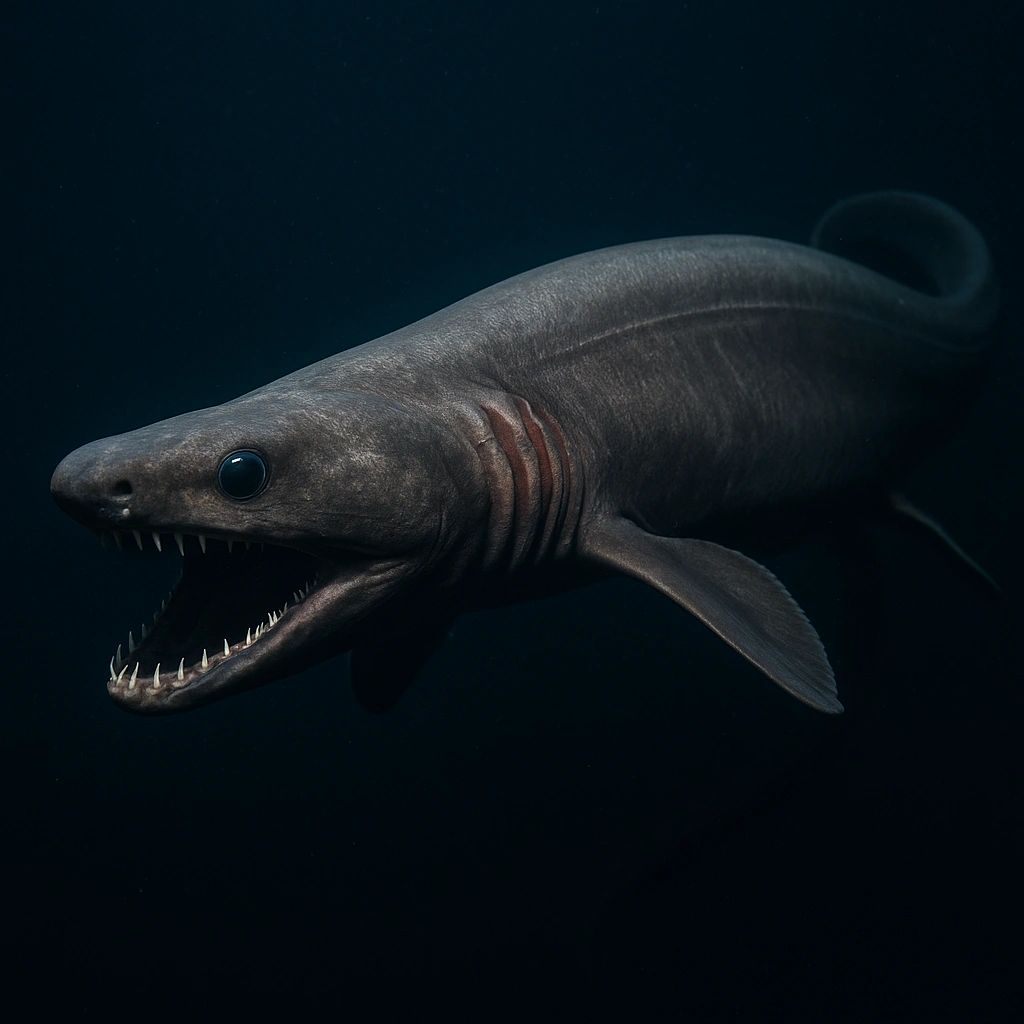
Imagine you’re in a submarine, drifting deep beneath the surface of the ocean. The sunlight has long disappeared. The water outside your tiny window is inky black. Suddenly, a strange shadow slides into view. It has the body of an eel, the gaping mouth of a monster, and teeth like needles. You’ve just met the frilled shark—one of the ocean’s most mysterious and terrifying deep-sea creatures.
Welcome to the world of the frilled shark, also known as the “silent stalker” of the deep.
What Is a Frilled Shark?
The frilled shark (Chlamydoselachus anguineus) is a rare, deep-sea species that scientists often call a “living fossil.” That’s because it’s barely changed since prehistoric times. It’s part of a small and ancient family of sharks that have survived for over 80 million years—almost unchanged from the age of the dinosaurs (Tanaka et al., 2018).
It gets its name from its gill slits. Most sharks have five gills, but the frilled shark has six, with the first pair stretching across its throat in a way that looks like a frilly collar. It kind of looks like a dragon. Or maybe even something from a horror movie.
Where Does It Live?
You won’t see a frilled shark while snorkeling off the beach. These creatures live deep in the ocean, usually between 500 and 1,500 meters (1,600–4,900 feet) below the surface (Ebert & Compagno, 2009). They prefer cold, dark waters near continental shelves and ocean ridges.
Frilled sharks have been found in oceans all over the world—off the coasts of Japan, Australia, New Zealand, South Africa, and even parts of the Atlantic, including near Norway and Scotland (Finucci et al., 2021). But they’re rarely seen by people because they live so far down where sunlight can’t reach.
What Does It Look Like?
Let’s get spooky. The frilled shark can grow up to 2 meters (6.5 feet) long. Its long, eel-like body lets it glide through the water like a ribbon. Its skin is dark brown or gray, helping it hide in the shadows of the deep.
But its most chilling feature? Its teeth.
The frilled shark has around 300 trident-shaped teeth—each shaped like a three-pronged fork—lined up in 25 rows (Shimada & Ward, 2016). These teeth are made to snag slippery prey, and once something is caught in that mouth, it’s almost impossible to escape.
Oh, and did we mention? Its jaw opens extremely wide, almost like a snake unhinging its mouth. Scientists think it can swallow prey more than half its own size!
The First Recorded Encounter
Because frilled sharks live in such deep, remote waters, human encounters are incredibly rare. But one of the first shocking live captures happened in 2007 off the coast of Japan. A fisherman spotted a strange eel-like creature near the surface—sick or dying, it had come up from the depths.
Staff at Japan’s Awashima Marine Park placed it in a tank, and the footage quickly went viral. The shark looked like something out of a sci-fi movie. It twisted its body, gaped its jaws, and swam in eerie slow motion before sadly dying hours later. But for scientists and shark lovers, this was a moment of awe.
Since then, only a handful of frilled sharks have been caught or seen on video.
A Shark That Hunts Like a Snake
What makes the frilled shark so creepy is not just how it looks—but how it hunts.
It doesn’t chase prey like a great white. Instead, it glides silently through the darkness. Scientists believe it curls its body like a coiled snake and strikes quickly, wrapping around its prey and swallowing it whole (Tanaka et al., 2018).
Its preferred snacks? Squid, small sharks, and bony fish. Biologists have found glowing squid beaks inside frilled shark stomachs. Some prey items were shockingly large, showing the shark has a stretchy stomach and big appetite!
Why Is It Called a “Living Fossil”?
The frilled shark hasn’t changed much since the Cretaceous period. That means its body design was already great for surviving the deep ocean—and there was no reason for nature to change it.
It’s part of the order Hexanchiformes, which includes other ancient sharks like the bluntnose sixgill. Their skeletons, tooth shapes, and internal organs are more similar to prehistoric sharks than to modern ones (Maisey, 2012).
This makes them super important for science. Studying frilled sharks helps us understand what early sharks were like and how life evolved in the deep sea.
An Encounter from the Deep
In 2016, researchers using a remotely operated vehicle (ROV) off the coast of Portugal captured rare footage of a live frilled shark swimming calmly in its natural habitat. The shark didn’t act aggressive. In fact, it barely noticed the camera. It slowly drifted by, twisting its ribbon-like body as it vanished into the black water.
Seeing this creature in action was like watching a ghost from another time. It moved with grace, yet its face and teeth reminded viewers this was still a shark—and a predator.
How Does It Survive in the Deep?
To live in the deep ocean, animals need special adaptations.
Frilled sharks have:
- Slow metabolism: They don’t need to eat much, which is great because food is hard to find down there.
- Low body temperature: They’re cold-blooded and do well in chilly deep-sea temperatures.
- Electroreception: Like other sharks, they can detect electric fields from other animals, helping them hunt in the dark (Kempster et al., 2012).
Their eyes are also large and sensitive to help them see even in near-total darkness.
Is the Frilled Shark Dangerous to Humans?
Not really. While it may look terrifying, the frilled shark isn’t a threat to people. It lives so deep it would never cross paths with swimmers or surfers. And it’s pretty slow-moving, not built for attacking fast or large prey.
The truth is, the frilled shark has more to fear from us than we do from it.
Threats to the Frilled Shark
Even though it’s rarely seen, the frilled shark is not safe from danger.
- Bycatch: Frilled sharks sometimes get caught in deep-sea fishing nets meant for other fish. Because they live deep, they can’t survive long when brought to the surface.
- Habitat disruption: Deep-sea mining and oil drilling could hurt their habitat in the future.
- Slow reproduction: The frilled shark has one of the longest pregnancies of any shark—researchers estimate it could last up to 3.5 years! (Hamlett et al., 2005). That means they can’t quickly replace lost numbers.
Because of this, the International Union for Conservation of Nature (IUCN) lists the frilled shark as “Near Threatened” (Finucci et al., 2021). Scientists worry that if we don’t protect it, we could lose this ancient predator forever.
Why the Frilled Shark Fascinates Us
Let’s be real: part of why the frilled shark is so captivating is its spooky appearance. It looks like a monster from a legend—or an alien from a horror movie. Its prehistoric features make it feel like a time traveler.
But it’s more than just scary-looking. The frilled shark reminds us how much we don’t know about the ocean. Over 80% of the ocean remains unexplored (NOAA, 2023). Who knows how many other mysterious creatures are out there?
The frilled shark is a symbol of how wild and weird nature can be—and how many secrets still lurk beneath the waves.
Final Thoughts: Respect the Mystery
Not every predator is fast. Not every shark is a toothy torpedo. The frilled shark is quiet. Ancient. Strange. And beautiful in its own creepy way.
It’s a reminder that evolution doesn’t always lead to flashiness. Sometimes, survival means staying in the shadows, moving slowly, and keeping your secrets.
The frilled shark is a silent stalker of the deep—one of the ocean’s best-kept mysteries. And as long as it glides through the dark, it will continue to inspire wonder, awe, and just the right amount of shivers.
Bibliography
Ebert, D. A., & Compagno, L. J. V. (2009). Sharks of the world. Princeton University Press.
Finucci, B., Cheok, J., Ebert, D. A., Herman, K., & Kyne, P. M. (2021). Ghosts of the deep—Biodiversity, fisheries, and extinction risk of ghost sharks. Fish and Fisheries, 22(1), 39-58. https://doi.org/10.1111/faf.12502
Hamlett, W. C., Kormanik, G., Storrie, M., Stevens, B., & Walker, T. I. (2005). Chondrichthyan parity, lecithotrophy and matrotrophy. In W. C. Hamlett (Ed.), Reproductive biology and phylogeny of Chondrichthyes: sharks, batoids and chimaeras (pp. 395–434). Science Publishers.
Kempster, R. M., Hart, N. S., & Collin, S. P. (2012). Survival of the stillest: predator avoidance in shark embryos. PLOS ONE, 7(7), e52551. https://doi.org/10.1371/journal.pone.0052551
Maisey, J. G. (2012). What is an ‘elasmobranch’? The impact of palaeontology in understanding elasmobranch phylogeny and evolution. Journal of Fish Biology, 80(5), 918–951. https://doi.org/10.1111/j.1095-8649.2012.03245.x
National Oceanic and Atmospheric Administration (NOAA). (2023). How much of the ocean have we explored? NOAA Ocean Exploration. https://oceanexplorer.noaa.gov/facts/exploration.html
Shimada, K., & Ward, D. J. (2016). The oldest fossil record of the frilled shark, Chlamydoselachus (Chondrichthyes: Hexanchiformes), from the Lower Cretaceous of England. Journal of Vertebrate Paleontology, 36(3), e1105491. https://doi.org/10.1080/02724634.2016.1105491
Tanaka, S., Suzuki, K., & Nakaya, K. (2018). Morphological features and feeding habits of the frilled shark Chlamydoselachus anguineus from Suruga Bay, Japan. Ichthyological Research, 65(2), 171–180. https://doi.org/10.1007/s10228-017-0604-y
Originally published at the live site .