
Rivers ·
The Springs of the Suwannee River: Nature’s Hidden Jewels
When you think of Florida, many people picture sunny beaches, theme parks, and swaying palm trees. But deep in the heart of northern Florida lies a natural wonder that is just as magical—if not more so—than anything man-...
By Rebecca "Madam Chronicler" Ryan
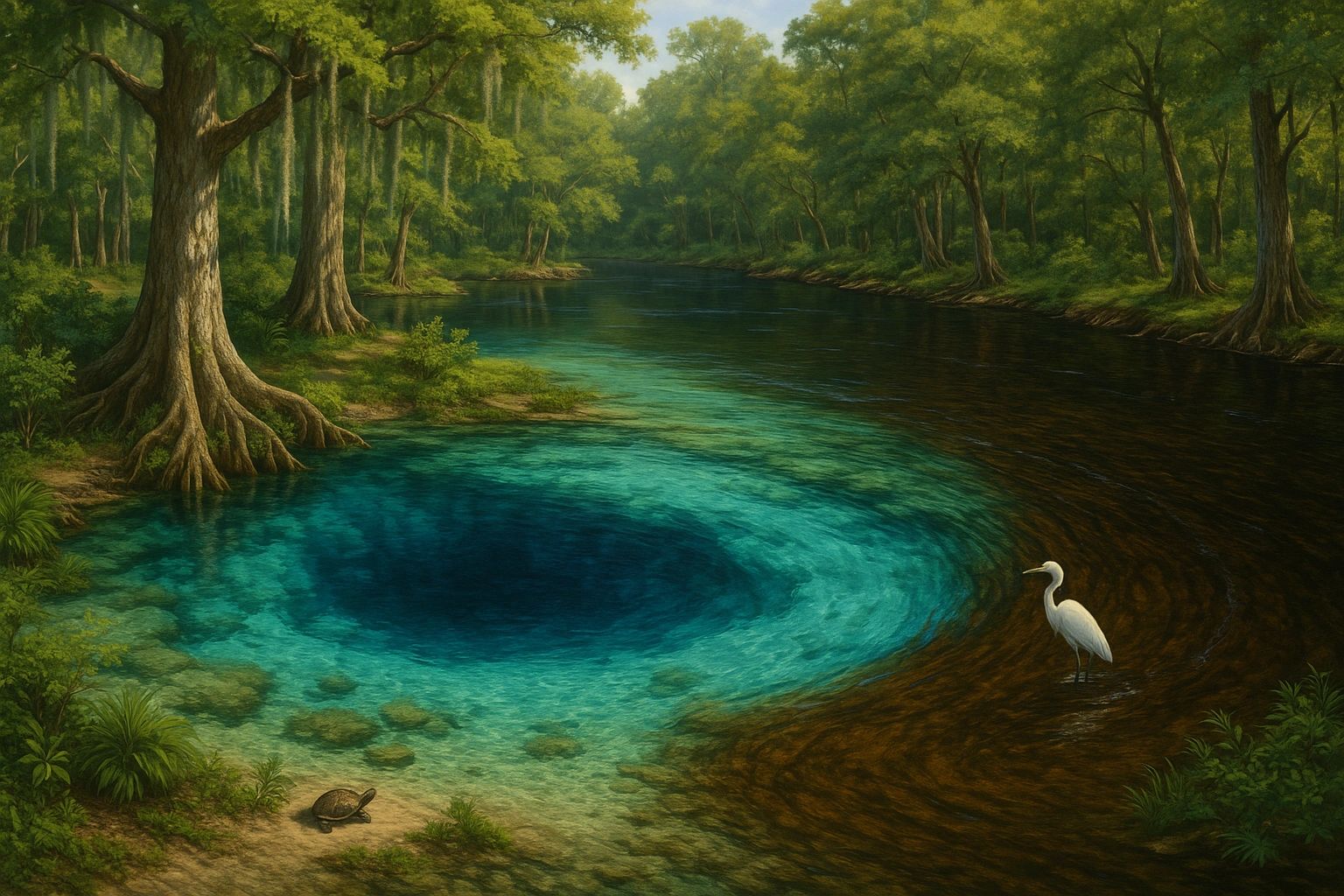
When you think of Florida, many people picture sunny beaches, theme parks, and swaying palm trees. But deep in the heart of northern Florida lies a natural wonder that is just as magical—if not more so—than anything man-made. Flowing for more than 240 miles from the Okefenokee Swamp in Georgia to the Gulf of Mexico, the Suwannee River is one of America’s great waterways. Along its journey, it hides some of the most breathtaking natural treasures in the world: its freshwater springs.
These springs, over 200 of them, bubble up from the limestone aquifer beneath the ground. They feed the Suwannee River with crystal-clear, cool waters, creating dazzling blue pools and serene swimming holes. Beyond their beauty, the springs are also vital ecosystems, cultural landmarks, and windows into Florida’s geology and history. In this blog, we’ll explore the springs of the Suwannee River—their science, their role in human culture, their threats, and why protecting them matters.
What Makes a Spring?
A spring forms when groundwater under pressure in an aquifer flows naturally to the surface through cracks in the rock. In Florida, this aquifer is the Floridan Aquifer, one of the largest and most productive in the world. Rainwater seeps down through sandy soil and dissolves the underlying limestone, creating vast underground caverns filled with water. When the pressure is strong enough, the water bursts out in a spring, creating those iconic blue pools we see today (Katz et al., 2017).
Springs are classified by the amount of water they discharge. A first-magnitude spring discharges at least 65 million gallons per day, enough to fill about 100 Olympic swimming pools! The Suwannee River basin is home to some of Florida’s largest first-magnitude springs, including Fanning, Manatee, and Ichetucknee (Rosenau et al., 1977).
The Suwannee River’s Springs: An Overview
The Suwannee River is a spring lover’s paradise. Scientists estimate that more than 300 springs lie in the basin, with at least 200 directly connected to the river itself (Florida Springs Institute, 2020). These springs create stunning landscapes where sapphire-colored waters mix with the darker tannins of the river, giving the Suwannee its distinctive beauty.
Some of the most well-known springs along the Suwannee include:
- Ichetucknee Springs – Famous for its tubing runs and crystal-clear waters, this spring-fed river flows into the Santa Fe, a tributary of the Suwannee.
- Fanning Springs – A popular recreational spot, this is one of the largest first-magnitude springs on the river.
- Manatee Springs – Known for its winter visitors: manatees seeking warm water refuge.
- Royal Springs – A favorite for cliff jumping, this spring plunges directly into the Suwannee River.
- Peacock Springs – One of the world’s most extensive underwater cave systems, drawing cave divers from around the globe (Florea et al., 2007).
Each spring has its own personality, shaped by geology, hydrology, and history. Some are gentle seeps, while others roar with the force of millions of gallons per day. Together, they form a mosaic of habitats supporting fish, birds, turtles, and rare plants.
A Geological Wonder
The springs of the Suwannee River owe their existence to Florida’s unique geology. Beneath much of the state lies the Floridan Aquifer, a massive limestone formation formed during the Eocene epoch, roughly 56–34 million years ago (Miller, 1986). Over millennia, acidic rainwater dissolved the limestone, carving out vast networks of caves and conduits. This process, known as karst geology, is why Florida is famous for sinkholes, caves, and springs.
What makes the Suwannee River springs unique is how they interact with the river’s dark, tannin-stained waters. The river itself often looks brown or even black, colored by organic matter from decaying vegetation upstream. But when a spring flows into the river, it bursts forth as a brilliant, turquoise-blue window into the aquifer. The contrast is breathtaking and has become one of the defining features of the Suwannee.
Wildlife of the Springs
Springs are not just pretty swimming holes—they are thriving ecosystems. Their waters remain a constant 72°F year-round, providing refuge for many species. During cold winters, manatees seek warmth in springs like Manatee Springs, where they can survive chilly river temperatures that would otherwise threaten them (Laist & Reynolds, 2005).
The springs also support a rich diversity of fish, including sunfish, largemouth bass, and mullet. Some springs even serve as spawning grounds for Gulf sturgeon, a federally threatened species that migrates up the Suwannee River each spring to spawn (Edwards et al., 2007).
Aquatic plants thrive in the clear waters, fueling entire food webs. Birds like herons, ospreys, and wood ducks rely on these habitats. Even small creatures—such as freshwater snails and crustaceans—play essential roles in keeping the springs healthy.
Springs in Human Culture
For thousands of years, the springs of the Suwannee River have been central to human life. Indigenous peoples such as the Timucua and Seminole considered springs sacred places, vital for survival and spiritual practices (Milanich, 1998). Later, during the 19th and early 20th centuries, springs became tourist attractions. Hotels and resorts were built around them, drawing visitors with promises of the springs’ “healing waters.”
Even today, springs remain popular recreation spots. Families gather at Fanning Springs to swim, snorkel, and picnic. At Ichetucknee, thousands of tubers float the river every summer. Cave divers from around the globe descend into Peacock Springs to explore its labyrinthine passages. For locals, the springs are beloved backyards; for tourists, they are unforgettable destinations.
Threats to the Springs
Despite their beauty and importance, the springs of the Suwannee River are under threat. Scientists warn that groundwater pumping, nutrient pollution, and climate change are taking a toll on spring health (Knight et al., 2015).
- Overpumping the Aquifer – Agriculture and urban development draw heavily from the Floridan Aquifer. When too much water is withdrawn, spring flows decline, sometimes drying up springs completely.
- Nutrient Pollution – Fertilizers, septic tanks, and livestock waste seep into the aquifer. When this nitrogen-rich water emerges at the springs, it fuels harmful algal growth, smothering native plants and clouding once-clear waters (Katz et al., 2009).
- Climate Change – Rising sea levels can push saltwater into the aquifer, threatening freshwater springs. Changes in rainfall patterns may also affect recharge rates (Marella & Berndt, 2005).
If left unchecked, these threats could turn Florida’s springs from vibrant ecosystems into stagnant, algae-covered pools. Already, many Suwannee springs show signs of decline, with reduced flows and diminished clarity.
Conservation Efforts
The good news is that Florida is home to passionate scientists, conservationists, and community members working to protect these springs. Programs such as the Florida Springs Initiative and organizations like the Howard T. Odum Florida Springs Institute conduct research, advocate for policy changes, and engage the public in spring stewardship.
State parks also play a crucial role. Places like Ichetucknee Springs State Park and Manatee Springs State Park protect spring habitats from development while allowing people to enjoy them responsibly. Restoration projects, such as replanting native vegetation and reducing nutrient pollution, are making progress in some areas (Florida Department of Environmental Protection, 2021).
But protecting springs requires more than science and parks—it takes people. Locals and visitors alike can help by conserving water, using less fertilizer, supporting clean water policies, and respecting spring ecosystems.
Why the Springs Matter
The springs of the Suwannee River are more than natural attractions. They are windows into the aquifer that supplies drinking water to millions of people. They are nurseries for fish, refuges for manatees, and playgrounds for families. They are cultural landmarks tied to the history of Florida’s Indigenous peoples, early settlers, and modern communities.
Most importantly, they are fragile. Once lost, springs are nearly impossible to restore fully. Protecting them ensures that future generations will be able to marvel at the same sapphire waters and swim in the same cool pools that we enjoy today.
Conclusion: Guardians of the Springs
Standing at the edge of a Suwannee River spring, it’s easy to feel a sense of timelessness. The water flowing out of the aquifer may have fallen as rain thousands of years ago. It trickled through sand, dissolved rock, and wandered underground in darkness before bursting forth into the sunlight. To swim in a spring is to connect with deep geological time and the living heartbeat of Florida itself.
The springs of the Suwannee River are treasures—scientific, cultural, ecological, and spiritual. Protecting them is not just about preserving pretty swimming holes. It’s about safeguarding water, wildlife, and a way of life tied to the river. If we act now, we can ensure these hidden jewels continue to sparkle for centuries to come.
Bibliography
Edwards, R. E., Sulak, K. J., & Randall, M. T. (2007). Gulf sturgeon migrations in the Suwannee River, Florida. Transactions of the American Fisheries Society, 136(3), 589–605. https://doi.org/10.1577/T06-041.1
Florea, L. J., Vacher, H. L., & Donahue, B. J. (2007). Quaternary cave levels in north Florida: Relations to aquifer stratigraphy, sea-level change, and regional tectonics. Geomorphology, 91(3–4), 302–322. https://doi.org/10.1016/j.geomorph.2007.04.020
Florida Department of Environmental Protection. (2021). Florida springs restoration initiatives. Tallahassee, FL.
Florida Springs Institute. (2020). State of the springs report: Suwannee River basin. High Springs, FL.
Katz, B. G., Coplen, T. B., Bullen, T. D., & Davis, J. H. (1997). Use of chemical and isotopic tracers to characterize the interactions between ground water and surface water in mantled karst. Groundwater, 35(6), 1014–1028. https://doi.org/10.1111/j.1745-6584.1997.tb00174.x
Katz, B. G., Sepúlveda, A. A., & Verdi, R. J. (2009). Estimating nitrogen loading to ground water and assessing vulnerability to nitrate contamination in a large karstic springs basin, Florida. Journal of the American Water Resources Association, 45(3), 607–627. https://doi.org/10.1111/j.1752-1688.2009.00316.x
Knight, R. L., Clarke, R., & Heffernan, J. (2015). Springs of Florida: Past, present, and future. Florida Scientist, 78(3), 165–180.
Laist, D. W., & Reynolds, J. E. (2005). Florida manatees, warm-water refuges, and an uncertain future. Coastal Management, 33(3), 279–295. https://doi.org/10.1080/08920750590948040
Marella, R. L., & Berndt, M. P. (2005). Water withdrawals and trends from the Floridan aquifer system in the southeastern United States, 1950–2000 (U.S. Geological Survey Circular 1278). Reston, VA: U.S. Geological Survey.
Milanich, J. T. (1998). Florida’s Indians from ancient times to the present. University Press of Florida.
Miller, J. A. (1986). Hydrogeologic framework of the Floridan aquifer system in Florida and in parts of Georgia, Alabama, and South Carolina (U.S. Geological Survey Professional Paper 1403-B). Washington, D.C.: U.S. Government Printing Office.
Rosenau, J. C., Faulkner, G. L., Hendry, C. W., & Hull, R. W. (1977). Springs of Florida (Florida Geological Survey Bulletin No. 31). Tallahassee: Florida Geological Survey.
Originally published at the live site .