
Maritime ·
Shark Evolution: From Prehistoric Giants to Modern Predators
When we think of sharks, we often picture sleek, fast swimmers like the great white shark or the hammerhead. But sharks have been around for a very, very long time. In fact, sharks are older than dinosaurs, trees, and ev...
By Rebecca "Madam Chronicler" Ryan
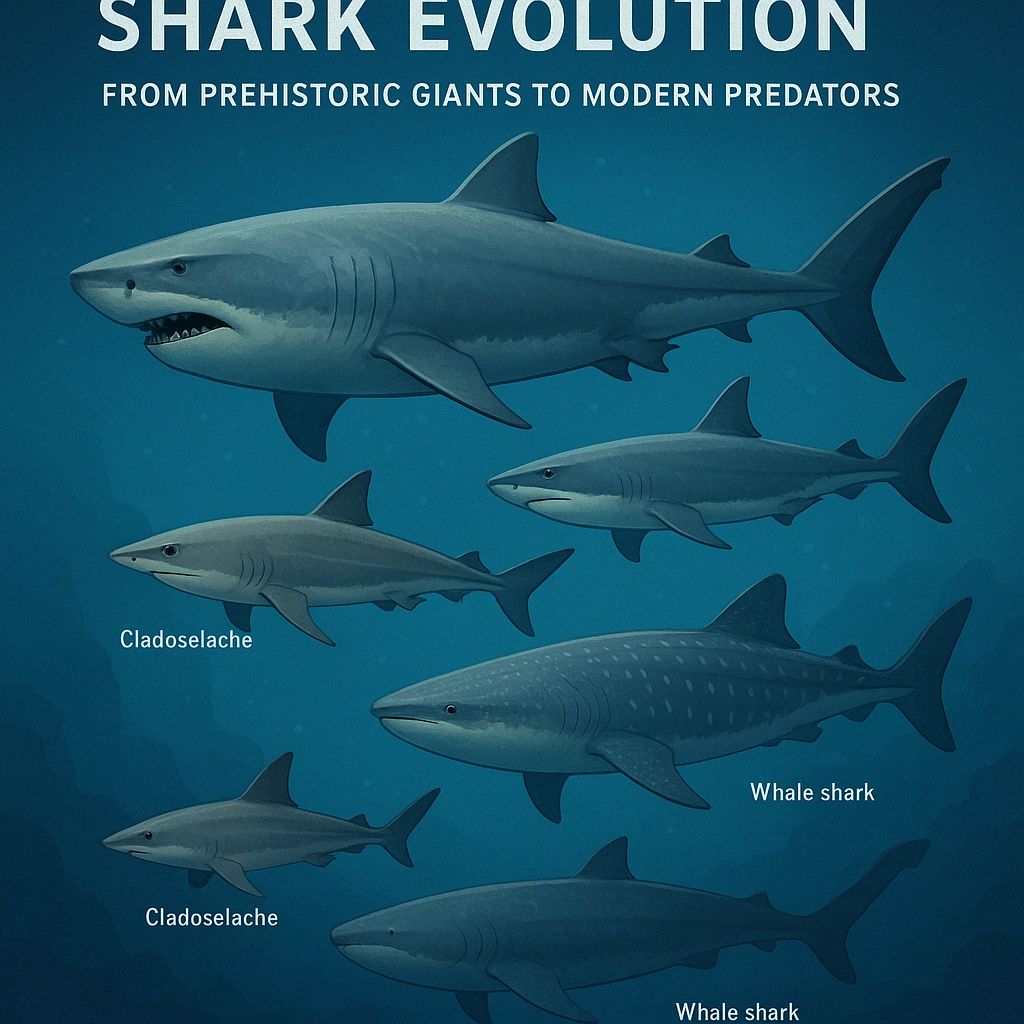
When we think of sharks, we often picture sleek, fast swimmers like the great white shark or the hammerhead. But sharks have been around for a very, very long time. In fact, sharks are older than dinosaurs, trees, and even most land animals! For over 450 million years, sharks have ruled the oceans, changing and adapting through time. This journey—from toothy giants of the past to the powerful predators we know today—is one of the most fascinating stories in nature.
So, how did we go from ancient armored sharks to the stealthy hunters gliding through our oceans now? Let’s dive in and explore the amazing evolution of sharks!
Chapter 1: Sharks Before Dinosaurs
The earliest sharks showed up during the Late Ordovician period, over 450 million years ago. That’s around 200 million years before dinosaurs even existed! These early sharks didn’t look much like the ones we see today. Many had bony plates and didn’t even have modern jaws. Scientists believe one of the earliest shark-like species was Elegestolepis, known only from fossilized scales found in what is now Russia (Andreev et al., 2015).
These early sharks were small and simple, but they had something powerful: cartilage skeletons. Unlike bones, cartilage is lightweight and flexible. This gave sharks a swimming advantage early on and helped them survive massive changes in Earth’s climate.
Chapter 2: Devonian Diversification – The “Age of Fishes”
The Devonian period (419–359 million years ago) is often called the “Age of Fishes,” and it’s when sharks really started to shine. A wide variety of shark species began to appear during this time. Some were weird. Some were wild. And some were enormous.
One of the strangest was Cladoselache, a fast-swimming shark with a torpedo body and no scales. It lived around 370 million years ago and grew up to 6 feet long. Unlike modern sharks, Cladoselache had no claspers (male reproductive organs), and its teeth were small and pointed—ideal for catching fish.
There was also Stethacanthus, a shark that looked like it had an ironing board on its back! The males had a strange, flat structure with spikes that scientists still don’t fully understand. It might have been used to attract mates or scare off enemies (Maisey, 2005).
Sharks during this time became faster, more agile, and better hunters. These changes helped them survive several mass extinctions that wiped out other marine animals.
Chapter 3: Carboniferous Super Sharks
Fast forward to the Carboniferous period (359–299 million years ago), and sharks were everywhere! In fact, this period is sometimes called the “Golden Age of Sharks.”
During this time, the oceans were filled with species like:
- Helicoprion – the shark with a buzzsaw jaw. Its lower teeth spiraled like a saw blade. For a long time, scientists had no idea how this tooth-whorl worked until 3D imaging showed it likely sat inside the jaw and helped the shark slice through squid (Tapanila et al., 2013).
- Xenacanthus – a freshwater shark that looked like an eel and had a spine sticking out of the back of its head. It swam through rivers and swamps, showing sharks weren’t just ocean predators.
- Falcatus – a tiny shark with a huge spike on its head, possibly for fighting or impressing females.
These sharks lived in both oceans and freshwater. Their teeth show they ate everything from hard-shelled crustaceans to soft-bodied prey. Evolution had made them top predators in almost every watery environment.
Chapter 4: Permian Extinction and Survival
Then came one of Earth’s darkest times: the Permian-Triassic extinction event about 252 million years ago. This was the biggest extinction event in Earth’s history, wiping out around 90% of marine species.
Many sharks died out, but not all. Some were able to survive in deeper waters or had diets that helped them adapt. The survivors included ancestors of modern sharks. Their success shows just how resilient sharks can be.
Chapter 5: Rise of Modern Sharks – The Mesozoic Era
During the Mesozoic Era (252–66 million years ago), dinosaurs roamed the land—but sharks ruled the sea. This era gave rise to more familiar-looking sharks, including species in the order Lamniformes, which includes great whites and makos.
Fossils from this period show sharks developing:
- Sharper teeth for slicing prey
- More flexible jaws for biting larger animals
- Better fins and tails for speed and control
One standout from this era was Hybodus, a shark with both sharp and flat teeth. It could crunch hard shells and also catch slippery fish. This was a sign of the diverse diets sharks had developed.
Chapter 6: The Age of Megalodon
Let’s talk about the most famous ancient shark of all: Megalodon.
This massive predator lived around 23 to 3.6 million years ago and could grow up to 60 feet long—that’s about three times the size of a great white shark today!
Megalodon had:
- Teeth the size of your hand
- A bite force over 40,000 pounds
- A wide range, living in warm oceans around the world
It fed on whales, dolphins, and large fish. Fossil bite marks on whale bones show Megalodon’s raw power. But despite its dominance, it went extinct around 3.6 million years ago.
Why? Scientists believe a mix of cooling oceans, the rise of smaller, faster competitors like the great white shark, and the decline of prey may have caused its fall (Pimiento & Clements, 2014).
Chapter 7: The Sharks We Know Today
Modern sharks began to appear during the Cenozoic Era, after the dinosaurs were gone. Today, there are over 500 species of sharks, each adapted to different environments.
Let’s look at some of today’s coolest sharks and how evolution shaped them:
Great White Shark
- Speed and power
- Razor-sharp, serrated teeth
- Strong sense of smell
The great white evolved from early mako shark ancestors. Its body shape allows it to swim fast and breach the water to catch seals.
Hammerhead Shark
- Wide, flat head with eyes on each side
- Can see almost 360 degrees
- Enhanced electrical sensing ability
Hammerheads evolved this unique head (called a cephalofoil) to find prey hidden under sand and improve their turning ability.
Greenland Shark
- One of the oldest living vertebrates
- Can live over 400 years
- Cold-water specialist
This slow-moving shark shows that evolution isn’t always about speed—sometimes it’s about patience and endurance.
Whale Shark
- The biggest fish in the world
- Eats tiny plankton
- Uses filter feeding, not teeth
Despite its size, the whale shark is gentle and harmless to humans. Evolution made it huge not for hunting, but for scooping up tons of food from the water.
Chapter 8:** Evolution **in Action – Adapting to Modern Challenges
Even today, sharks continue to evolve. Some species are developing resistance to climate change by shifting their ranges. Others are adapting their hunting habits as ocean temperatures rise.
For example:
- Bull sharks can swim in both salt and freshwater—an amazing adaptation.
- Blacktip sharks have changed migration patterns as oceans warm (Heithaus et al., 2022).
And while humans are now a huge threat—through overfishing, habitat loss, and pollution—sharks are doing their best to adapt. Some have shrunk in size, while others are changing breeding seasons or moving to cooler waters.
Chapter 9: Fossils Tell the Tale
How do we know so much about shark evolution? Through fossils—especially teeth.
Shark teeth fossilize easily because they’re made of hard enamel. Sharks lose thousands of teeth in a lifetime, so there are millions of fossilized shark teeth in the world. Each one tells scientists what that shark ate, how big it was, and when it lived.
Other fossils, like vertebrae and jaw fragments, help paint a bigger picture. Advances in 3D imaging and CT scans now allow scientists to rebuild ancient sharks digitally. This helps us understand how their bodies worked and how they hunted.
Chapter 10: Why Shark Evolution Matters
Studying shark evolution isn’t just cool—it’s important.
Sharks play a key role in keeping ocean ecosystems healthy. They eat the sick and weak fish, keeping populations balanced. Understanding how sharks evolved helps us predict how they’ll respond to climate change, ocean pollution, and overfishing.
Sharks have survived five mass extinctions, but today’s sixth one is different—it’s driven by humans. We now have a chance to protect these incredible creatures, knowing just how far they’ve come.
Final Thoughts: From Ancient to Awesome
Sharks are more than just scary movie monsters. They’re living fossils—creatures that have swum the world’s oceans for hundreds of millions of years. From strange spiral-toothed beasts to giant Megalodon to today’s sleek hunters, shark evolution is a story of survival, adaptation, and power.
The next time you see a shark, think about this: it’s not just a fish. It’s the result of 450 million years of evolution—a living legend of the sea.
Bibliography
Andreev, P. S., Coates, M. I., Karatajūtė-Talimaa, V., Shelton, R. M., Cooper, P. R., Wang, N.-Z., & Sansom, I. J. (2015). The systematics of the Mongolepidida (Chondrichthyes) and the origin of the chondrichthyan crown group. Journal of Vertebrate Paleontology, 35(4), e1007746. https://doi.org/10.1080/02724634.2015.1007746
Heithaus, M. R., Frid, A., Wirsing, A. J., & Worm, B. (2022). Predicting ecological consequences of marine top predator declines. Science, 336(6085), 1247–1250. https://doi.org/10.1126/science.1220222
Maisey, J. G. (2005). Braincase of the Upper Devonian shark Cladodoides wildungensis (Chondrichthyes, Elasmobranchii), with observations on the braincase in early chondrichthyans. Bulletin of the American Museum of Natural History, 288, 1–103. https://doi.org/10.1206/0003-0090(2005)288<0001:BOTUDS>2.0.CO;2
Pimiento, C., & Clements, C. F. (2014). When did Carcharocles megalodon become extinct? A new analysis of the fossil record. PLoS ONE, 9(10), e111086. https://doi.org/10.1371/journal.pone.0111086
Tapanila, L., Pruitt, J., Pradel, A., Wilga, C., Ramsay, J., Schlader, R., & Didier, D. (2013). Jaws for a spiral-tooth whorl: CT images reveal novel adaptation and phylogeny in fossil Helicoprion. Biology Letters, 9(2), 20130057. https://doi.org/10.1098/rsbl.2013.0057
Originally published at the live site .